Portland's confusing property taxes, explained


Add Axios as your preferred source to
see more of our stories on Google.
Your property tax bill for this year is ready and should be in your mailbox soon.
- Payment is due Nov. 15 — with discounts if you can swing at least two-thirds of the bill by then.
Why it matters: Property taxes make up roughly a third of Portland's budget, a quarter of Portland Public Schools', and about 15% of Multnomah County's, but arcane rules mean your bill could be very different from your neighbor's.
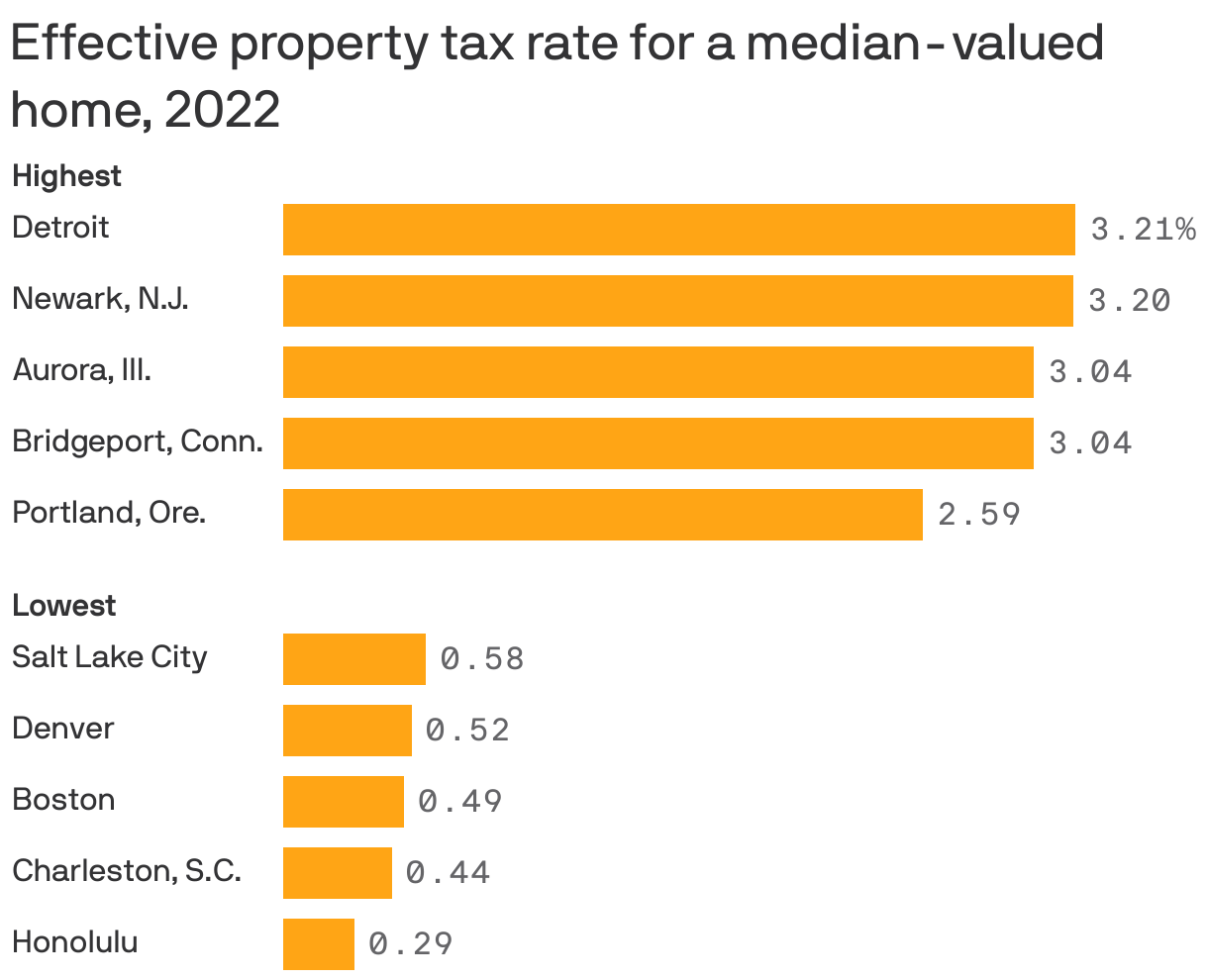
Driving the news: Portland ranked fifth highest nationally for effective property tax rate — a homeowner's tax bill as a percentage of a property's value — on a median-value home.
- That's according to a recent report from the nonprofit Lincoln Institute of Land Policy and the Minnesota Center for Fiscal Excellence.
Zoom in: The report notes that differences in property values across cities mean that some cities with high tax rates can still have low tax bills on a median valued home — if they have low home values.
- In 2022, Portland — where prices have been dropping but still trend comparatively high — had the highest tax bill on a median-value home, per the report, at 3.5 times the national average.
Flashback: Oregon saw big property tax limitations in the 1990s, first cutting rates almost in half by strictly limiting the rate that could be levied against a home's value, then moving away from an exclusively market-value based assessment.
The intrigue: Unlike in most cities, in Portland these limits don't reset when homes are sold. They're based instead on the age of the home.
- The report found that effective tax rates on newly built homes in Portland are 40% more than those built before the tax limits that started in 1996.
- Taking the limitations into account, Portland would drop to the 12th highest effective tax rate for median-value homes, the report says.
By the numbers: Two figures are the starting point for how much property tax you pay.
- The "real market value" of your home — as determined by a county assessor. This is typically based on sales of similar homes.
- "Maximum assessed value" is an Oregon-specific concept and can be lower than the market value. The maximum assessed value can't go up more than 3% each year, although there are exceptions, such as zoning changes or significant remodels.
- Your tax is based on the lower of these two numbers.
Meanwhile, Multnomah County is divided into different tax rate zones. To see the rate you pay for different services — as well as your total overall rate — find the "code area" number on the first page of your bill, then look that up in the far left- or far right-hand column of this document.
- Voters can add on extra property taxes for local services, such as schools or parks.
Be smart: Renters don't get billed directly for property taxes, but landlords could fold the expense into rent.
- Want to find out the tax on the building where you live? Just plug in the address here and log on as a guest.