How to safely swim in Portland's rivers

Add Axios as your preferred source to
see more of our stories on Google.
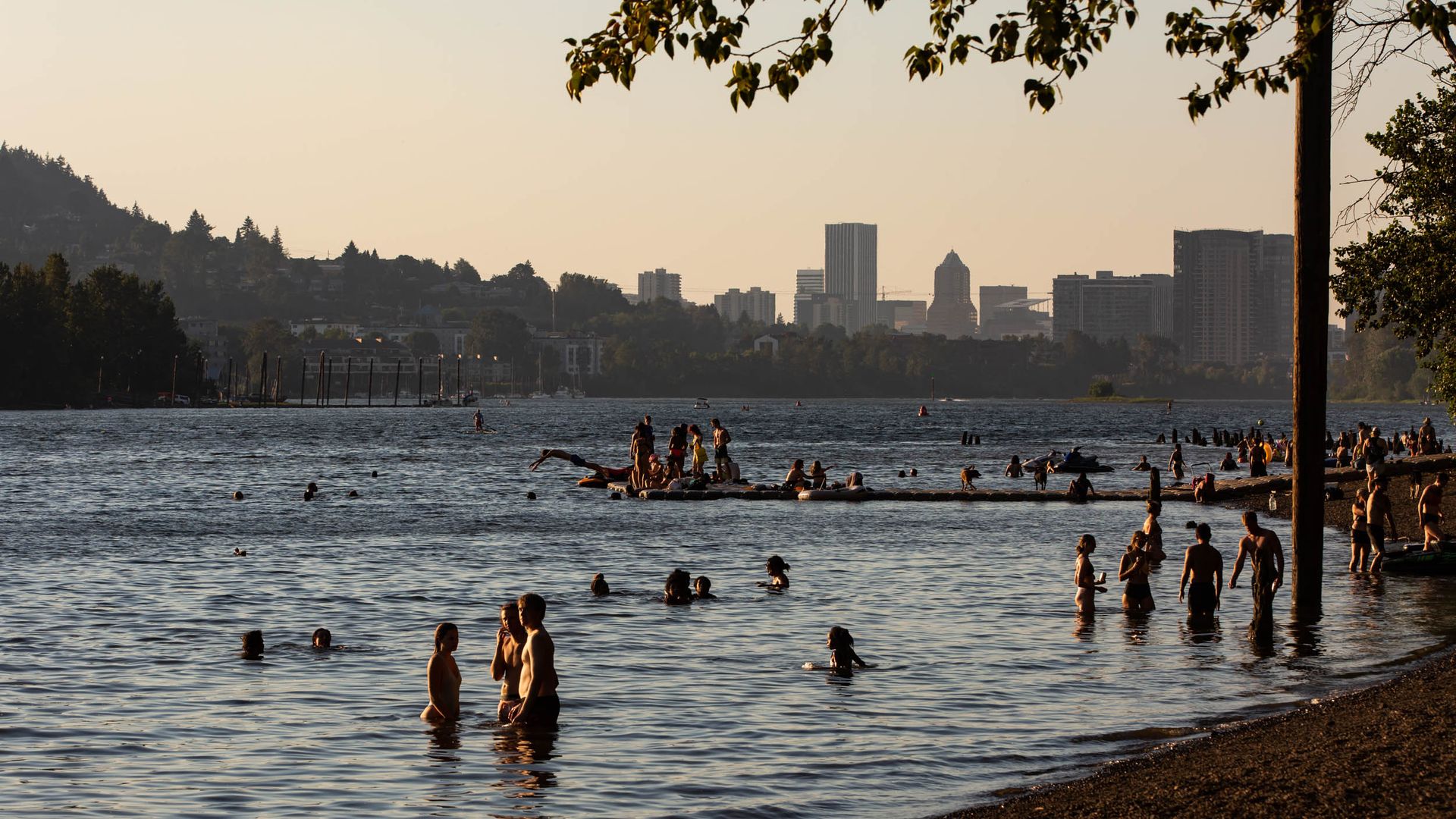
People cool off in the Willamette River at Sellwood Riverfront. Photo: Maranie Staab/Bloomberg via Getty Images
The Willamette and Columbia rivers are a vital part of how Portlanders celebrate the return of summer. But safety should always be top of mind before diving in.
Why it matters: While city agencies and nonprofit organizations routinely test the water quality of our rivers, there are other safety concerns that factor into deciding whether to take a dip.
- Temperature, current and potentially harmful algal blooms are all factors that swimmers, paddlers and kayakers should take into consideration too.
What they're saying: "A river is a dynamic system," Lorri Epstein, the water quality director of Columbia Riverkeeper, tells Axios. "You have to make your own risk-benefit analysis."
Context: Columbia Riverkeeper collects E. coli samples from various recreational sites along the Columbia twice a month and then submits those results to the Swim Guide app, which tracks water quality at thousands of sites across the country.
- Portland city officials test five locations along the Willamette River — including swimming hotspots like Poet's Beach, Sellwood Riverfront and the Kevin Duckworth Dock — for E. coli weekly, as well as three additional sites monthly.
- Testing so far this summer has yielded E. coli counts below state health standards, which is considered safe, according to Portland's Check the Rec site.
Details: E. coli bacteria is found in mammals (including humans) and if ingested can cause digestive issues and fever. It's especially dangerous for those who are young, immunocompromised or elderly.
- The Willamette and Columbia rivers are also susceptible to harmful algal blooms — a type of toxic, algae-like bacteria that thrives in nutrient-rich warm water and can cause a range of symptoms like eye irritation, coughing, congestion and rash.
- Oregon and Washington do not routinely test for harmful algal blooms statewide, but local health authorities are responsible for posting safety signage in vulnerable areas, so look out for those.
- If the water appears to be pond-like, foamy and green, Epstein suggests swimmers stay out.
Separately, factors like temperature are recorded by the U.S. Geological Survey and updated throughout the day. Rivers in the Northwest can be cold and swift, which increases the risk of shock and drowning.
Flashback: In 2011, Portland completed its $1.4 billion Big Pipe Project, which eliminated nearly all sewer overflows into the Willamette River and Columbia Slough.
- In the following years, the duration and volume of overflows caused by rainfall significantly decreased, improving river health, according to Diane Dulken, a spokesperson for the city's Bureau of Environmental Services.
- Before the project began, Portland used to see over 50 sewage overflows per year, altering many Portlanders' perception of the cleanliness of the Willamette for recreation.
Since then, volunteer-led efforts like the Human Access Project, which launched the annual Big Float, are encouraging residents to recreate in the water source that runs through the city.
The bottom line: Both the Willamette and Columbia rivers are considered safe to swim, but use caution.
- "Know your own limits and swim close to shore," Epstein said.