Western cities push HUD to count homeless campsites as shelter


Add Axios as your preferred source to
see more of our stories on Google.
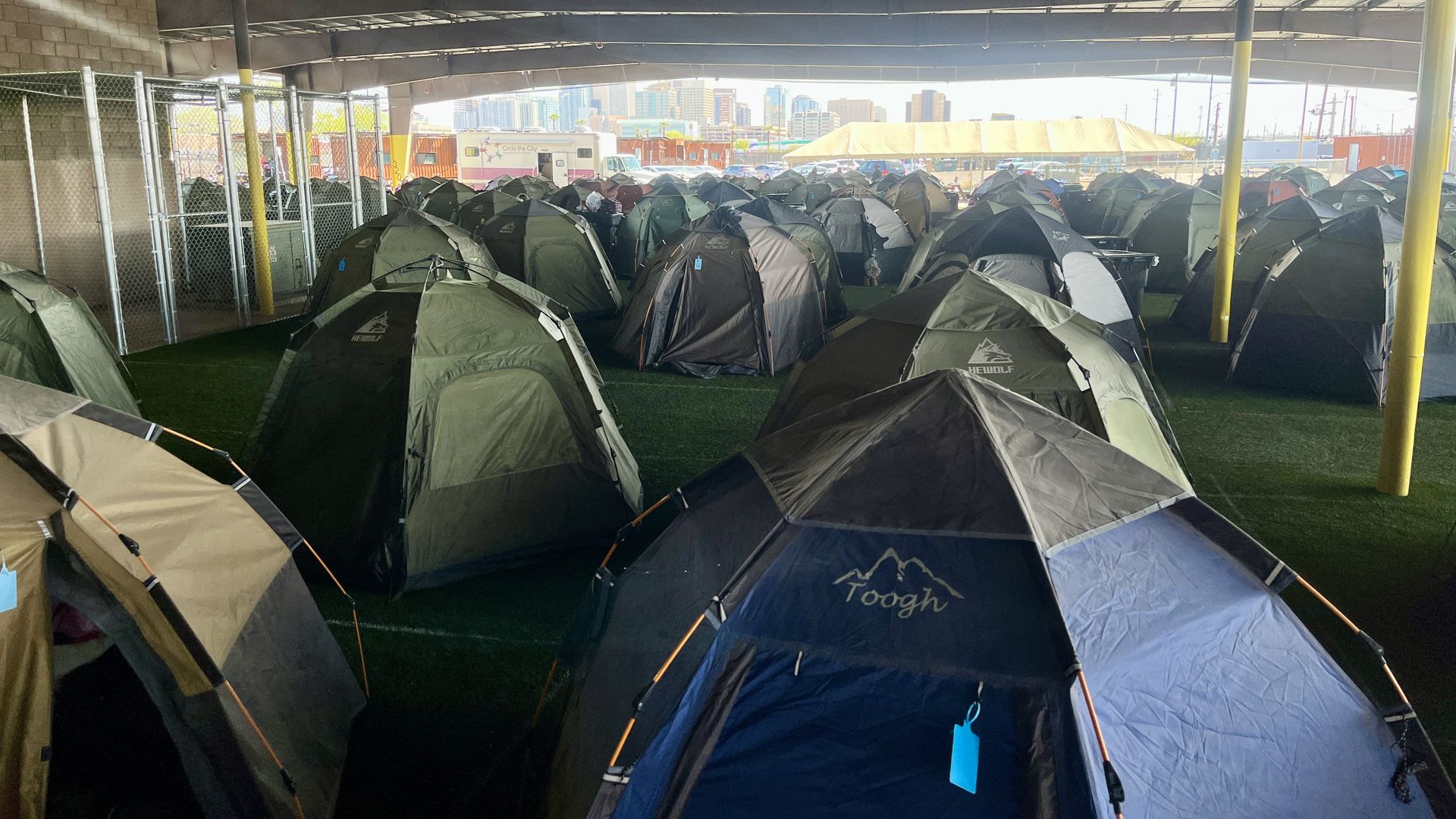
Residents of Phoenix's Safe Outdoor Space will be considered "unsheltered" in this year's point-in-time count. Photo: Jessica Boehm/Axios
As local and federal officials prepare to release their annual counts of unhoused people, they are at odds over one question: whether city-run homeless campsites should be considered shelter.
The big picture: The yearly point-in-time count, conducted in January and typically released in May or June, is required by the U.S. Department of Housing and Urban Development (HUD) and provides a snapshot of people experiencing homelessness in communities nationwide.
- It includes a breakdown of the number of unhoused people staying in shelters (where services are available and the likelihood of transitioning into permanent housing is higher) and those who aren't (on the street, in parks or in vehicles).
State of play: Many cities throughout the West have opened "structured campgrounds" in recent years, and they typically feature reserved tent-camping spaces and are monitored 24/7 by social workers.
- Unlike typical "unsheltered" people, individuals staying at these sites must abide by campground rules, have access to bathroom facilities and are provided meals, medical services and employment help onsite.
- Yes, but: Unlike a typical "sheltered" person, people staying at the campgrounds are sleeping outdoors.
Friction point: Local officials in Arizona and California want HUD to recognize the investment they've made and the results they've seen out of the campgrounds by counting the people who stay there as "sheltered."
- San Diego Mayor Todd Gloria last year wrote to HUD's chair requesting the change, arguing that if it were in place last year, the city's unsheltered population would have dropped by 9.5%, rather than increasing by 3%.
- A HUD official flatly rejected the request, shooting down the premise and criticizing the effort.
What they're saying: "The department is particularly concerned with the adoption of models of temporary solutions that promise a visible reduction in visible unsheltered homeless," Kimberly McClain, a HUD official in the Biden administration, wrote in response to Gloria.
- "Temporary solutions are not a permanent solution to emergency shelter capacity concerns," she wrote.
The big picture: In a statement, Walt Bishop, director of government affairs for San Diego, said enrollees in safe camping or parking programs have far more resources than people sleeping on the streets, but HUD's methodology acts as if they're the same.
- "By not recognizing these interventions, HUD's not providing the full picture of understanding of what works to help people end their homelessness," he said.
Zoom in: Phoenix opened its first structured campground in November 2023. Dubbed the Safe Outdoor Space, it has many of the same features as the city's indoor shelters, per homeless services director Rachel Milne, including:
- Onsite security
- Daily social services visits
- Three meals served per day
- Showers, toilets and laundry facilities.
Between the lines: Milne noted that these campgrounds are often an important in-between step from the street to indoor housing for people who are hesitant about the rigidness of traditional homeless shelters, which typically have stricter curfews and other rules.
- The city is also seeing successful exits from the campground, she said. About 33% of people who have stayed at the Safe Outdoor Space have left for housing, traditional shelters, reunification with family or other indoor services.
- That's compared with about 46% positive exits at the city's indoor Washington Street Shelter.
Meanwhile, San Diego's safe sleeping program — its supervised camp site — provides residents with showers and restrooms, meals, laundry, shuttle transportation and connection to detox and mental health treatment. The safe parking program also offers substance-use and mental health treatment, and job training, housing navigation and other services.
- As of Friday, the safe sleeping program had 771 enrolled residents occupying 685 of the 767 total spaces.
- The safe parking program had 249 enrolled individuals living in 184 vehicles within the 206 reserved parking spaces.
- Another 70 people living in 16 RVs are in the 18 RV spaces the city provides.
The intrigue: In October, city leaders added 200 additional tents to the safe sleeping program as part of a scramble to replace a pending loss of beds from traditional shelters.
- At that time, it had placed about 6% of residents in permanent housing, compared with about 18% from traditional shelters.
- San Diego's City Council also voted in late April to nearly double the size of the parking program with a new location.
What's next: Those pushing for the reclassification hope they'll find a more receptive audience in a Trump administration, one that is not devoted to the "housing first" approach to homelessness — which says nearly every other problem associated with homelessness should be solved with permanent housing.
- Bishop said San Diego is talking to federal lawmakers about proposing legislation that would change how safe parking and camping sites are counted, and qualifying them for federal grant funds.
- In the meantime, they're shifting their focus to getting the U.S. Conference of Mayors to make a bipartisan endorsement of the concept at the organization's annual meeting in June.
- Gloria's office said it already has received support from Phoenix Mayor Kate Gallego as well as Seattle's and San Jose's.