Philly food truck owners allege retaliation over curfew pushback

Add Axios as your preferred source to
see more of our stories on Google.
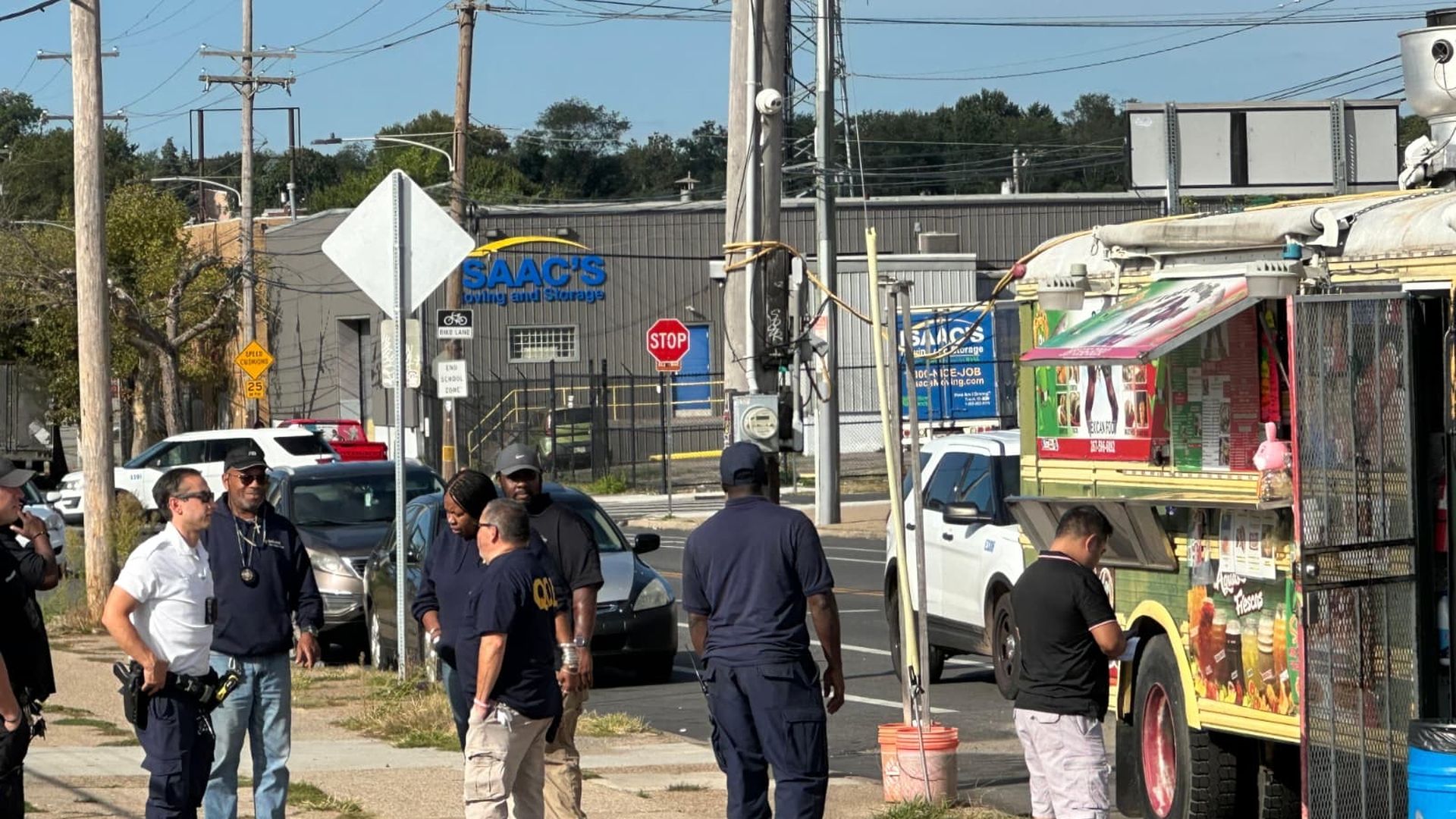
Philadelphia police and licensing officials during a Sept. 11 enforcement sweep of food trucks on G Street. Photo: Courtesy of Institute for Justice
Business advocates sent a warning to Philadelphia lawmakers this week, alleging that the city is retaliating against two food truck owners who spoke out against an expanded business curfew.
Why it matters: The law has faced ongoing pushback from local businesses, including at recent City Council meetings. Now, a public interest law firm says they're being targeted for it.
- The city denies the claims.
Driving the news: The Institute for Justice (IJ), which has been organizing against the curfew, alleged in a letter on Monday that city officials conducted an enforcement sweep on a pair of food truck owners shortly after they testified against the curfew at a Sept. 11 council meeting.
- A similar sweep occurred after the owners spoke out in late April, per the law firm.
What they're saying: The timing of the raids is "impossible to ignore," IJ senior attorney Erica Smith Ewing wrote in the letter.
- She instructed the city to retain all records and correspondence related to the sweeps — a typical demand made when a law firm considers bringing a lawsuit.
The other side: The Sept. 11 sweep was "preplanned," city spokesperson Sharon Gallagher tells Axios.
- Gallagher confirmed that one of the food truck owners who testified against the law at the Sept. 11 meeting was towed for having an expired permit.
- She says that owner was also cited for having an illegal electrical hookup, along with three others.
- Some City Council members at the Sept. 11 meeting accused Virginia-based IJ of meddling in Philadelphia's affairs without understanding its neighborhood dynamics.
Zoom out: IJ has litigated several government retaliation cases across the U.S., including the arrest of a former Castle Hills, Texas, city council member that went before the U.S. Supreme Court.
- That case broadened the types of evidence that can be used to prove government retaliation and could bolster a lawsuit brought on behalf of the Philly food truck owners, IJ attorney Jared McClain tells Axios.
Flashback: IJ also spearheaded a civil forfeiture case against the city of Philadelphia in 2014. It led to a consent decree and a $3 million settlement.
Catch up quick: The expanded curfew — which requires businesses in certain parts of the city to close between 11pm and 6am — took effect this month, but it's not being enforced for 60 days. Violators will face $1,000 fines.
- It's part of a city push to reduce crime and quality-of-life issues.
- But some opponents argue it hurts business and makes it harder for overnight workers to access food and other necessities.
Zoom in: Alta Cocina Restaurant chef José Luis tells Axios through a translator that he no longer runs his food truck past 11pm, fearing he could be fined despite the current grace period.
- As a result, he says, he has lost out on about 80% of the roughly $1,000-$1,500 he made daily and had to lay off two of his five employees.
What we're watching: IJ says it will "closely monitor" the city's conduct.