Philly businesses are organizing against an expanded curfew

Add Axios as your preferred source to
see more of our stories on Google.
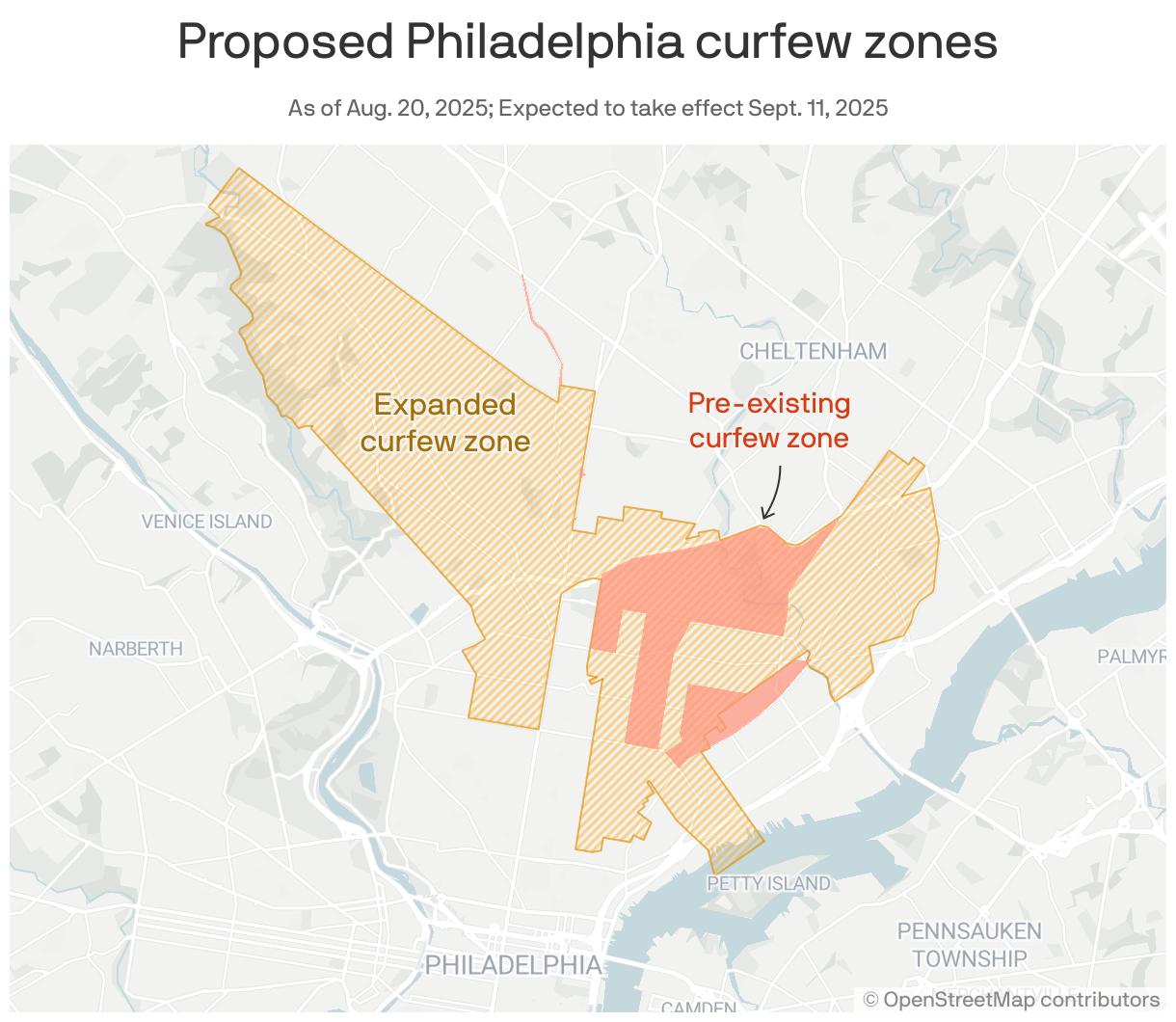
A coalition of Philly businesses and advocates is launching a campaign calling on city lawmakers to stop an expanded business curfew.
Why it matters: The curfew is part of a city push to crack down on "nuisance" businesses and reduce crime and quality-of-life issues, but some business leaders say it'll hurt Philly in the long term.
Context: Philly initially enacted a curfew in Kensington last year that requires businesses to close between 11pm and 6am.
- In June, city lawmakers voted to extend the curfew into North Philly, including the 7th and 8th council districts, plus parts of the 1st. That includes neighborhoods such as Germantown, Mount Airy and larger swaths of Kensington.
- Mayor Cherelle Parker is expected to sign the bill into law, which would take effect Sept. 11, Councilmember Quetcy Lozada tells Axios.
- The city didn't immediately respond to Axios' request for comment.
Driving the news: Several business owners are pressuring city leaders to prevent the expanded curfew from taking effect. They are holding a news conference Thursday at the Alta Cocina Philly food truck, organized by public interest law firm Institute for Justice (IJ).
- The group also plans to deliver at least 80 letters from community stakeholders to the council explaining how the curfew would negatively impact businesses.
- "It really is a situation where you need a scalpel, but you're using a hammer to solve a problem," Jennifer McDonald, IJ's cities work director, tells Axios.
The other side: Lozada, who has championed the curfews, tells Axios that she's unlikely to reconsider her position.
- She believes the initial Kensington curfew led to a stark reduction in crime — including homicides, which are down from a pandemic-era surge.
- "This is just one piece of that puzzle," she says.
How it works: Businesses that break the curfew face $1,000 fines.
- The law would start being enforced 60 days after it takes effect and would expire in 2030.
- There's an exception for restaurants with liquor licenses, drive-thrus and gas stations.
By the numbers: There are about 3,000 businesses in council districts 7 and 8 — including about 800 in the food, hospitality and retail sector — though it's unclear whether all of them would be impacted, IJ tells Axios, citing city permitting records.
- With 13% of the city's jobs part of the nighttime economy, the IJ argues that the curfew could make it more difficult for overnight workers to access food and other necessities.
Zoom in: The Mount Airy Business Improvement District already fired off a warning letter this month to Councilmember Cindy Bass.
- The group wrote that the expanded curfew could trigger an exodus of businesses from the neighborhood, potentially leading to "vacancy and blight."
Mitesh Patel, who owns Kensington-based pharmacy The Medicine Shop, tells Axios his shop could be impacted by the curfew since aspects of the business run after 11pm, including providing medicine for area hospices.
- Patel says the law is "too gray."
Flashback: Last winter, a group of Asian and Arab businesses sued the city and state, alleging the curfew was being discriminatorily enforced against so-called stop-and-go stores.
- A federal judge dismissed the lawsuit in March, per court records.
What we're watching: The IJ-led coalition will continue canvassing businesses in the coming weeks to alert owners about what's on the horizon in hopes of projecting a "unified voice" against the curfew, McDonald says.