Extreme heat streaks on the rise in Philadelphia


Add Axios as your preferred source to
see more of our stories on Google.
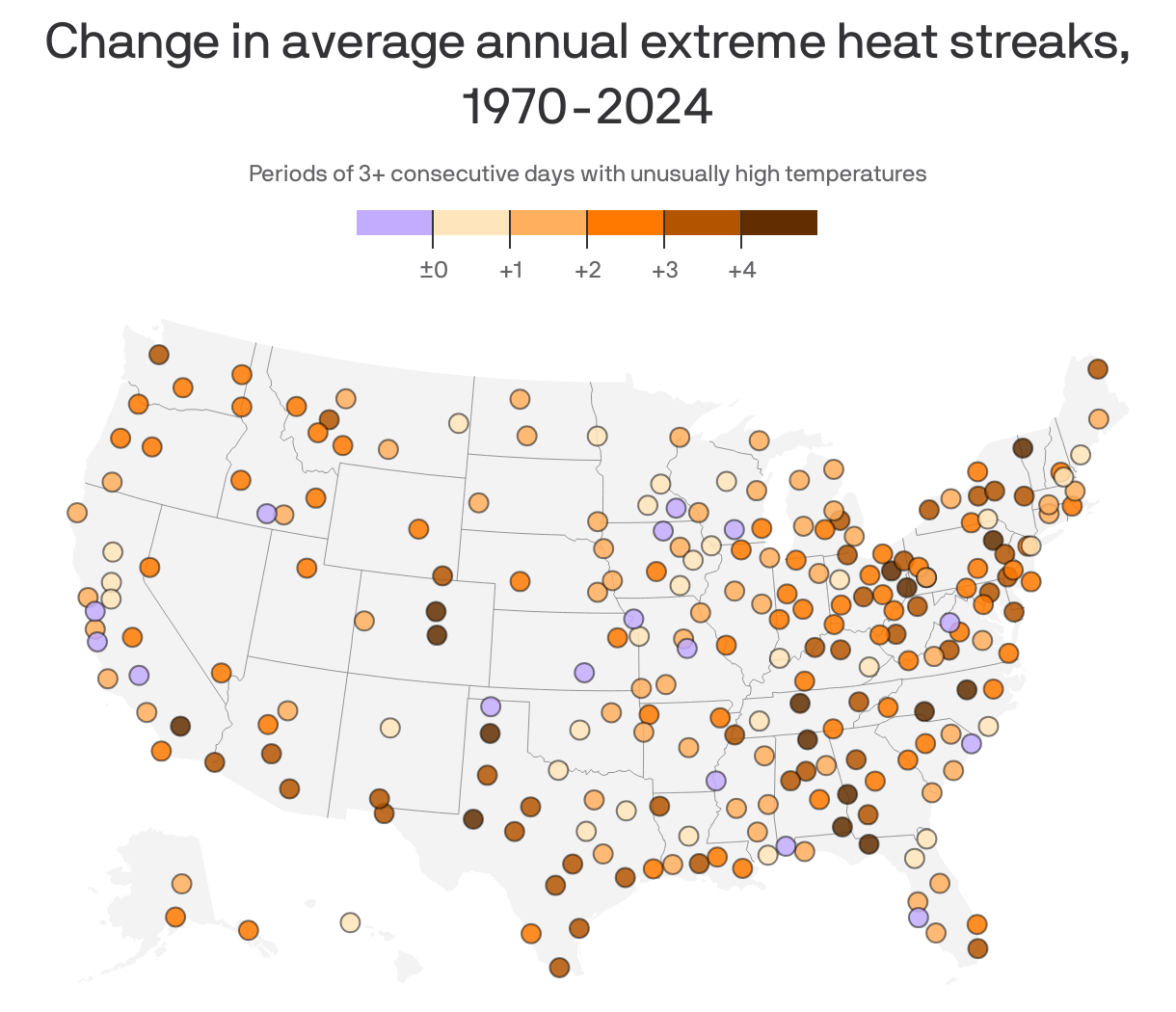
Heat streaks in Philadelphia are getting more common each year on average compared to 1970, a new analysis finds.
Why it matters: Prolonged heat — as Philly and much of the U.S. has experienced this summer — is particularly hazardous to human health.
- Plus: Multi-day heat streaks are also challenging for power grid operators, given all the energy-intensive A/C use.
By the numbers: Philly averaged five extreme heat streaks between 2020-24 — two more than during the 1970s, per a report from Climate Central, a climate research group.
How it works: Climate Central defines an "extreme heat streak" as three or more days in a row with maximum temperatures over the 90th percentile of a given location's daily max temperatures during the 1991-2020 period.
- For Philly, that threshold is 89 degrees, per Climate Central.
🌡 The latest: Philadelphia is in the midst of a hot and humid streak, with temps or the heat index clocking in above 90 since last Friday
- Wednesday's temps are pegged to hit the upper 90s and remain in the high 80s with a chance of showers on Thursday, per NWS.
- Yes, but: Relief is coming. Temps are forecast to dip into the mid-70s on Friday and lower 80s on Saturday.
Zoom out: The average number of extreme heat streaks rose in 80% of the 247 U.S. cities analyzed by Climate Central.
- But a few places, like Myrtle Beach, South Carolina, and Sarasota, Florida, now have fewer heat streaks compared to 1970.
Between the lines: Climate change is making extreme heat more intense and more frequent, studies have shown.
- Many urban neighborhoods — including those in Philly — suffer from the "urban heat island" phenomenon, where buildings, roads and other structures trap heat, making it even hotter.