How a new real estate deal will preserve some of Philly's murals

Add Axios as your preferred source to
see more of our stories on Google.
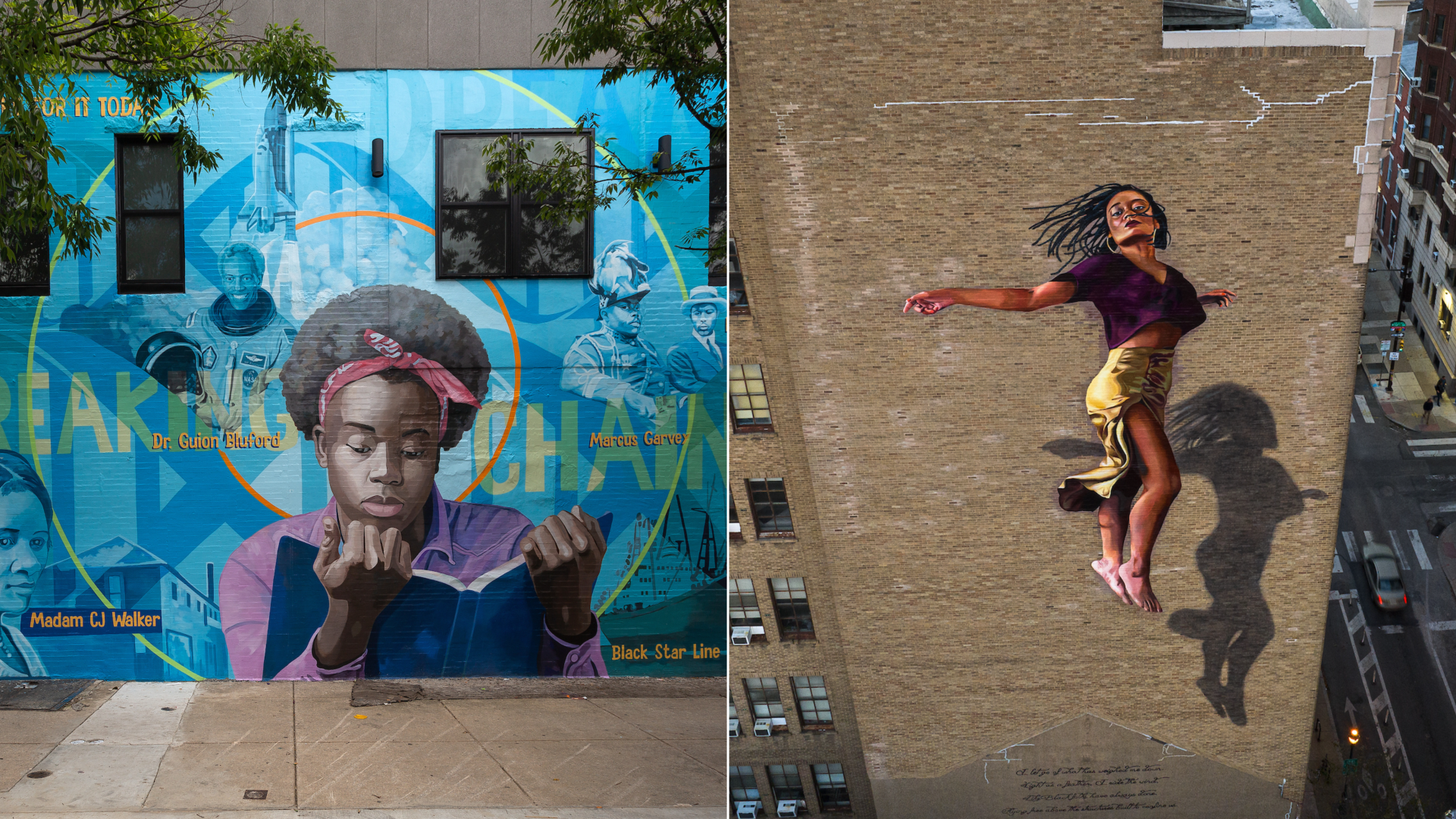
Philly murals: "Breaking Chains," left, and "Flight" Photos: Courtesy of Steve Weinik for Mural Arts
Mural Arts has entered into a groundbreaking public art preservation agreement with a local real estate developer that'll safeguard projects for decades to come.
Why it matters: The groups hope the deal becomes a standard adopted by communities elsewhere to protect their artistic and cultural legacies.
The big picture: Philly, the nation's best city for street art, has about 4,500 murals — more than a quarter of them painted on privately owned buildings.
- Those murals are at risk of erasure whenever buildings swap hands.
Driving the news: Developer Ryan Spak tells Axios that he has agreed to a lifetime easement with Mural Arts that protects four murals currently at his properties.
- The legally binding deal applies to future murals painted at any of his company's nearly three dozen holdings.
What they're saying: Spak says public art adds value to buildings, but it's susceptible to being destroyed. He realized that after selling a property to a buyer who wanted to eliminate a suicide awareness mural.
- Spak's real estate company convinced the new owner to retain the mural, one that's especially important to him, because friends and family have struggled with depression.
The caveat: The deal contains a provision that allows Spak to sell his buildings to buyers who don't want to keep the murals, if presented with a deal he can't "refuse."
- But the new owners must pay to re-create the mural elsewhere or provide a donation to Mural Arts equal to the mural's value.
"Our company looks to do well and do good," Spak says. "Everything about this [deal] checks both boxes."
Flashback: Mural Arts encountered a similar problem after a new West Philly development that blocked the view of a mural of Martin Luther King Jr. near where the civil rights activist once gave a speech.
- Luckily, Mural Arts was allowed to re-create the mural on the new building last year.
Yes, but: That's not always the case.
By the numbers: More than 1,480 murals are on private property, Mural Arts spokesperson Chad Eric Smith tells Axios.
- The group loses about six murals a year due to development, often learning about the removals after the fact.
Between the lines: Restrictive covenants and easements are common in real estate deals to ensure buildings or plots of land retain historic, cultural or aesthetic significance.
- Art officials and Spak tell Axios this arrangement is unique because it was initiated by a developer, and it provides lifetime protection for the murals. They're unaware of a similar agreement anywhere else in the U.S.
The bottom line: This deal "transcended industries," Smith says. "We can only hope this sparks more people to be enthusiastic about [preserving art]."