We're driving more


Add Axios as your preferred source to
see more of our stories on Google.

Driving rates are above pre-pandemic levels in Philadelphia and almost every other major U.S. metro.
Why it matters: The COVID-19 pandemic, when driving plummeted as people sought to "stop the spread," was a unique chance for cities to get a lasting handle on transportation-related emissions.
Driving the news: Average daily vehicle miles traveled (VMT) per capita increased 12.3% across the 100 biggest U.S. metro areas this past spring compared with the same period in 2019.
- That's according to a new report from StreetLight Data, a transportation analytics firm.
- VMT fell in just 12 of the metros.
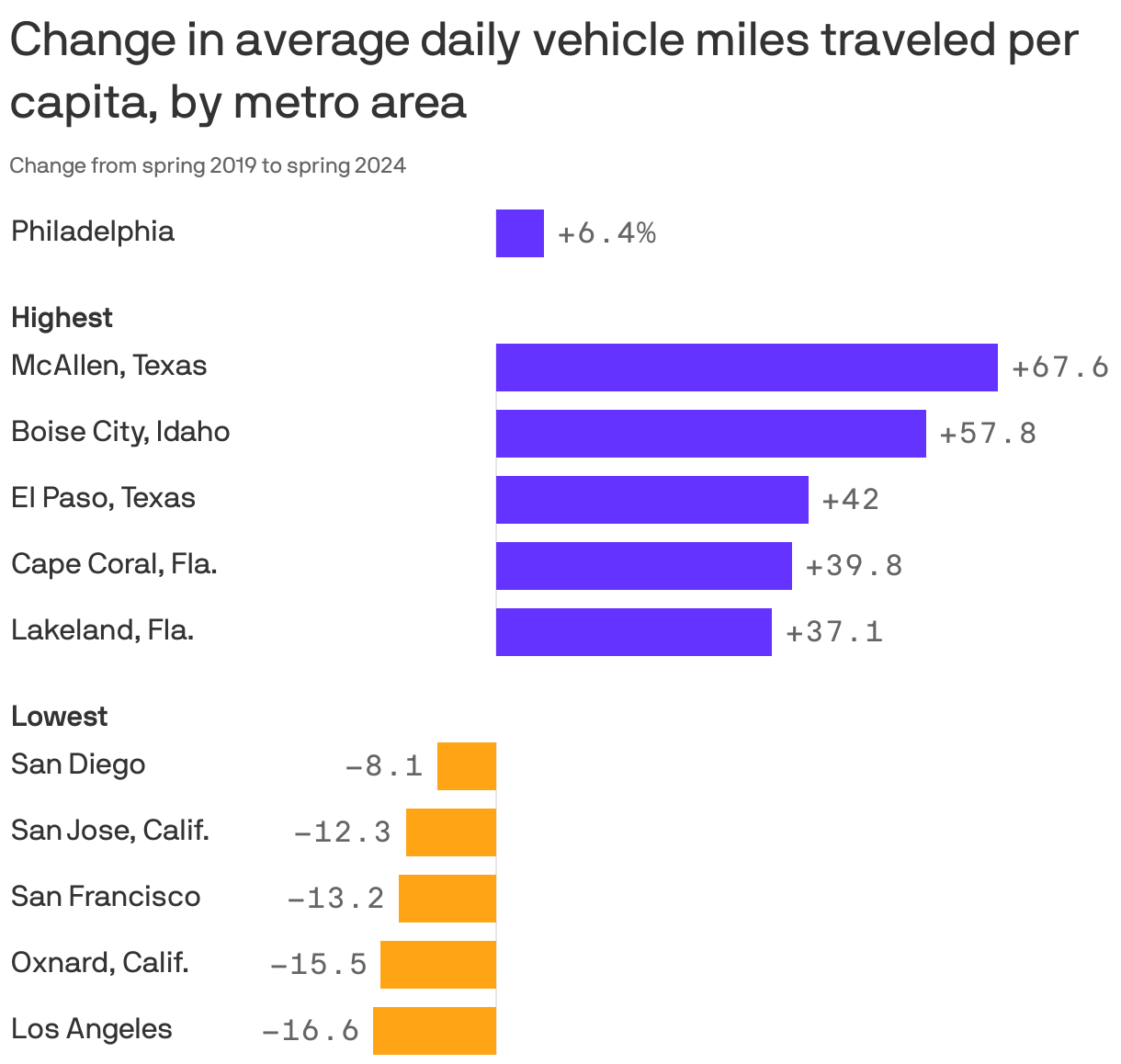
By the numbers: VMT per capita increased in the Philly metro by 6.4%.
- The metros with the biggest reductions in VMT per capita were in California, including Los Angeles (-16.6%) and San Francisco (-13.2%). Standouts elsewhere include Springfield, Massachusetts (-6.1%) and Memphis (-4.1%).
The intrigue: VMT is up 14% in the New York metro area, where a first-in-the-nation "congestion pricing" plan — meant in part to reduce driving and gin up funds for public transit — was shelved indefinitely at the 11th hour.
Between the lines: While higher VMT tends to mean more vehicle-related emissions, it can also be a sign of changes generally perceived as positive, like more economic activity.
- Lower VMT can be a sign of successful public transit or cycling projects — or an indication that lots of people are still working hybrid or remotely.
Yes, but: "GDP now stands above 2019 levels even in the metros where VMT is still down," per StreetLight's report.
- "This is a signal that GDP growth can be decoupled from VMT growth."
The bottom line: "It's not just that [VMT] is back up, but we're actually seeing a bit of an acceleration compared to the previous couple of years," Emily Adler, director of content at StreetLight, tells Axios.
- "So that suggests that we're not peaking, that whatever efforts we've strived for to keep VMT down, they're not quite working — or they're not working yet."