Pennsylvania's fight for food security

Add Axios as your preferred source to
see more of our stories on Google.
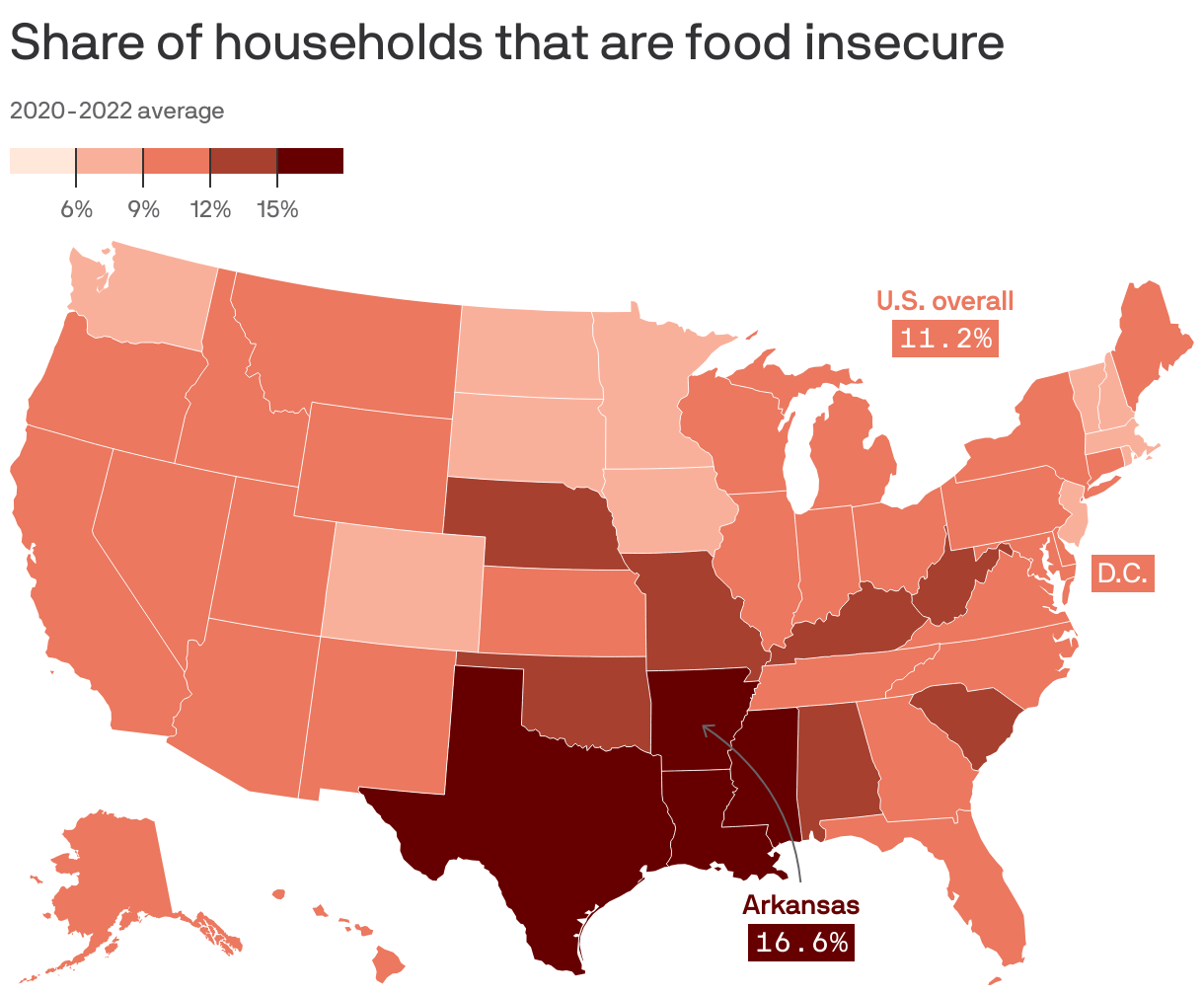
10.1% of Pennsylvania households were food insecure on average between 2020-2022, Axios' Emily Peck and Kavya Beheraj report based on new government data.
- That's compared to 11.2% nationally over the same time frame.
Details: Food insecurity means that at times during the year, a given household couldn't get enough food for one or more of its members because they didn't have enough money or resources.
- Those with "very low" food security eat less food or skip meals. In a house with children, the adults might go without so that the kids can eat.
The big picture: Looking at just 2022, the share of U.S. households that couldn't reliably afford food rose to 12.8% from 10.2% in 2021, per new U.S. Department of Agriculture data.
- The national economy might've looked great in 2022 by some metrics — like the low unemployment rate — but not this one.
Between the lines: The disappearance of pandemic-era support programs like the child tax credit, which was used by many families with children to buy food and lowered food insecurity rates in 2021, played a role here.
- But it's complicated. Some Supplemental Nutrition Assistance Program benefits were increased in 2022 — if they hadn't been, these numbers would likely look a lot worse, says Chloe East, an economist and visiting fellow at the Hamilton Project.
- This is an inflation story, too. And not just in food prices, which were up more than 10% in 2022 — energy prices and rents also soared.


Zoom out: Southern states had the highest rates of food insecurity on average between 2020 and 2022.
- Arkansas led all states in food insecurity with 16.6% during that time, followed by Texas at 15.5%.
- Meanwhile, New Hampshire had the lowest level of food insecurity during that span (6.2%).
Zoom in: In the Keystone State, 3.9% of households experienced "very low" food security on average between 2020 and 2022.
- That's lower than the national average (4.3%).
What they're saying: When times are tight, it can often be "easiest" to cut back on food, says Lisa Davis, a senior vice president at Share Our Strength, an anti-poverty nonprofit.
- "If you don't pay the rent or your mortgage, you don't have a place to live. If you don't put gas in the car, you can't get to work," Davis tells Axios.
- "Food is the place that folks turn when they have to tighten the belt even more."