Spotted lanternfly invasion is a menace in Pennsylvania

Add Axios as your preferred source to
see more of our stories on Google.


The invasive spotted lanternfly has nearly taken over Pennsylvania.
Why it matters: The small critters are a nuisance for most but also threaten to devastate the state’s agricultural and logging industries.
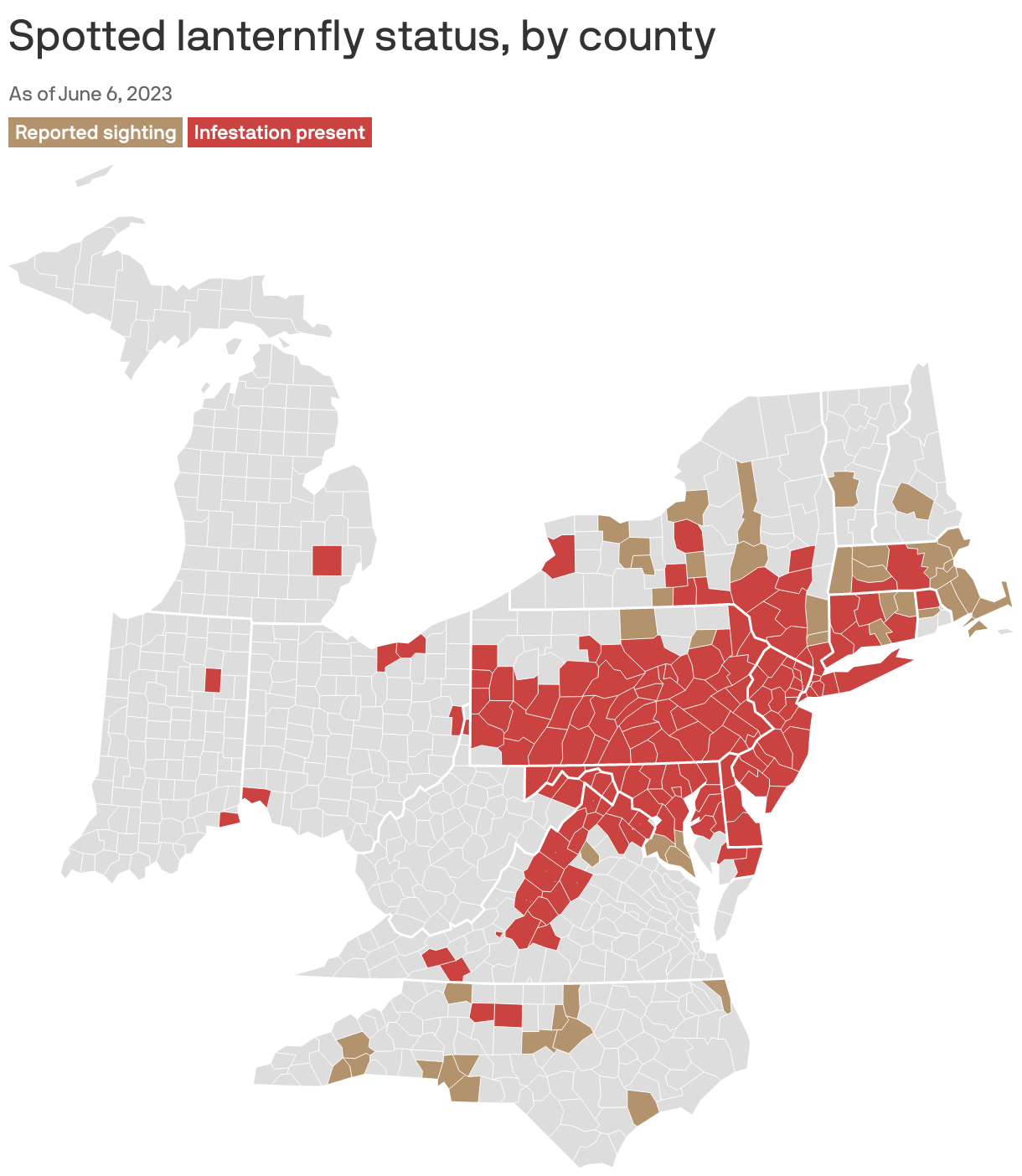
State of play: The spread of spotted lanternflies in Pennsylvania is growing with most of the state now under quarantine, including the Philly metro.
- Six counties were added to the quarantine zone in February, per the state Department of Agriculture.
- That designation allows officials to regulate the movement of anything that could spread the insect, such as landscaping waste, firewood and recreational vehicles.
Plus: Businesses that operate in or travel through those zones must obtain a permit.
Zoom in: The economic effects of the polka dotted pests are steep.
- They have the potential to cost the state between $324 million and $554 million, and as many as 5,000 jobs annually, per a 2019 report from Penn State.
- Spotted lanternflies have a strong taste for plants critical to Pennsylvania’s economy, such as grapevines and maple trees, which can devastate the wine, fruit and logging industries, per the state.
The big picture: Spotted lanternflies could spread across the U.S., per Axios’ Jacob Knutson.
- They have been in more than a dozen states, according to a map maintained by Cornell University.
- Delaware and New Jersey have infestations in every county, while infestations have been localized to a handful of counties in Midwestern states, including Ohio.
Flashback: The pest first reached in Pennsylvania in 2014.
By the numbers: 51 of the state’s 67 counties have a present infestation as of this week, per Cornell University's New York State Integrated Pest Management Program.
- At least $53 million has been funneled to the state Department of Agriculture to fight invasive species.
Be smart: You have a license to destroy the bugs on sight.
- Go ahead and squash them or remove their egg masses by scraping them into a plastic bag containing hand sanitizer.
- The state also suggests removing another invasive species, Tree-of-heaven, which is their preferred host tree.
What they're saying: Thanks to more awareness and earlier detection, "my gut would say we're slowing down the spread of it," Julie Urban, an evolutionary biologist at Penn State University, told Axios last month.
What to watch: Spotted lanternfly eggs should have already begun hatching last month and are on their way to becoming adults as soon as July.