Arkansas wins federal waiver on education rules

Add Axios as your preferred source to
see more of our stories on Google.
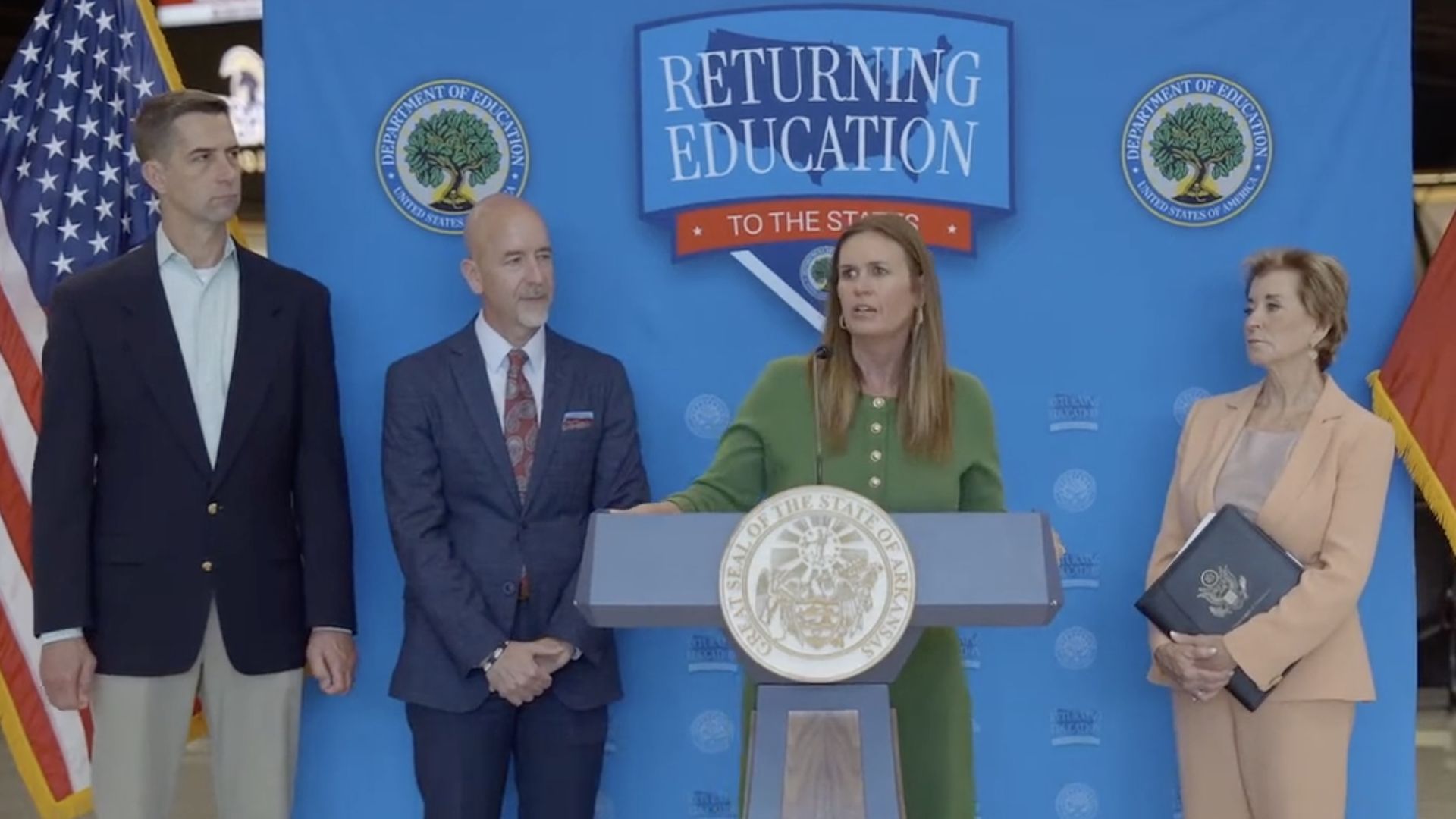
U.S. Sen. Tom Cotton, Arkansas Education Secretary Jacob Oliva, Gov. Sarah Huckabee Sanders and U.S. Education Secretary Linda McMahon. Screenshot courtesy of the Sanders administration.
Arkansas can merge four federal education funding streams and cut some federal reporting requirements under waivers approved Tuesday by U.S. Education Secretary Linda McMahon.
The big picture: Gov. Sarah Huckabee Sanders says the change is "about education, not paperwork" and will free districts to spend more time and money on students. Critics say it could weaken federal guardrails meant to make sure money reaches high-need students.
Driving the news: McMahon signed off on Arkansas' Returning Education to the States waiver, Ed-Flex authority and changes to the state's federal accountability plan during a Hot Springs press conference with Sanders, Arkansas Education Secretary Jacob Oliva and U.S. Sen. Tom Cotton.
- Arkansas is the fifth state to receive the flexibility, after Indiana, Iowa, Louisiana and Vermont, McMahon said.
State of play: Merging the four funding streams will allow the state to be more efficient, McMahon said.
- Sanders said the move would save Arkansas $13 million that will not be wasted "filling out reports" and which includes additional flexibility provided through the Alternative Fund Use Authority pilot, according to Arkansas Department of Education press secretary Kaelin Clay.
Details: The Alternative Fund Use Authority expands the program from small rural schools to include rural and low-income schools, which may also be urban.
- The four income streams are Titles II-A, III-A, IV-A, and IV-B of the Elementary and Secondary Education Act, according to the U.S. Department of Education.
What they're saying: Districts previously had to file reports "that weren't Arkansas-specific," while advanced students sometimes had to take extra tests that "did nothing but take away from that kid's time in the classroom," Sanders said.
- The waiver lets Arkansas write one plan for using federal money instead of several and is asking to be held to a higher level of accountability, not less, Oliva said.
The state found that about 34 cents of every federal education dollar went toward meeting compliance.
- "If we can reduce that, that's more dollars that we can put into supporting students, into high-impact tutoring programs … maybe hiring additional academic coaches to support teachers," Oliva said.
The other side: Some education advocates warn the rules exist for a reason.
- The shift relies on trusting states to serve vulnerable students well, and Arkansas' track record is "not great in that regard," Bill Kopsky of the Arkansas Public Policy Panel told the Arkansas Democrat-Gazette.
- Removing the guardrails could reduce transparency and make it harder to track whether money reaches intended students, April Reisma, president of the Arkansas Education Association, wrote in public comments collected before the waiver was approved.
Context: The approval extends Sanders' education agenda after the 2023 LEARNS Act, which raised starting teacher pay, expanded school choice and added literacy coaches and tutoring.
What we're watching: Whether districts see real savings from the waiver, and how Arkansas shows that consolidated federal money still reaches students with the greatest needs.