Climate change will cost Louisiana billions by 2050


Add Axios as your preferred source to
see more of our stories on Google.
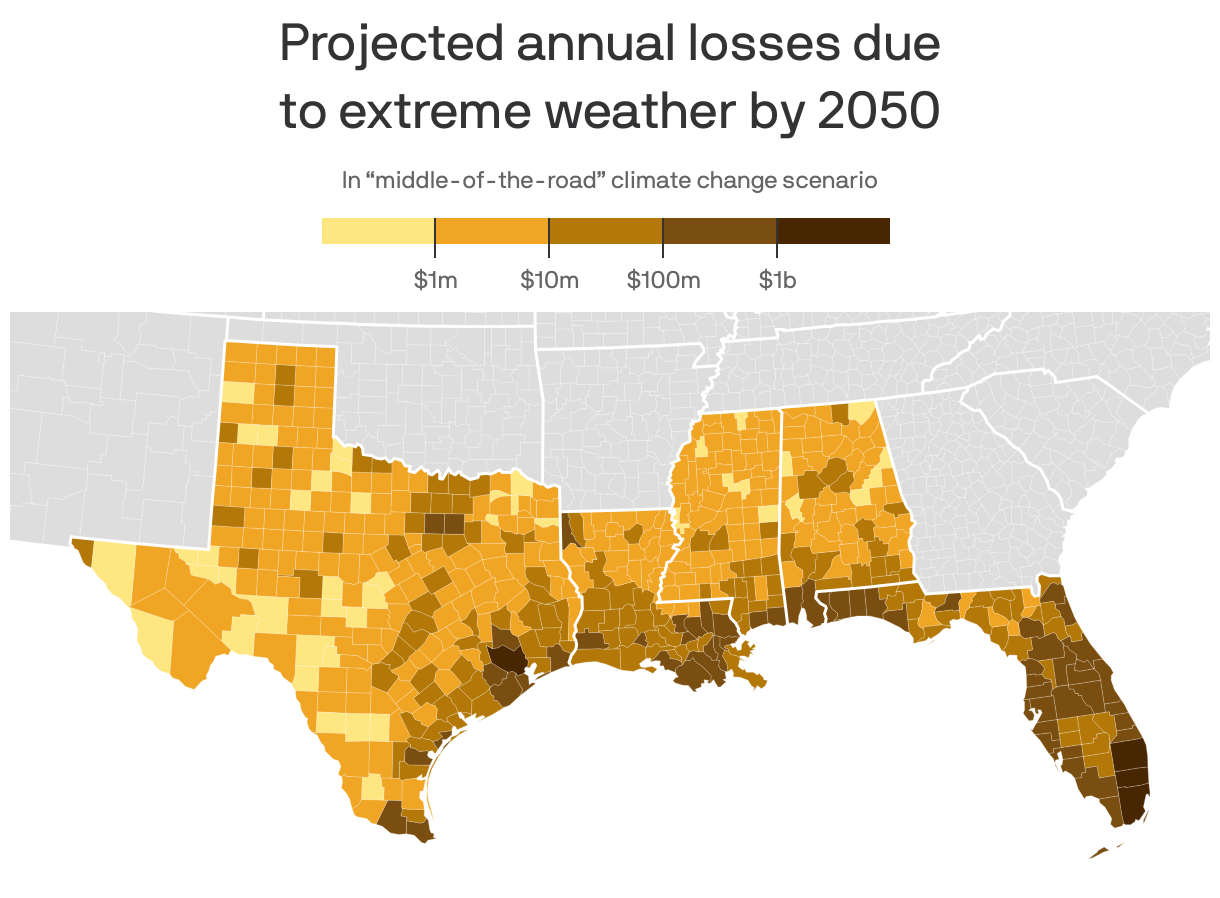
Louisiana will face more than $4 billion in annual property damage due to extreme weather by 2050, per a new analysis.
Why it matters: As the state remembers the 20th anniversary of Hurricane Katrina this week, climate change makes more pain and loss seem inevitable.
The big picture: Damage from extreme weather will cost $32 billion annually across Texas, Louisiana, Mississippi, Alabama and Florida by 2050 in a "middle of the road" climate change scenario, per a new Urban Institute analysis using FEMA data.
- That's more than double the projected $15 billion when ignoring climate change.
Zoom in: Dense, populous counties may see the biggest overall annual costs, like Harris County, Texas (about $2.6 billion by 2050) and Broward County, Florida ($2 billion).
- In the New Orleans metro, Jefferson Parish's projected costs ($586 million) outweigh those of Orleans Parish ($328 million).
Between the lines: When Hurricane Katrina first struck — and again this week as we revisit its anniversary — some questioned the wisdom of rebuilding and protecting such a vulnerable place as New Orleans.
- But the Urban Institute's analysis, which is based on FEMA's Future Risk Index and estimates future costs associated with coastal flooding, extreme heat, wildfires, hurricanes and drought, is a reminder that New Orleans isn't alone in the risk it takes to merely exist on the Gulf Coast.
- And multiple studies show how human-caused climate change has made recent hurricanes more potent and destructive.
State of play: FEMA published its index last December. It's since been taken down amid the Trump administration's purge of publicly accessible federal data and info about climate change.
- The financial figures are based on 2024 dollars.
The latest: Officials in New Orleans and elsewhere have been making storm resiliency upgrades to mitigate future disasters, Axios' Carlie Kollath Wells reports.
What's next: The Trump administration's efforts to dramatically reduce FEMA's disaster assistance role have yet to be tested by a major hurricane in Gulf Coast states.
- Those states have long relied on federal help and funds to recover from major storms.