These states could suffer the most without FEMA

Add Axios as your preferred source to
see more of our stories on Google.
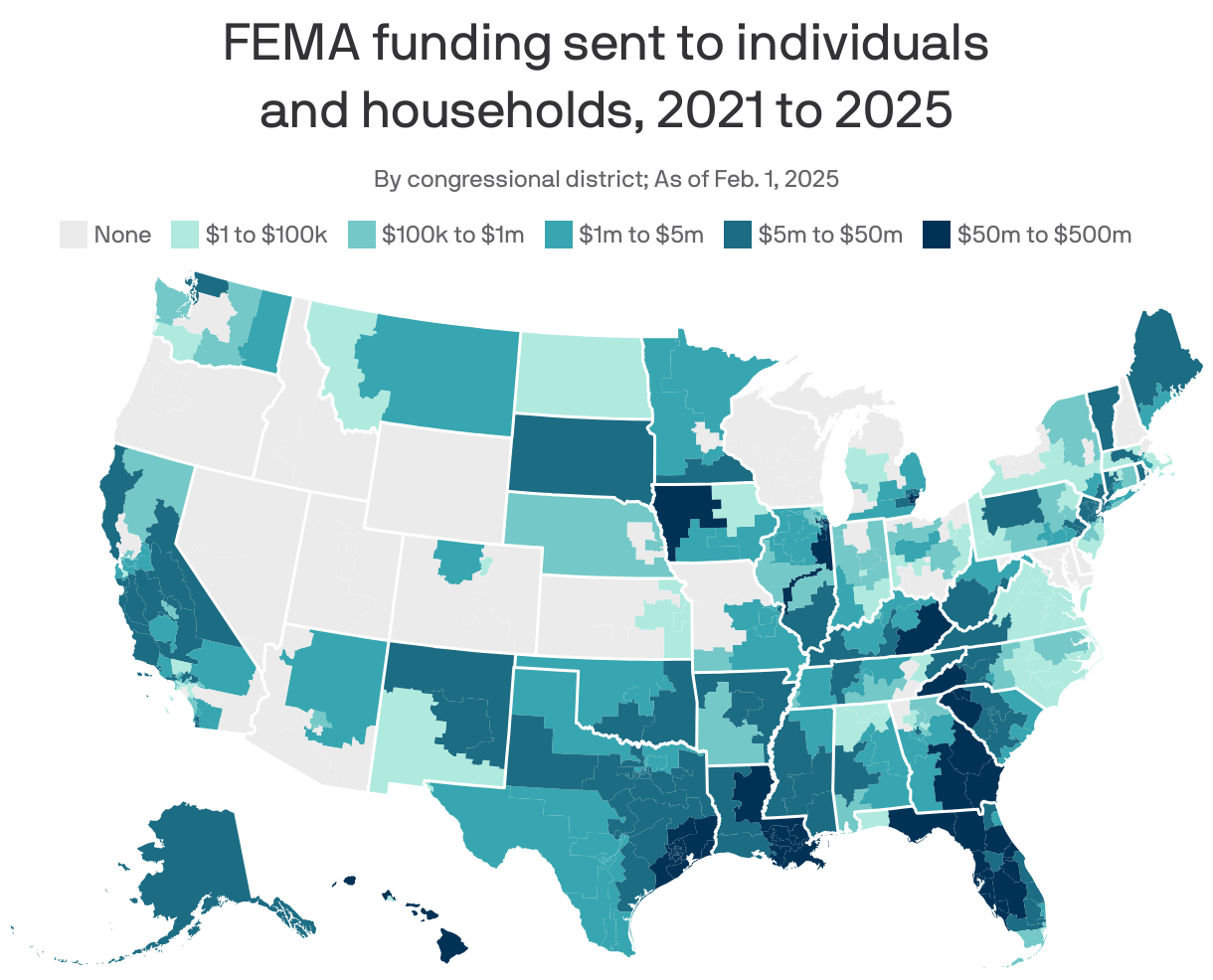
Some of the most disaster-prone states could face the greatest financial burdens in a world with less federal relief assistance, a new analysis finds.
Why it matters: President Trump earlier this year floated "fundamentally overhauling or reforming" FEMA, or "maybe getting rid" of it entirely — fueling concerns that U.S. disaster relief could be thrown into chaos just a few months before another hurricane season spins up.
Driving the news: Trump is reportedly mulling an executive order empowering state and local governments to handle disaster readiness and relief, and previously created a "FEMA review council."
- FEMA and other federal agencies, including the Department of Housing and Urban Development (HUD), already funnel billions of dollars to individuals and communities.
- It's unclear how or whether Trump's order might change that, or if it would result in fewer federal dollars for disaster-wracked states.
- Some FEMA reform advocates call for giving states "block grants" of relief money to spend as they see fit, rather than to meet specific needs — but others worry that would lead to fraud and abuse, or that many states lack the resources and expertise to rebuild without help.
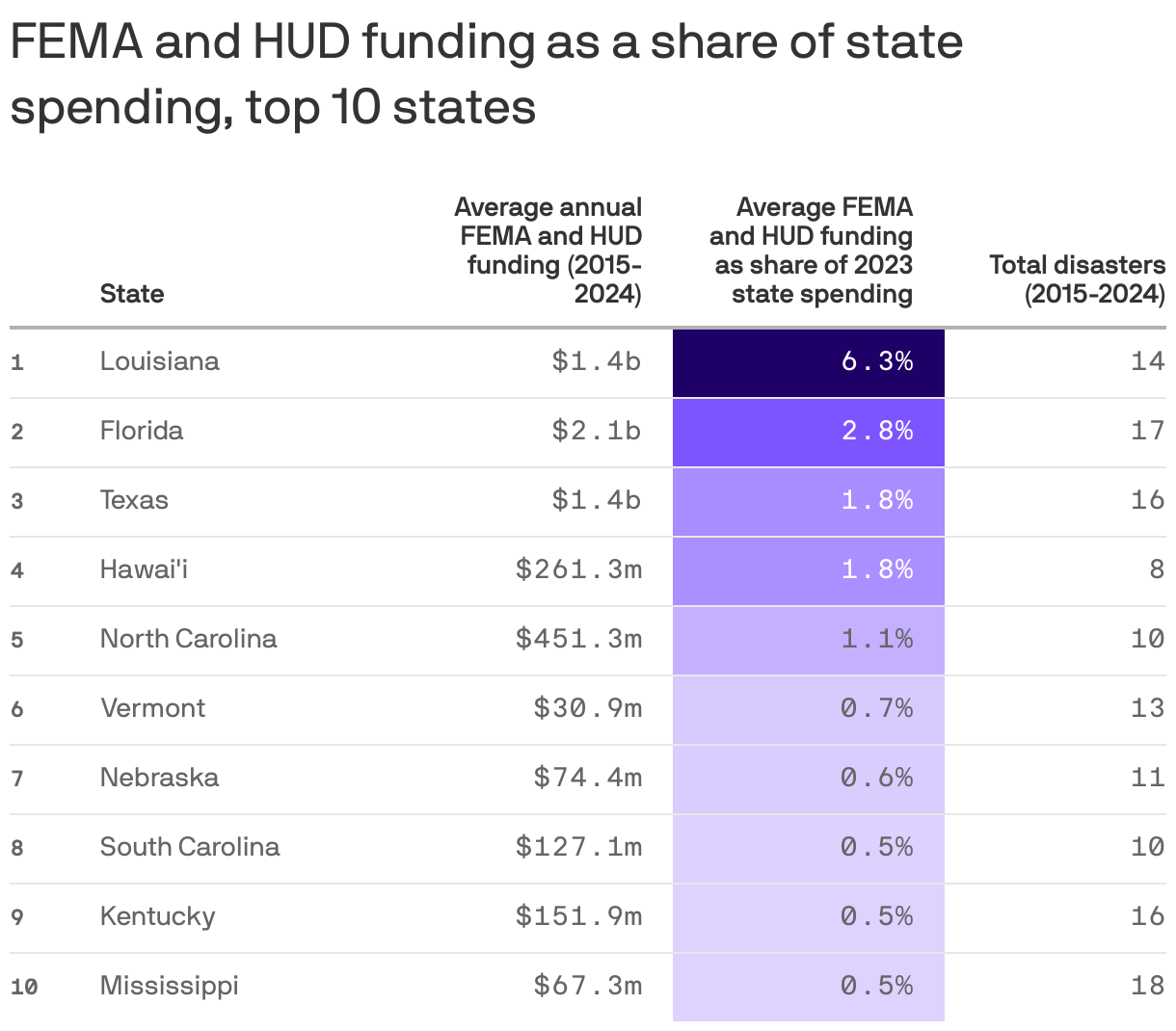
By the numbers: Certain states — many of them red — would be hit especially hard by reductions in federal relief funding, per a new analysis from the Carnegie Disaster Dollar Database.
- Louisiana, for example, received an average of about $1.4 billion annually in FEMA and HUD relief funding from 2015 to 2024, covering 14 disasters.
- That's equal to 6.3% of the state's approximately $21.9 billion in overall spending in fiscal 2023.
Florida got $2.1 billion a year on average during that time, equal to 2.8% of the state's 2023 spending.
- And Texas got $1.4 billion, equal to 1.8% of its 2023 spending.
What they're saying: "Up to now, when there is a disaster, the government responds. They clean up the debris, they rebuild the schools, they run shelters, they clean the drinking water," says Sarah Labowitz of the Carnegie Endowment for International Peace, who led this analysis.
- "All of that is supported by a federal disaster relief ecosystem that spreads the risk around the country, spreads the costs around the country. And if we stop spreading the costs around the country, then it's going to fall on states, and it's going to fall on states really unevenly."
"We as a disaster response sector, certainly we as an agency, need our federal partners," adds Katie Mears, senior technical specialist at Episcopal Relief and Development, the aid and relief wing of the the Episcopal Church.
- "We understand the need for reform, but we can't do this without support from all the different federal players."
Friction point: The Trump administration is already using disaster relief as leverage to extract political concessions.
- HUD Secretary Scott Turner recently blasted Asheville, North Carolina's draft proposal for $225 million for Hurricane Helene relief, which included language about prioritizing assistance for minority- and women-owned businesses.
- "DEI is dead at HUD," Turner said in a statement. "We will not provide funding to any program or grantee that does not comply with President Trump's executive orders," referring to Trump's January move to dismantle federal diversity, equity and inclusion programs.
The big picture: "I think we're all in agreement about [FEMA] reform, but let's do it smartly and be able at the same time to complete the mission," Pete Gaynor, who ran FEMA for about two years during Trump's first term, tells Axios.
- Part of FEMA's utility, Gaynor says, is directing not just money but people, including relief experts who can be dispatched to states as needed after disaster strikes.
- But he's concerned about an exodus of FEMA staffers, in part tied to Trump's broader purge of federal workers. More than 200 of FEMA's 20,000-plus staffers have been fired, NPR reports.
"Where does this goal of reform stop before it's too late and you lose these capabilities that have been critical over time?" Gaynor says.
- "There has been and will continue to be a departure of [senior leaders] that have been at FEMA for 25-30 years, experts at everything — they leave, and you have a freeze on hiring, or you instill fear into the workforce, that's going to hurt."
- "And you know who it's going to hurt first? It's going to hurt the disaster survivor — that's where it hurts."
What's next: "We really need to be proactive in making sure that we lay down some principles that reform should follow to make sure the result is positive," Gaynor says.
- "We have some work to do. I'm not sure there are red flashing lights just yet, but I think the lights are flashing yellow."
