Inside Mayor O'Connell's plan to upgrade Nashville's traffic signals

Add Axios as your preferred source to
see more of our stories on Google.
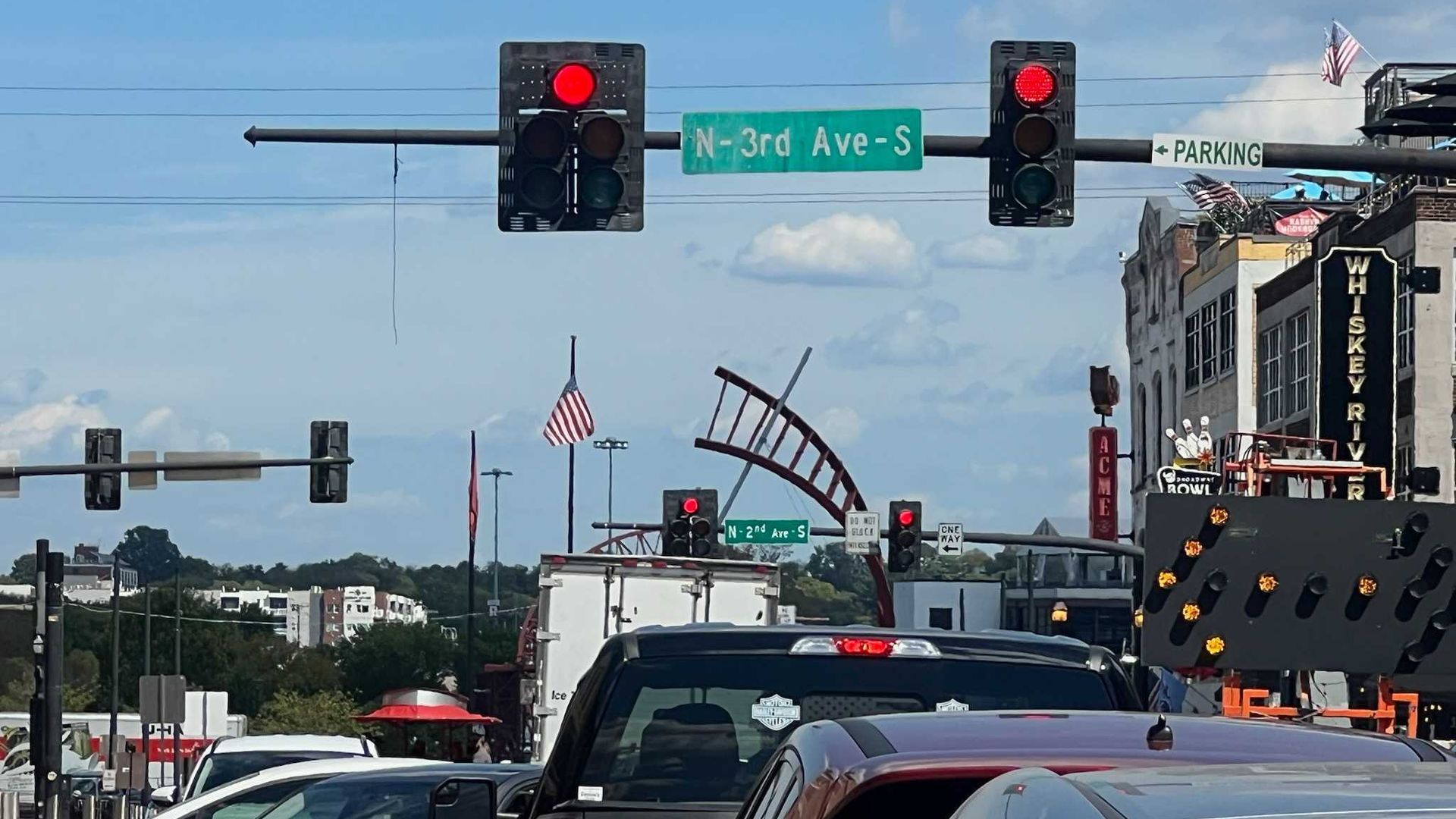
Traffic at a red light in downtown Nashville. Photo: Nate Rau/Axios.
If Nashville's traffic signals were described in terms of cellphone technology, a top city engineer says they're working with about an iPhone 6.
Why it matters: That's, of course, kind of bad news since Apple now offers the iPhone 16.
- Mayor Freddie O'Connell is pitching an overhaul of the city's traffic signal system as a foundational piece of his $3.1 billion transportation plan.
- Modernizing traffic signals is so important to the plan, the pro-transportation political group uses a green light signal as its main campaign graphic.
State of play: Derek Hagerty, assistant chief for transportation systems management for Metro, says the current system works "like setting a watch."
- Based on factors like the time of day, typical rush hour traffic and the speed limit, the city can time its lights to try to give motorists as many green lights as possible.
- "If you're not at max congestion, if there's not a crash in front of you that's throwing things off, you should be able to hit green (light) bands and go through a handful of signals before you have to stop," he says.
- The system can "drift" the same way a wristwatch can lose time, requiring updates every three to five years, Hagerty says. "With the way Nashville grows, there can be a lot of drift" over that time, he says.
Yes, but: This is where the iPhone metaphor comes into play. The system Hagerty described above is a rather crude tool by today's technological standards. Hagerty says that if the transportation ballot measure is approved by voters, it would allow the city to install "smart signals," which are the equivalent of an iPhone 16.
- O'Connell's plan earmarks $158.36 million to upgrade 592 of its approximately 900 signals over 15 years.
By the numbers: Hagerty says national data indicates that improving traffic signal systems improves travel time by about 10%.
How it works: Hagerty says the modernized signals would "see," "talk" and "think" using upgraded technology.
👀 See: Upgrading to "smart signals," as they're called, would provide traffic managers with new detection tools such as video, radar and laser-based lidar technology to sense where congestion occurs.
- "Not only can they see vehicles that are there, but they can see upstream what's coming. They can also detect bicycles, pedestrians and find different types of vehicles (like buses)."
📣 Talk: Hagerty says the city needs to build out its fiber infrastructure so that it can push traffic data to a centralized command center in real time.
- Currently, the city uses outdated cellular-based and old-school phone lines on most of its roads to share traffic data. "We have hard times pushing video and other data. It's not always in real time like we need."
🧠 Think: Hagerty says the city needs to update its software management system for its signals, and utilize artificial intelligence to analyze traffic patterns.
The other side: Emily Evans, a former councilmember who helps lead a grassroots group that opposes the transportation plan, says the issue is not that upgrading traffic signals is a bad idea.
- She says raising the sales tax by a half-percent disproportionately affects poor people, and argues the city should be paying for such upgrades out of its annual capital improvement budget.
- "It's not that all of these things are bad ideas. It's that using a regressive tax to pay for something that we should be doing within our regular budgeting process is a problem," she says.