Regional Transit Authority to assume control of Detroit's QLine streetcar service

Add Axios as your preferred source to
see more of our stories on Google.
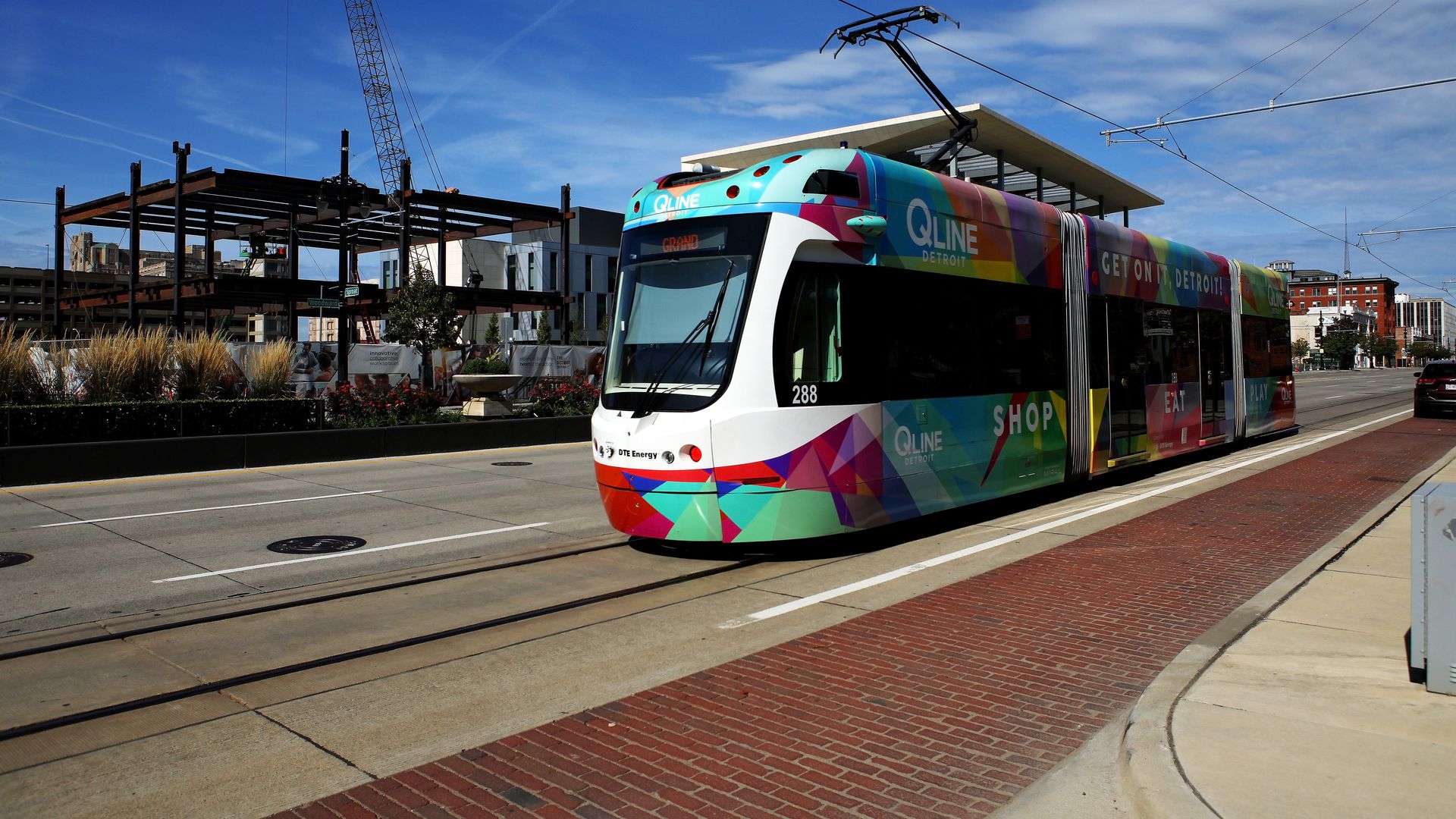
The QLine along Woodward Avenue pictured in 2019. Photo: Raymond Boyd/Getty Images
The Regional Transit Authority of Southeast Michigan today agreed to take control of the QLine, a transition that represents a milestone for the downtown streetcar service and could lead to future expansion.
The big picture: Transferring the QLine from the nonprofit M-1 Rail to the RTA is a step toward a true regional transit system, a crucial service Metro Detroit lacks.
- By bringing the QLine under its umbrella, the RTA is better positioned to grow its services portfolio, including the new bus route to DTW and the D2A2 bus connecting Detroit to Ann Arbor.
Why it matters: As part of a public authority, the QLine can access new state and federal funding previously unavailable with a nonprofit in charge.
State of play: There will be no service interruptions and the QLine's fare will remain free when the RTA takes over Oct. 1.
- The RTA board unanimously approved the transition at its meeting today.
Catch up quick: The QLine runs along a 3.3-mile stretch of Woodward Avenue, 12 stops from Congress Street to Grand Boulevard.
- Construction started in 2014, and it opened in 2017, thanks to $150 million in philanthropic donations from the Kresge Foundation, Dan Gilbert's Rock Family of Companies, Penske Corp., and others.
- The RTA is a public agency with a board of appointed members from Detroit, Wayne, Oakland, Macomb, and Washtenaw counties.
What they're saying: Rip Rapson, president and CEO of Kresge, says the transfer of the QLine to a public authority was envisioned since its inception.
- "It's a long overdue and joyous affirmation of how important this project is to the future of the region," Rapson tells Axios Detroit. "The whole funding equation completely changes."
- Kresge has been among the QLine's main financial backers, providing about $60 million since 2009, including a $35 million grant to begin its development.
Between the lines: After a rocky start — cars would park on the tracks and service was unreliable — residents and visitors have increasingly embraced the QLine for its convenience. Ridership skyrocketed during April's NFL Draft.
- Officials said the RTA's willingness to absorb the QLine shows that it is fully functioning and financially healthy.
Follow the money: The move costs taxpayers nothing extra, per the RTA.
- The RTA will assume the QLine's $10 million annual budget, its streetcars and other assets and the service's approximately 45 employees.
- The QLine will continue to receive $5 million in annual tax subsidies that the state agreed to provide two years ago through 2039.