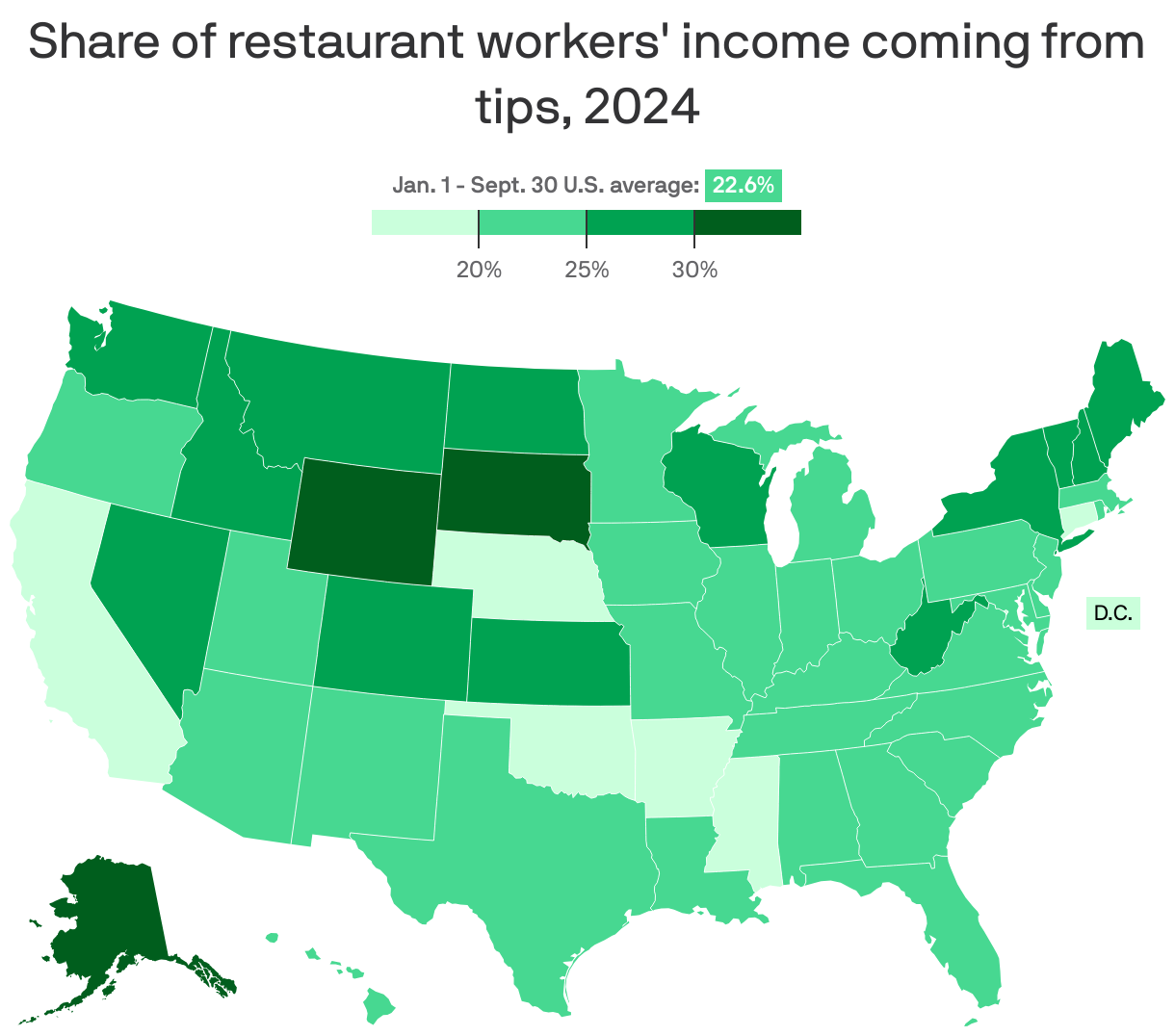
Tips make up 26% of Colorado restaurant workers' income


Add Axios as your preferred source to
see more of our stories on Google.
The pandemic-era surge in tipping is sticking around in Colorado and nationwide, with incessant prompts on iPad screens and printed receipts to leave a little extra.
Why it matters: As tipping is expected on more transactions than ever, it's reshaping how consumers approach gratuity — historically tied to service quality — and how employers pay their workers.
- Meanwhile, consumers are left feeling increasingly confused and pressured to avoid a tipping faux pas.
Driving the news: New data from payment company Square shows tips now account for about 26% of Colorado restaurant workers' income, with customers tipping on average 15% of their bill.
- The annual wage for servers in Colorado, excluding tips, averages at about $41,630, according to the latest figures from the U.S. Bureau of Labor Statistics.
What they're saying: "We're very concerned about tipping fatigue, which is real and becoming ever more common as other retail businesses add tipping to their pay models," Colorado Restaurant Association president and CEO Sonia Riggs told Axios Denver in a statement.
The big picture: Tips make up an increasingly large share of restaurant workers' pay nationally amid the rise of tipping culture, according to Square's recent report, which examines payroll data.
- In October, gratuities made up nearly 23% of restaurant workers' pay across the U.S. — up from 14% in 2019.
What's happening: Restaurants across the country have seen an increase in sales volume during post-pandemic years that's translated into more customers per hour — and more tips, says Ara Kharazian, research lead at Square.
- In Colorado, tips have also gone up because of increasing menu prices, as restaurants try to compensate for the rising minimum wage requirements, Riggs told us.
- Another factor is technology, "with modern point-of-sale systems making it easier to add a tipping option to every transaction," Riggs added.
State of play: Colorado's restaurant services fees — mandatory charges that grew in popularity during the pandemic as a way to ensure higher hourly pay for all staff — are also becoming a mainstay on customer bills.
- More operators are shifting to this service model to lessen the pay disparity between front- and back-of-house teams.
Zoom in: The amount and type of services fees vary widely from place to place as restaurants experiment with new approaches to pay their employees.
- For example, Urban Cowboy Public House — which opened in September in Denver's Capitol Hill neighborhood — adds a non-negotiable 20% service charge to every bill.
- American Elm in West Highlands applies a 2.5% "living wage" fee.
- The Burns Pub & Restaurant in Broomfield includes a 1.5% "kitchen appreciation" charge.
Yes, but: While these fees help address wage gaps, they also leave customers wondering whether they're still expected to tip on top of the added charges.
What we're watching: One of President-elect Trump's campaign proposals was to eliminate taxes on tips.
- In Colorado, this would mean exempting more than a quarter of restaurant workers' income from taxes — a significant chunk.
- The Colorado Restaurant Association hasn't taken a position on the proposal yet. "The devil is in the details, and we have a lot of questions," Riggs said.
Go deeper: Should you tip on top of a service fee? An etiquette expert has the answer