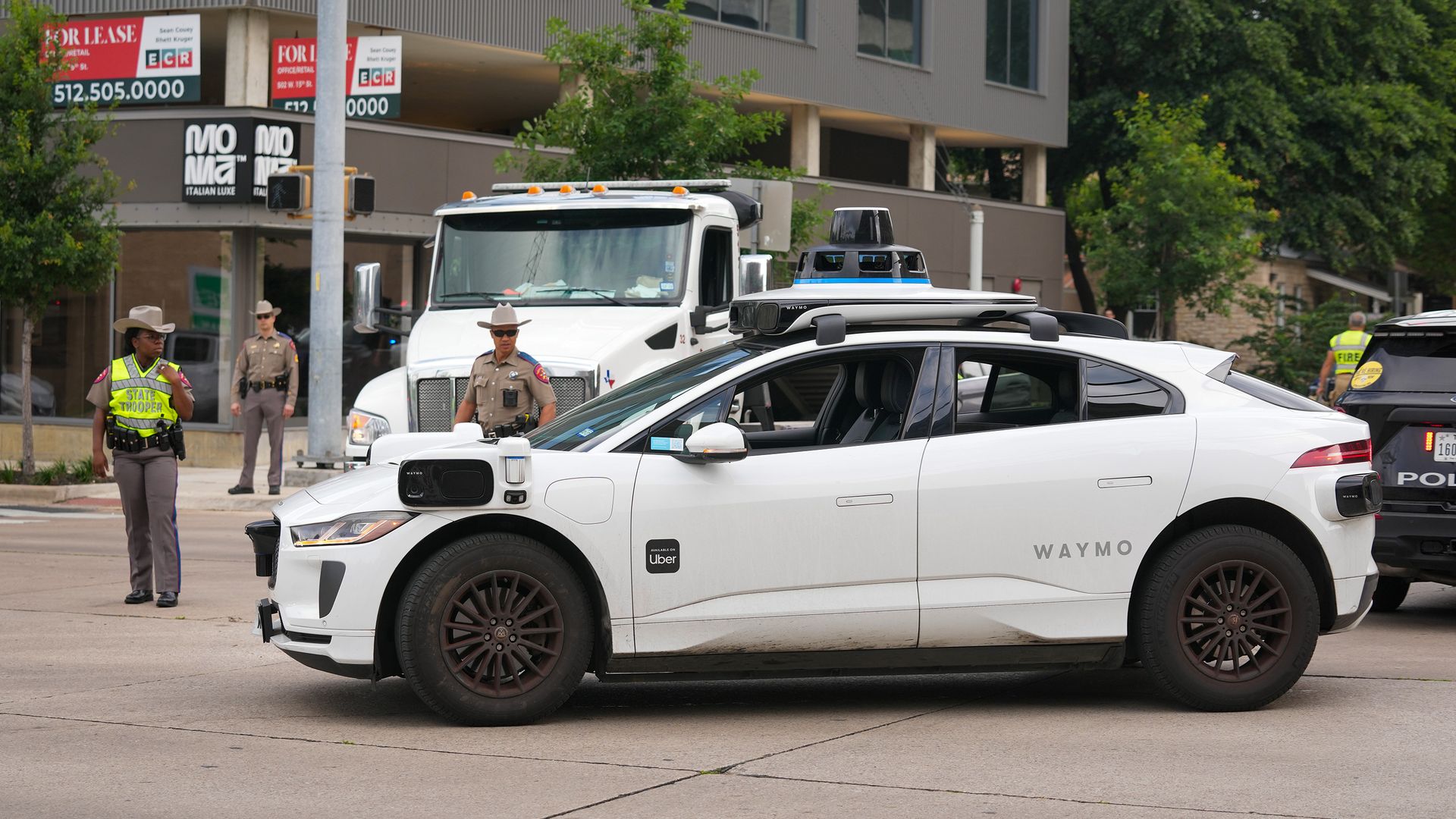
Texas Department of Public Safety troopers interact with a Waymo robotaxi near a rollover crash in Austin. Photo: Jay Janner/The Austin American-Statesman via Getty Images
The Trump administration is simultaneously loosening federal rules to accelerate autonomous vehicle deployment while also slapping robotaxis for getting in the way of first responders during emergencies.
Why it matters: Government regulations aren't keeping pace with the emerging technology. Self-driving cars are here, but uniform safety standards are not.
Driving the news: The head of the National Highway Traffic Safety Administration is calling attention to what he refers to as "a disturbing trend" in recent months: AVs interfering with police, ambulances and fire trucks.
Jonathan Morrison issued a warning to the industry in a letter to AV developers last week. But there's no mistaking that his target was Waymo, which has driverless operations in 11 U.S. cities — including Dallas — and four more coming soon.
Zoom in: A Waymo robotaxi picking up a passenger near a mass shooting earlier this year in Austin blocked an ambulance from reaching the scene.
"The inability to detect and appropriately respond to such situations represents a functional insufficiency. Emergency scenes are not rare or extreme 'edge cases'" that can be blamed on a software anomaly, Morrison wrote.
What they're saying: Waymo declined to comment.
Morrison noted that human drivers who impede emergency operations are subject to fines and even jail time, but it's not clear how NHTSA will punish AV companies for the same infraction.
NHTSA has not launched a safety investigation into the issue as it often does for similar concerns.
What's next: Morrison is giving companies until the end of the month to explain how they will fix the problem.