Dallas-Fort Worth runs afoul of federal air standards

Add Axios as your preferred source to
see more of our stories on Google.
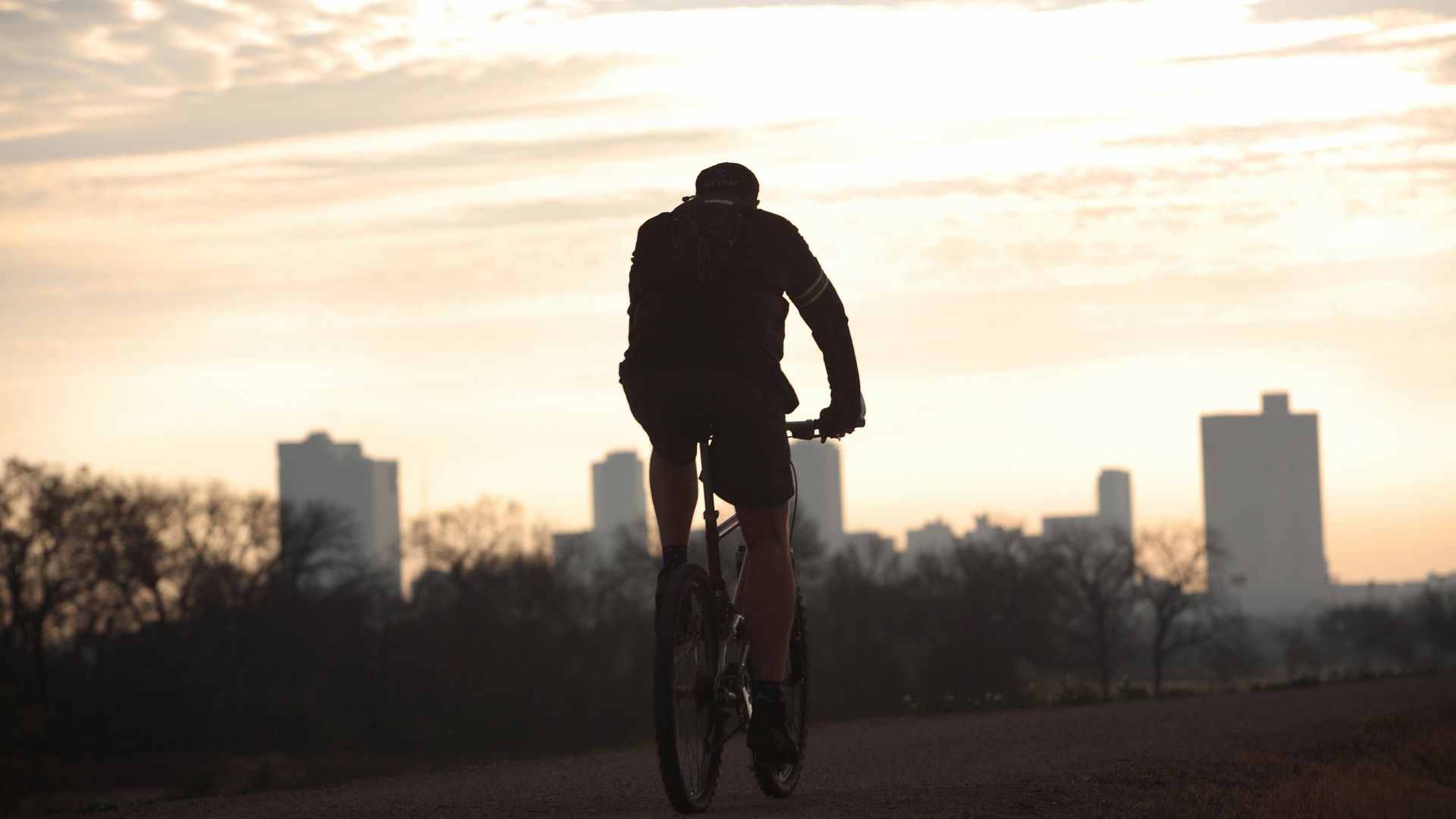
Biking along the Trinity Trail is not advised on an ozone action day. Photo: Robert Nickelsberg/Getty Images
Dallas-Fort Worth polluters could face $45 million in yearly federal fines if the region's air quality doesn't improve by 2027.
Why it matters: Air pollution is a serious threat to health, particularly for children, elderly people and those who have asthma or other lung conditions.
- The region has repeatedly failed to meet air quality standards set by the Environmental Protection Agency.
The latest: D-FW has seen an early start to the ozone season, which lasts through November.
- There has already been one day recorded this year when the air quality reached an unhealthy level for sensitive groups, per tracking data by the North Central Texas Council of Governments.
The big picture: Nearly 40% of Americans live in areas with unhealthy levels of ozone or particle pollution, according to the American Lung Association's latest "State of the Air" report on ground-level ozone.
- D-FW is the 13th worst out of 228 metro areas for its number of high ozone days.
Zoom in: Dallas, Tarrant, Collin and Denton counties all received Fs in the report.
- Denton and Tarrant counties had the most ozone action days of the four major North Texas counties.
Threat level: Ozone levels last year in D-FW reached 83 parts per billion, well above federal standards.
Context: The EPA's strictest air quality standard, set in 2015, sets an ozone limit of 70 ppb.
- In early March, D-FW started the ozone season with 74 parts per billion.
Between the lines: President Trump has targeted environmental regulations, including by attempting to end bans on "forever chemicals" and boosting U.S. oil and gas production.
- Still, the federal air quality standards in the Clean Air Act — which has been updated several times since it was first passed in the 1960s — are still in place
Yes, but: D-FW has fewer high ozone days now than it did 20 years ago.
- Not all of the ozone is from human-made pollution. Extreme heat and severe weather could be partly to blame.
Worthy of your time: Read how to reduce pollution in Dallas-Fort Worth.