How American Airlines responded to fatal crash


Add Axios as your preferred source to
see more of our stories on Google.
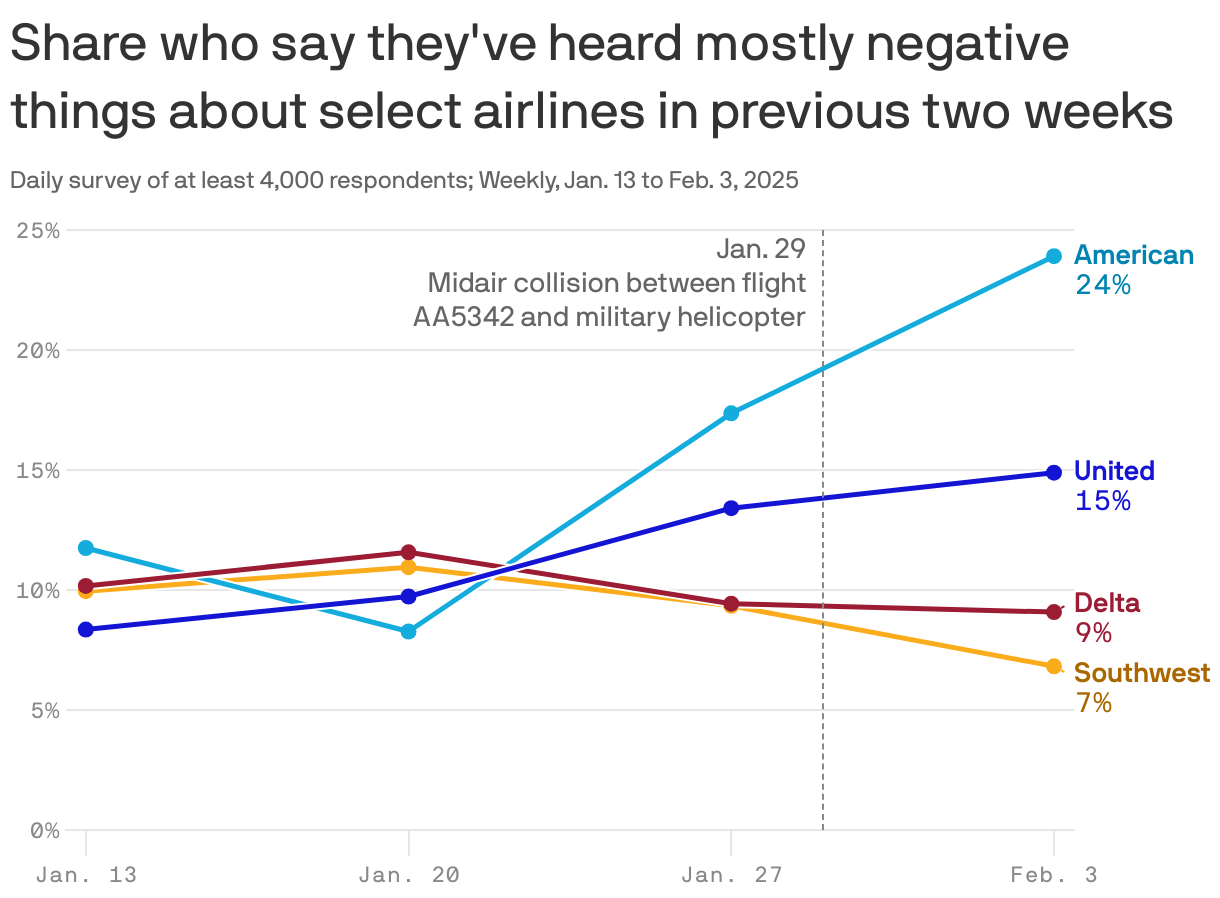
American Airlines' reputation metrics around brand favorability, trust and purchasing consideration have not shifted since a crash involving one of the company's passenger jets killed 67 people.
Why it matters: The stable reputation metrics collected by Morning Consult could signal the Fort Worth-based airline's response has been appropriate and well-received by key stakeholders and the general population.
- The American Airlines communications team had a plan, followed it and managed to avoid major political distractions after the deadliest aviation disaster in the U.S. since November 2001.
Catch up quick: Within an hour of the Jan. 29 crash, the airline released written communication with a helpline and directions for anyone who believed they had relatives onboard.
- The airline also established its newsroom page for updates and activated its CARE Team, a group of specialists who are trained to offer support.
Context: By 11pm the night of the crash, American Airlines CEO Robert Isom had released a video statement offering deep sympathies and saying the company's priority was the investigation and those impacted by the crash. He acknowledged there were still unanswered questions.
- The following morning, Isom appeared alongside local officials and first responders for a press conference. He released another video that afternoon, wearing the same outfit he was wearing in his response just hours after the crash.
Reality check: Before the crash, only 8% of U.S. adults reported seeing, reading or hearing something negative about American Airlines, according to Morning Consult's daily brand tracking.
- Since the collision, 25% say they have heard negative buzz.
Between the lines: It's not the first time a North Texas airline has had to quickly communicate after a deadly incident.
- Southwest Airlines CEO Gary Kelly released a video statement in 2018 after a passenger died from an injury on a flight.
Zoom in: Jennifer Riordan was the first person in Southwest's history to die from an in-flight incident.
The bottom line: 66% of U.S. adults are concerned about flying in the future. One-third say they are "very concerned."
- Calming nerves after this tragedy will be a task for all U.S.-based airlines.