Dallas-area houses cost four times median income


Add Axios as your preferred source to
see more of our stories on Google.
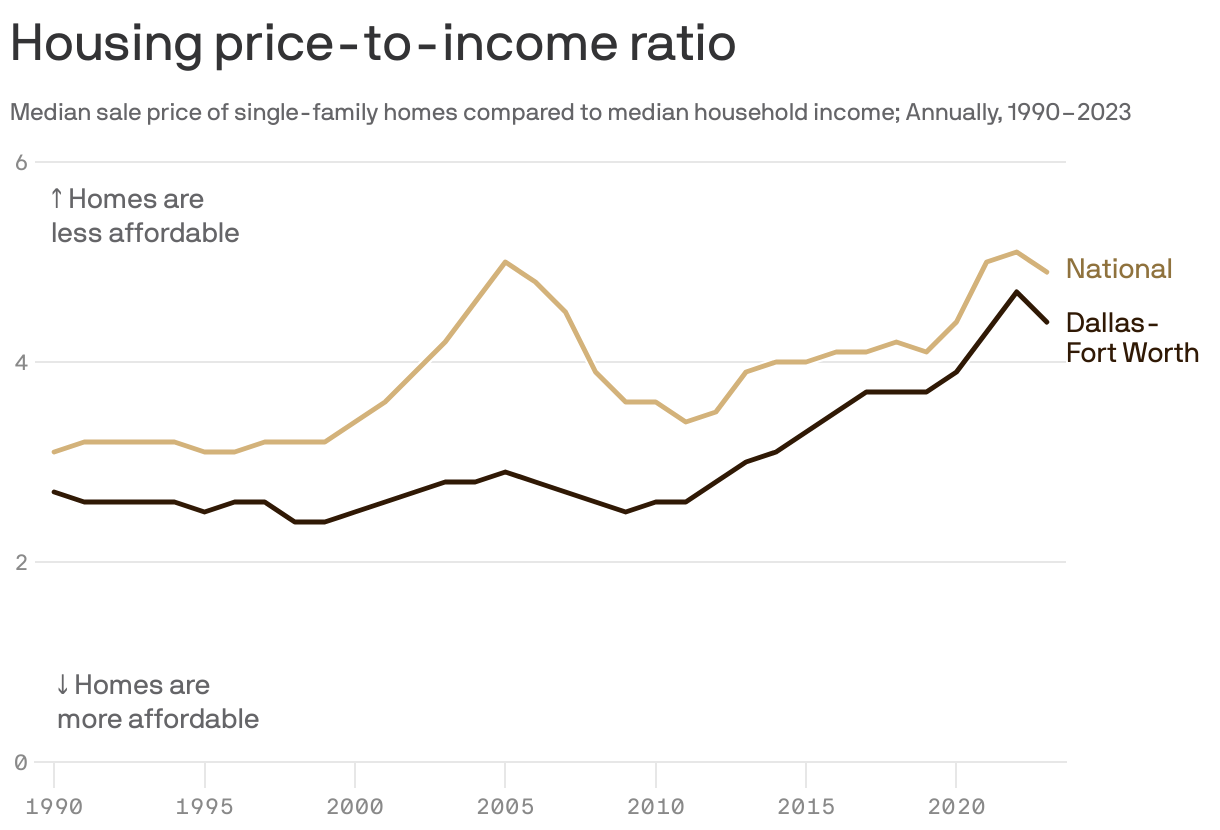
The median home price in Dallas-Fort Worth was 4.4 times the region's median income last year, according to a Harvard University analysis.
Why it matters: Home prices continue to outpace incomes nationwide, putting the American dream of owning a home out of reach.
- U.S. homebuyers are now the oldest on record, with the median age of first-timers reaching 38.
The big picture: In 2023, the national median sales price for existing single-family homes was 4.9 times the median household income, researchers from Harvard's Joint Center for Housing Studies found.
- That ratio dipped slightly from 2022 as home price growth slowed, but it remains historically high, per the analysis.
- Increasing taxes and insurance costs, plus elevated interest rates, have driven up the cost of homeownership.
The latest: The current median home price in Dallas County is $368,000, which is 2.4% higher than a year ago, per Redfin research.
- In Collin County, it's $506,000 — a 6.5% increase since last year.
Zoom in: The median income in Dallas-Fort Worth falls below what is needed to buy a home.
- A D-FW resident or household must have an annual income of at least $116,000 to be able to afford a $377,700 house, the region's median home price, per the Harvard analysis.
- That's a $3,000 monthly payment.
Flashback: The median home price was only 2.6 times the median income in D-FW in 1994.
- Median home prices didn't triple the D-FW median income until 2013.
By the numbers: The median household income in D-FW was $87,000 in 2023, per U.S. Census Bureau data.
- Collin County's median household income of $119,000 was the highest in the region.
- Dallas County's $74,000 was the lowest.
Between the lines: Homeownership is increasingly out of reach, especially as renters are becoming more cost-burdened and are less able to save money for down payments, per the Harvard report.
- The supply of higher-rent units is increasing, while options for lower-cost apartments are declining, particularly in fast-growing Texas, North Carolina and Georgia.
Case in point: In D-FW, nearly 24% of homeowners are cost-burdened, meaning they spend more than 30% of their monthly income on housing.
- That's compared with nearly 53% of D-FW renters who are cost-burdened.
Go deeper: Researchers' interactive map