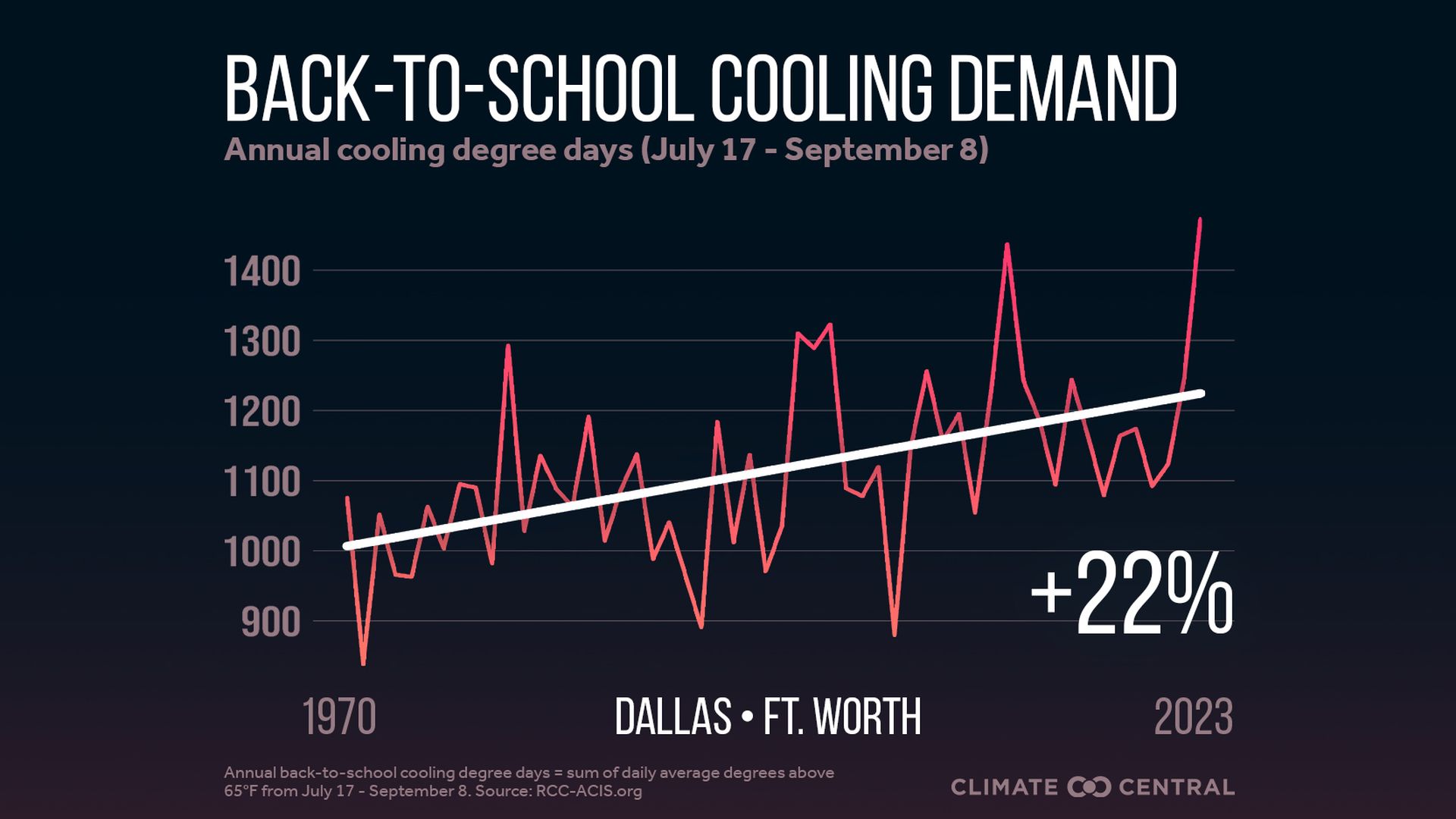
Chart credit: Climate Central; Note: "Cooling degree days" represent how much daily average temperatures in a time period need to be cooled to reach 65°F
Classrooms need more cooling during the back-to-school season compared to previous decades — even in hot Dallas-Fort Worth.
Why it matters: Heat waves affect children more seriously than adults because their bodies aren't able to regulate their temperature as well.
In North Texas, where August is often one of the hottest months of the year, districts adjust recess times and sports practices based on the extreme heat.
Driving the news: The average daily temperature this month has been more than 3 degrees above average, per National Weather Service data.
The hottest day of the month was Aug. 19 with a high of 107. That was a week after school started for most North Texas districts.
The big picture: A Climate Central report finds that cooling demand between late July and early September increased in 95% of nearly 250 U.S. locations between 1970 and 2023.
In Dallas-Fort Worth, cooling demand increased 22%.
What they did: The nonprofit climate research group measured the difference between a metro's daily average temperature and 65°F, considered the ideal indoor temperature.
So, if it's 100 outside, the cooling degree day metric would be 35. The analysis added up that metric for every day when students are in school to get the annual demand.
Zoom out: Reno, Nevada (+320%); Eureka, California (+300%); and San Francisco (+240%) saw the biggest percentage increases in back-to-school cooling degree days between 1970 and 2023.
What they can do: Schools can adapt to increasing heat like other buildings. Districts can install better windows and insulation, per Climate Central.