Texas' low per-student funding


Add Axios as your preferred source to
see more of our stories on Google.
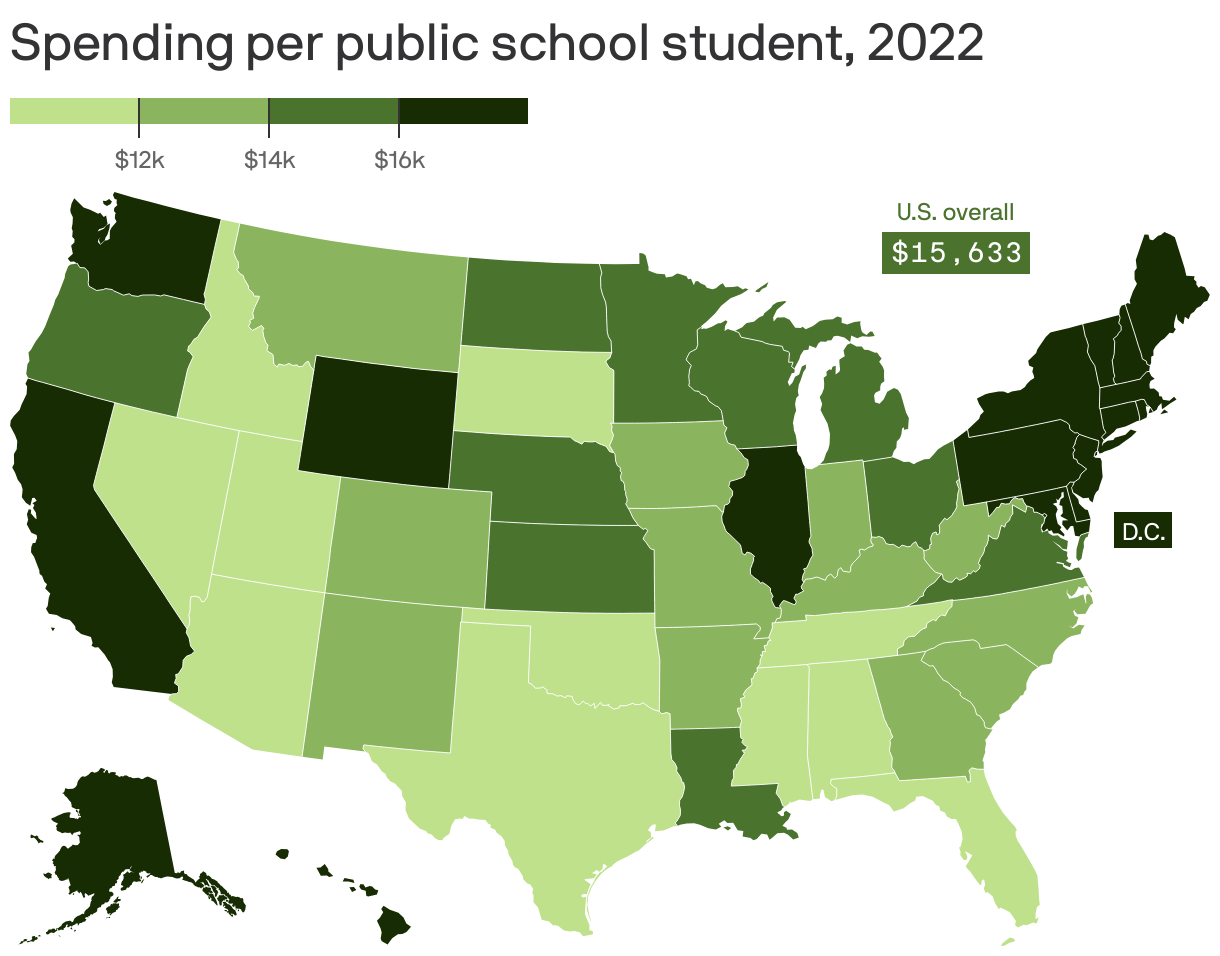
Around 9 in 10 Texas students attend inadequately funded schools, per a report analyzing public school funding nationwide.
Why it matters: Texas ranks in the bottom 10 states in the country for education spending by several measures, including the report by the Albert Shanker Institute, the University of Miami and Rutgers University.
- The state Legislature hasn't increased per-student funding since 2019, leaving cash-strapped school districts to consider deep budget cuts to make ends meet.
How it works: Per-student funding is set by the Legislature using a formula.
- The state's basic allotment is $6,160 per student and can be higher based on characteristics of the district, including family income and the number of students who need accessible education.
- Local property taxes also contribute to a district's overall funding.
Zoom in: Dallas ISD had a $40 million shortfall for 2023-24 and projects a $188 million deficit for 2024-25, officials tell Axios.
- Teacher salaries, security mandates and inflation-related spending, and the number of seniors graduating "career, college and military ready" have all increased at Dallas ISD in recent years, superintendent Stephanie Elizalde tells Axios.
- "About the only thing that isn't up is the money that the state gives us to teach the children," Elizalde says.
Threat level: Districts are spending more on maintenance, health care, food services, custodial work and utilities because of inflation.
- Texas schools received $19.2 billion of federal COVID funding, which ends in September.
- The state Legislature hasn't increased per-student funding for districts with compounding financial woes.
Meanwhile: Several legislative sessions last year focused on a voucher-like proposal to provide public funding for private school tuition. It didn't pass.
- Gov. Greg Abbott and Republican leaders are pushing again to pass a voucher bill when the Legislature reconvenes next year.