Nearly 10 percent of North Texas households are multigenerational

Add Axios as your preferred source to
see more of our stories on Google.
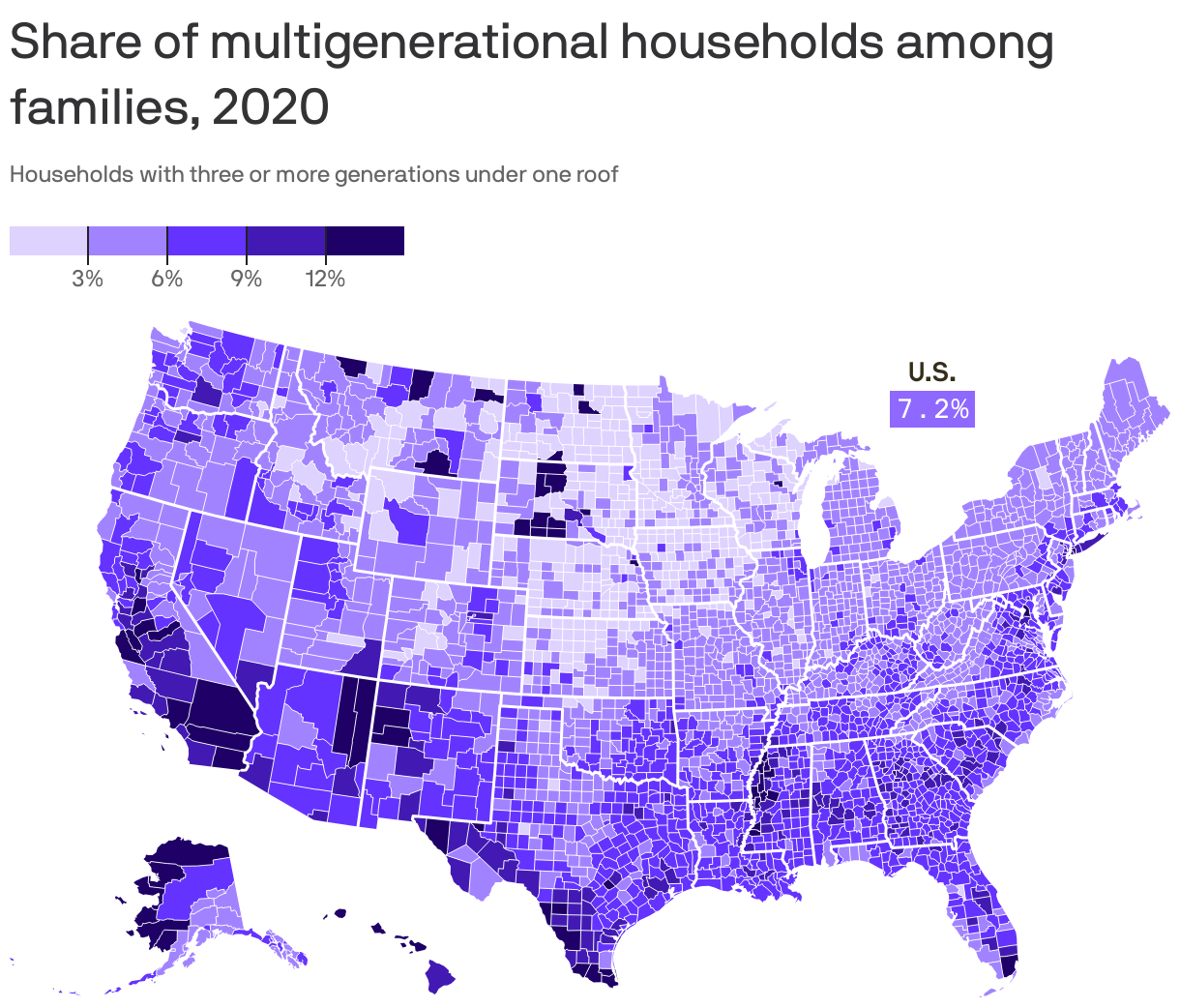
Multigenerational households — three or more generations under one roof — are on the rise in the U.S. and make up a sizable percentage of the population in North Texas.
Why it matters: Living close to family or friends can improve your health and happiness.
- Plus, in some cultures, living with your parents is totally normal.
The big picture: The rising costs of housing and living could be driving the rise in multigenerational living.
- Financial concerns and caregiving needs are two of the major reasons that people cite for living with their parents (and parents' parents).
Zoom in: The share of multigenerational households in North Texas counties ranges from almost 6% to 10%, per U.S. Census Bureau figures.
- Nearly 10% of households in Dallas and Kaufman counties were multigenerational in 2020. That's 61,446 households in Dallas County.
- Almost 9% of households in Tarrant County were multigenerational.
Zoom out: There were 6 million multigenerational households in the U.S. in 2020, up from 5.1 million in 2010, according to Census Bureau data.
- Asian, Black and Hispanic Americans are more likely than white Americans to live in multigenerational family households, per a 2022 analysis by Pew Research Center.
- Immigrants are also more likely to live in multigenerational households compared to U.S.-born people, the analysis found.
Flashback: Residual repercussions of the 2008 Great Recession could have also contributed to the rise in multigenerational households, University of Texas at San Antonio demography professor Rogelio Saenz tells Axios.
- He says it "disrupted" the route into the workforce for many millennials and could have had a negative impact on employment and educational attainment.
Reality check: Saenz points out that living with family can offer advantages in terms of financial and emotional support, but he underscores a gender inequality issue, noting that women often assume the primary caregiving responsibilities for children and older family members.
- "The physical and emotional toll of caregiving can impact the well-being of those involved," he says.