Federal EV tax credits expire, but Ohio offers no relief


Add Axios as your preferred source to
see more of our stories on Google.
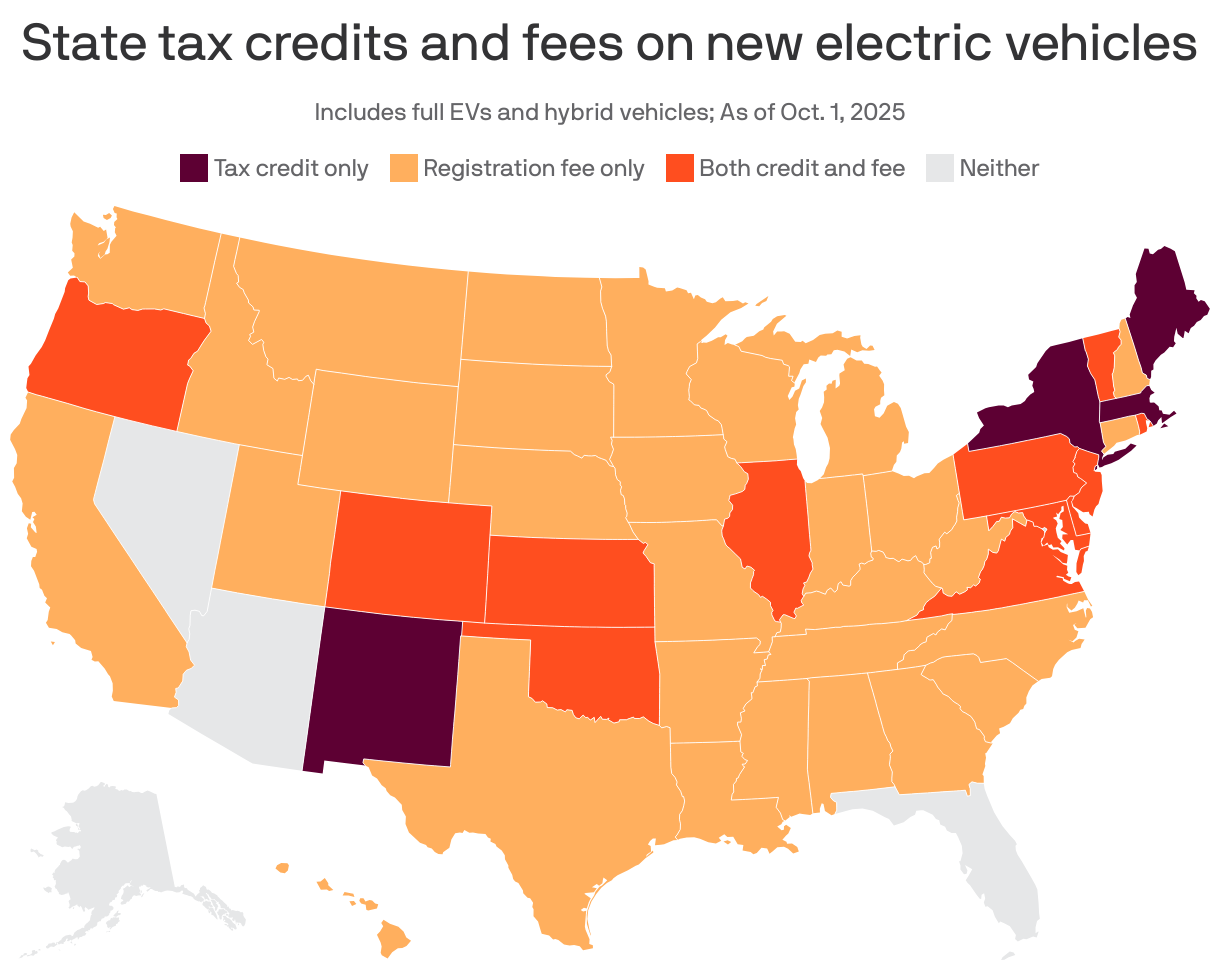
Federal tax credits for electric vehicle purchases are dead, and there's no state tax break to speak of in Ohio.
Why it matters: The rewards and penalties on EVs reflect an industry in flux, as policymakers try to balance environmental goals with the need to pay for roads and other critical infrastructure.
State of play: Biden-era federal tax credits on EV purchases — up to $7,500 for new EVs and up to $4,000 on pre-owned EVs — were killed by Congress, effective Sept. 30.
- Buyers rushed to take advantage of the expiring federal credits, leading many forecasters to predict an immediate drop in EV sales.
- The numerous states with continuing incentives hope they'll sustain some level of sales momentum.
Yes, but: Ohio doesn't have any, and its fees can run counter to increasing EV adoption, note researchers at the Tax Foundation, a nonpartisan think tank that mostly supports lower taxes.
- Ohioans pay a $200 annual EV registration fee, $150 for plug-in hybrids and $100 for hybrids.
Context: In car sales platform Carvana's 2024 state-by-state breakdown, EV sales in Ohio accounted for just 2.9% of used car sales.
- That was lower than the national average (4.3%) and significantly behind EV hot spots that approached 10%.
What we're watching: State lawmakers are once again pushing back with a bipartisan proposal to eliminate the $100 hybrid fee.
The big picture: States fund most of their road and infrastructure budgets with revenues from federal and state gasoline taxes.
- But that income isn't enough to meet rising costs, and the funding gap will keep growing as cars get more efficient and EV ownership grows.
- Since EV owners don't pay gas taxes, states like Ohio levy the extra fees to ensure they pay their share for road maintenance.
Between the lines: Ohio's lack of EV tax credits may be par for the course, but our EV infrastructure lags far behind other states.
- As of January, our 15.5 charging stations per 100,000 residents was far behind the top states, and even neighbors like Michigan and Pennsylvania.
- To close the gap, some Central Ohio suburbs are taking matters into their own hands.