Ohio lags behind in EV charging stations


Add Axios as your preferred source to
see more of our stories on Google.
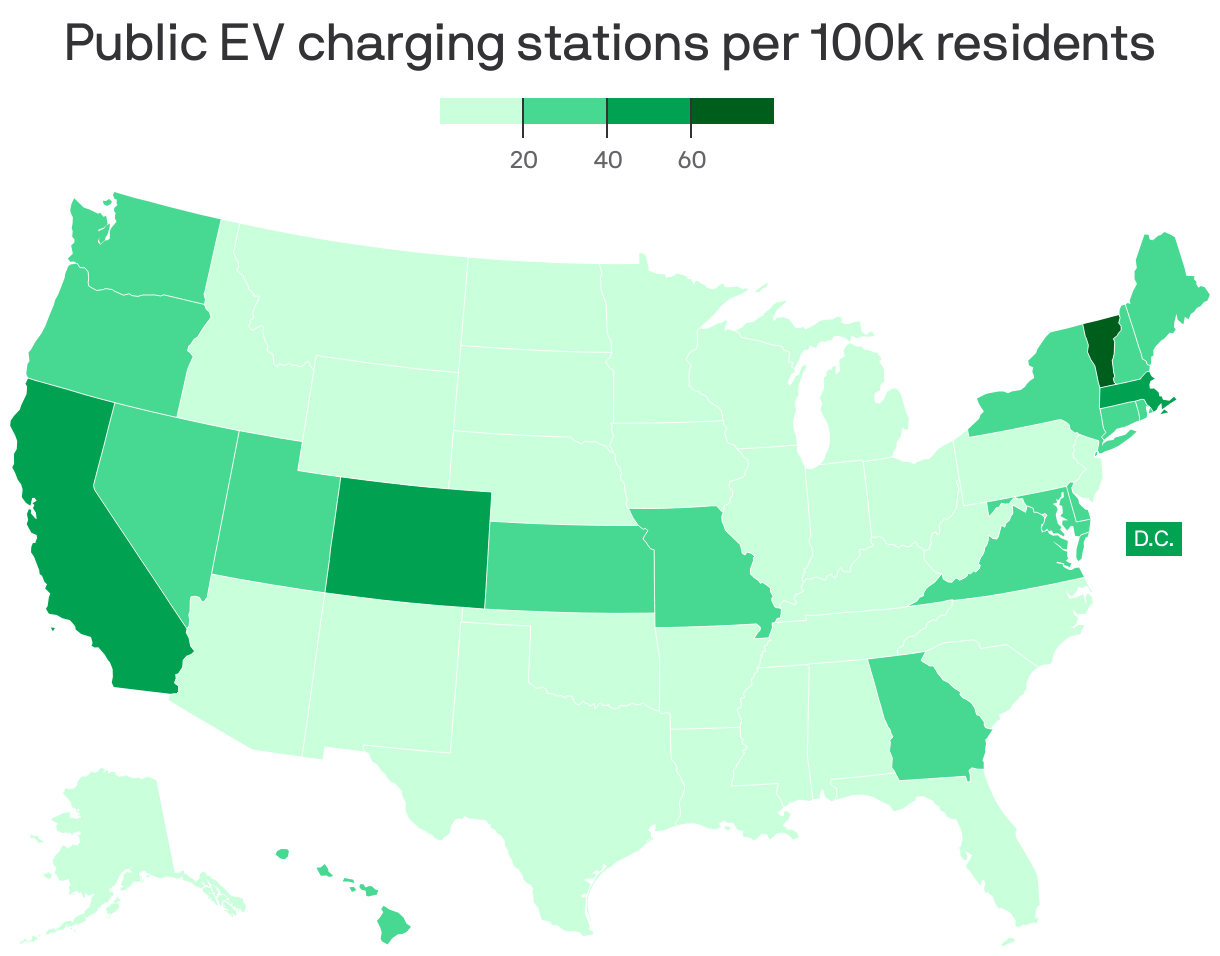
The number of public electric vehicle chargers doubled nationally during the Biden administration, but Ohio still lags behind many states in charging station availability.
Why it matters: As cities and regional agencies work to catch up, the U.S. is far short of the estimated 1.2 million public chargers the National Renewable Energy Laboratory says will be needed by 2030 to support expected EV sales.
By the numbers: There are more than 207,000 public EV charging ports in America today — up from around 95,000 when President Biden took office in January 2021.
- Ohio's 15.5 charging stations per 100,000 residents is far behind the top states — like Vermont (71.5), California (46.8) or Colorado (41.9) — and is lower than comparable neighbors like Michigan (17) and Pennsylvania (16).
Zoom in: Local governments are working to close gaps and put EV infrastructure in place, but it's a slow process.
- The Mid-Ohio Regional Planning Commission received a $15 million federal grant last year to install charging stations at 62 locations across 13 counties.
- Meanwhile, communities like Hilliard, Grove City and Worthington are chipping away by adding as few as two public EV stations at a time.
The big picture: Incentivizing the shift from gasoline-powered cars to battery-electric vehicles was a key part of Biden's climate agenda.
- It's been a chicken-and-egg problem. People won't buy an electric car unless they're confident they have somewhere to charge it.
- But companies won't invest in charging infrastructure without enough EV owners to plug in.
- Biden pushed a variety of policies with the intent to make EVs account for 50% of new car sales and install 500,000 chargers by 2030 — a goal supported, in part, by $7.5 billion allocated by Congress under the bipartisan infrastructure act.
Yes, but: President Trump, in his first day in office Monday, signed an executive order aimed to halt much of those policies, including funding for charging stations.
Reality check: EV sales are growing, but far off the expected pace.
- Only 8.1% of new car sales in 2024 were EVs, according to Cox Automotive, a record of 1.3 million EVs sold.
- A flood of new, more affordable models could help keep that going — even if Trump kills the consumer tax credits as expected.
Editor's note: Cox Automotive and Axios are both owned by Cox Enterprises.