Trump's end to "EV mandate" could weaken automakers against China

Add Axios as your preferred source to
see more of our stories on Google.
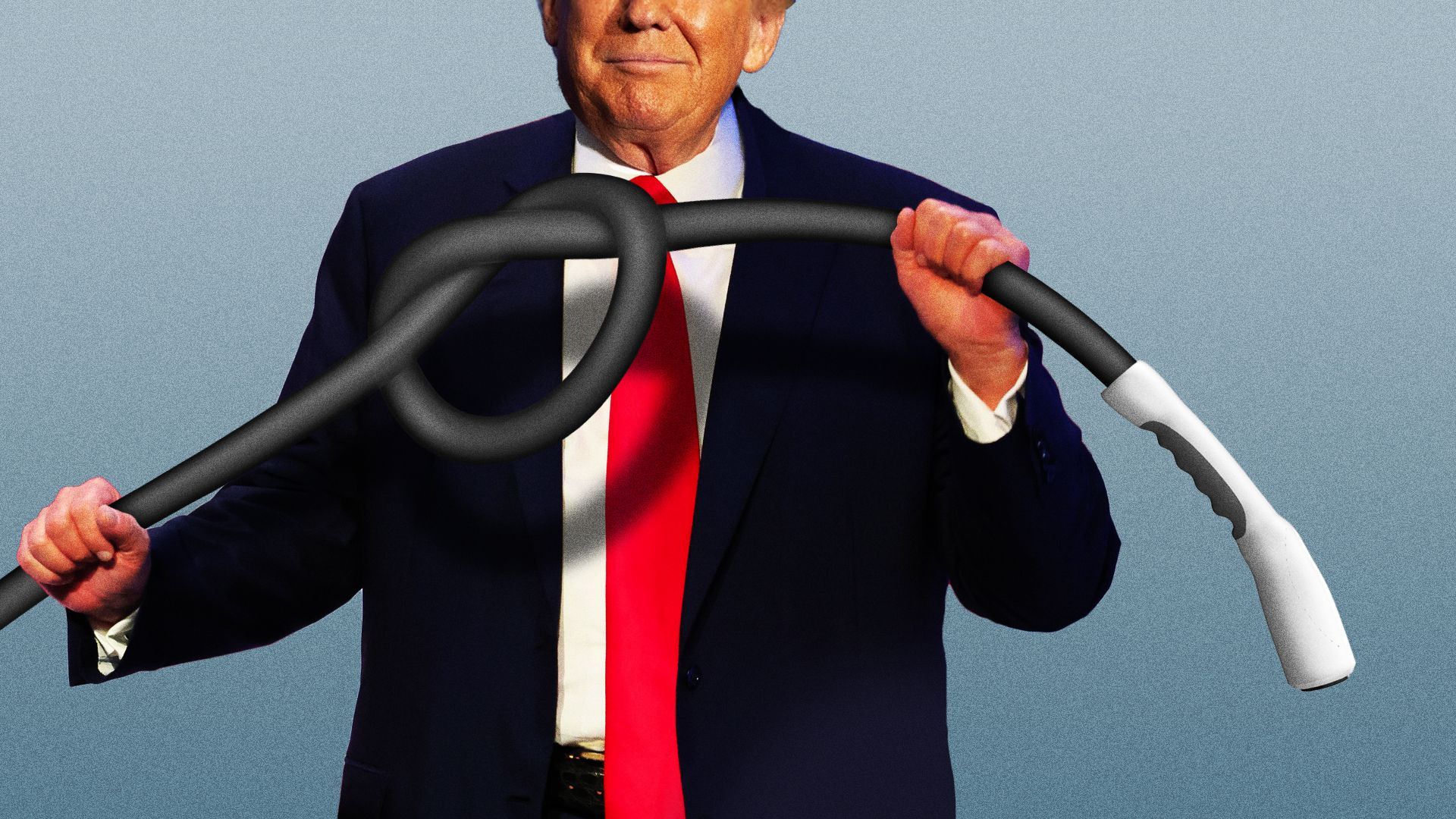
Illustration: Maura Losch/Axios. Photos: Michael Santiago/Getty Images and Scott Eisen/Getty Images
President Trump's order to revoke what he calls the "EV mandate" gives automakers a welcome reprieve from regulatory hurdles — but could make it harder for them to compete on a global scale with Chinese rivals.
Why it matters: The rise of lower-cost Chinese manufacturers is an existential threat to U.S. car companies that are already in the midst of a once-in-a-century transformation.
- Trump's policies, while meant to help the domestic industry, could leave it fighting China globally with one hand behind its back.
Driving the news: Just hours after taking office Monday, Trump signed a broad energy-focused directive that includes a plan to "eliminate the electric vehicle (EV) mandate" — ostensibly to give consumers more choices.
- Trump revoked a 2021 executive order from President Biden that aimed to make 50% of new vehicle sales electric or plug-in hybrid by 2030.
- He also halted distribution of unspent government funds for EV charging stations and said the U.S. would terminate the EPA waiver that allows California and 11 other blue states to phase out gas-powered cars by 2035.
- Not specifically mentioned, but also likely to end: $7,500 tax credits for EV buyers and sharply stricter rules on tailpipe emissions that would necessitate more EVs starting in 2027.
What they're saying: Industry leaders loved Trump's unwinding of prescriptive policies that they say distort the U.S. market.
- "Artificial government mandates and subsidies are not working," Toyota told Axios in a statement.
- John Bozzella, president and CEO of the Alliance for Automotive Innovation, cited a mismatch between EV demand and sales targets built into current regulations.
- "There's a saying in the auto business: You can't get ahead of the customer," he said.
Between the lines: Automakers aren't thrilled if EV tax breaks go away, but the impact is small since only about 15 models qualify.
- They're more worried about defending the far richer production tax credits for EV and battery manufacturing in the U.S., which are worth billions of dollars and critical to making EVs profitably.
- They're waiting to see if Trump's administration rewrites the tax credits' guidance or otherwise makes the credits difficult to access.
- "Many of our plants in the Midwest that have converted to EVs depend on the production credit," Ford CEO Jim Farley told reporters at the recent Detroit auto show. "We would have built those factories in other places, but we didn't ... It changed the math for a lot of investments."
Zoom out: Regardless of what happens with U.S. policy, however, the auto industry is a global one.
- EVs are coming — much sooner in other parts of the world.
- If the U.S. wants to be a global leader, automakers must somehow match their lower-cost Chinese competitors, whose head-snapping growth is already upending the industry.
The big picture: About half of cars sold in China are electric or plug-in hybrids.
- Carmakers in China are heavily supported by government subsidies, and most of the EV battery supply chain is based there.
- That gives companies like BYD, Geely and SAIC huge cost advantages that they've leveraged through global exports.
- Chinese cars aren't sold in the U.S., and a newly enacted ban on software from China will likely keep it that way.
- But Chinese brands are rapidly expanding across Southeast Asia, Africa, Latin America, the Middle East and Europe. Even in Mexico, one in five cars is now made in China.
State of play: For the rest of the industry, that's going to require further belt-tightening, more innovation and increased collaboration to help shoulder the investment burden of new technologies.
- Ford has a "skunkworks" project under way in California to develop a new low-cost EV platform. The first model, a medium-sized pickup truck, will debut in 2027.
- General Motors is building a vertical EV supply chain to lower costs and control risks, and is also partnering with Hyundai for better global purchasing clout.
- Alliances are popping up everywhere: including Volkswagen's investment in Rivian and Honda's plan to merge with Nissan and Mitsubishi.
- "One of the reasons we're so committed to making our business more efficient is because we can't count on government actions to save our business," General Motors CEO Mary Barra told me onstage at an Automotive Press Association event in December.
- And Ford's Farley told reporters: "We have to get our company fully fit to compete globally with the Chinese OEMs."
The bottom line: Taking regulatory pressure off carmakers isn't going to help that effort.
