How states' EV tax policies stack up after U.S. credits end

Add Axios as your preferred source to
see more of our stories on Google.
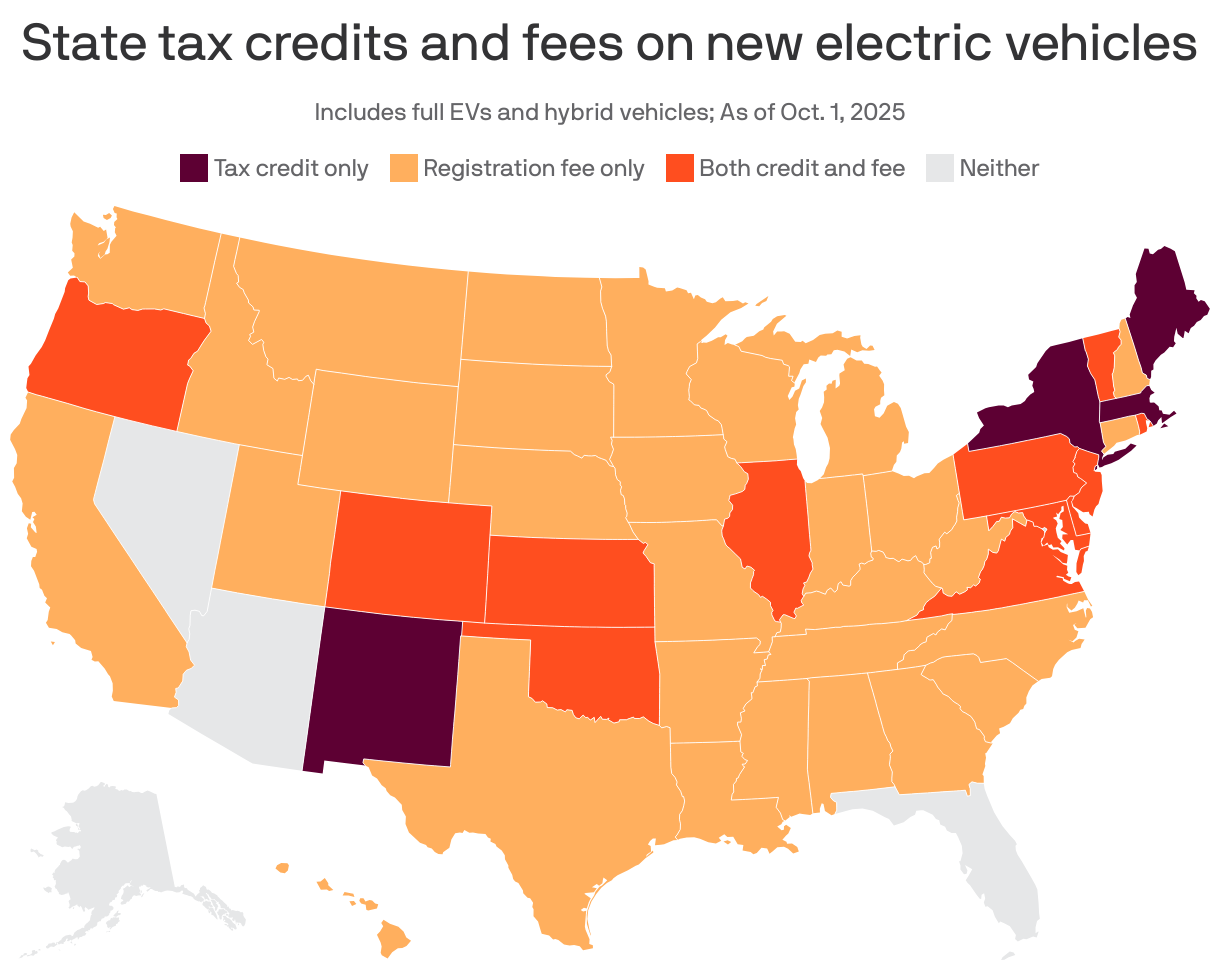
Federal tax credits for electric vehicle purchases may be dead, but depending on where you live, you might still get a sizable state tax break on your EV.
- But be prepared to pay a higher vehicle registration fee than your neighbor who drives a gasoline-powered car.
Why it matters: The rewards and penalties on EVs reflect an industry in flux, as policymakers try to balance environmental goals with the need to pay for roads and other critical infrastructure.
Catch up quick: Biden-era federal tax credits on EV purchases — up to $7,500 for new EVs and up to $4,000 on pre-owned EVs — were killed by Congress, effective Sept. 30.
- Buyers rushed to take advantage of the expiring federal credits, leading many forecasters to predict an immediate drop in EV sales.
- Some states hope their continuing incentives will help sustain at least some level of sales momentum for EVs.
Yes, but: Tax credits and rebates aimed at increasing EV adoption sometimes run counter to other fees levied against EV owners, note researchers at the Tax Foundation, a nonpartisan think tank that mostly supports lower taxes.
The big picture: States fund most of their road and infrastructure budgets with revenues from federal and state gasoline taxes.
- But that income isn't enough to meet rising costs, and the funding gap will keep growing as cars get more efficient and EV ownership grows.
- Since EV owners don't pay gas taxes, many states have levied extra fees on battery-powered cars to ensure they pay their share for road maintenance.
Driving the news: Colorado is one example of how states are threading the needle on EV policies.
- After the federal tax credits ended, the state said it would increase EV subsidies for low- and middle-income drivers who trade in an old gas-guzzler.
- Starting in November, eligible buyers can get a $9,000 rebate on a new EV (a $3,000 increase) and $6,000 on a used EV (up from $4,000) when they trade in an old car with high CO2 emissions.
The change comes even as the state's broader EV tax credits are set to shrink next year, from $3,500 to just $750 on EVs priced up to $80,000.
- Buyers of cheaper EVs (priced below $35,000) will get a tax credit of $3,250, down from the current $6,000.
And yet EV owners must pay an extra $60.05 annual registration fee in Colorado.
Where it stands: Forty states impose a higher vehicle registration fee for EVs and hybrids to offset lost gas tax revenue, according to the Tax Foundation.
- These fees range from $50 in Hawaii and South Dakota to $260 in New Jersey.
- 17 states offer state tax incentives for EV purchases, ranging from a $1,500 tax credit in Rhode Island to a $7,500 credit in Oregon and Maine.
- 12 states have both a higher registration fee and a credit; 4 states have neither.
What they're saying: "State leadership on clean transportation is more important than ever as the federal administration props up the fossil fuel industry at the expense of our economic well-being and health," Eric Willadsen, a Sierra Club strategist, tells Axios.
- The group doesn't support higher EV registration fees, however.
- "We should be incentivizing and rewarding people who choose to drive electric, not slapping them with unfairly punitive fees," Willadsen says.
What to watch: Some experts say a better way to pay for roads is to institute a vehicle miles traveled (VMT) tax to charge everyone based on how much they drive.
- Four states — Oregon, Utah, Virginia and Hawaii — currently have VMT tax programs, and others are discussing it.
- There are technical and privacy challenges, however, and some environmentalists worry new fees would slow the adoption of EVs.
