What to know about Ohio's latest redistricting fight

Add Axios as your preferred source to
see more of our stories on Google.
Illustration: Brendan Lynch/Axios
It's crunch time again for congressional redistricting in Ohio, with state lawmakers facing their first deadline Tuesday to approve a new, bipartisan map — and Republicans yet to release a proposal.
Why it matters: Congressional redistricting is the process of redrawing the boundaries used to elect Ohioans to the U.S. House of Representatives starting in 2026.
- If there is gerrymandering, when politicians manipulate boundaries to favor their party, that will impact whether voters' preferences are heard in future elections.
Friction point: Ohio's current map disproportionately favors Republicans, who hold 10 out of 15 seats (66%), despite receiving about 56% of the vote in 2022.
- They're reportedly eyeing new maps with 12 or 13 seats.
- Lawmakers are set to meet at 9am Tuesday.
Catch up quick: If you're feeling déjà vu, it's because we were here not too long ago.
- Ohio normally redraws its districts every 10 years, following the release of census data, to better reflect the state's current population.
- But officials must do so early because the current map, enacted in 2022, didn't have the bipartisan support our state constitution requires.
How it works: Maps with bipartisan support remain the full 10 years, while those without only last four years.
- The redrawing process has several stages and deadlines.
This year's timeline: First, the state legislature gets its chance. That's Tuesday's deadline.
- If lawmakers fail to reach a bipartisan consensus with a three-fifths majority, the responsibility shifts to the Ohio Redistricting Commission, with an Oct. 31 deadline and similar bipartisan mandate.
- If unsuccessful, the task goes back to the legislature, with a Nov. 30 deadline and only a simple majority required. But that map would also only last four years.
Reality check: Voters reformed Ohio's redistricting system in 2015 and 2018 in hopes of transparency and compromise.
- But Republicans control the legislature, redistricting commission and Ohio Supreme Court, which rules on map constitutionality.
- If there's another deadlock, it's possible an unconstitutional, gerrymandered map could move forward again anyway like in 2022 — because otherwise, elections could be delayed.
What they're saying: "The real concern about the way Ohio is moving is the thing that drives this process more than anything is partisanship," Kareem Crayton, with the nonpartisan Brennan Center for Justice, tells Axios.
- "The maps aren't reflective of the votes people are casting … or the fact that this is a state where people like choices."
"Republicans will be following the constitution, and when we propose our map, I'm sure we will make it public," said Sen. Jane Timken (R-Jackson Twp.), co-chair of the Joint Committee on Congressional Redistricting, at a recent meeting.
What we're watching: An anti-gerrymandering constitutional amendment failed last November, and there hasn't yet been a push for another attempt.
Why you're hearing so much about redistricting
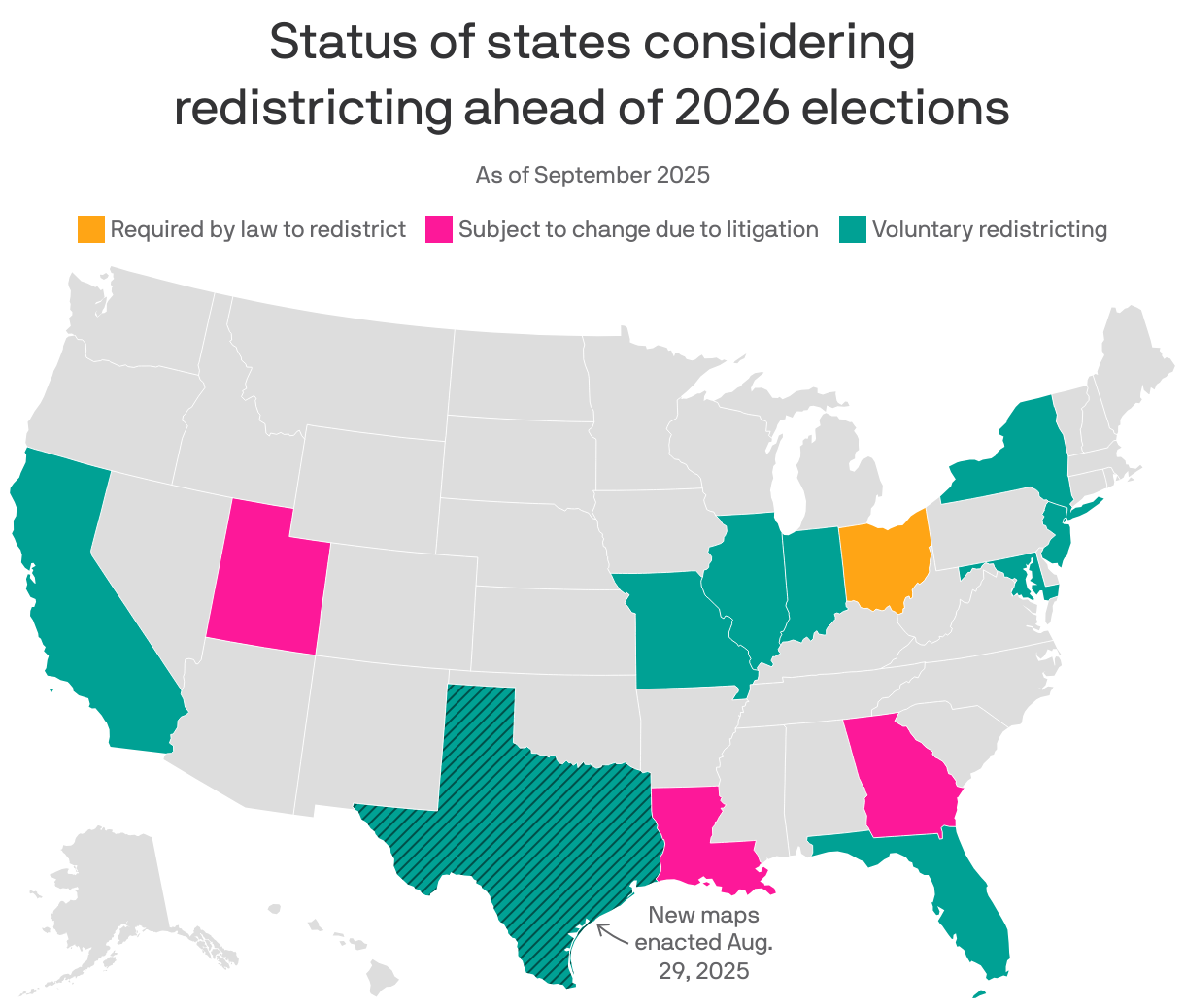
Redistricting is a hot topic right now in many states, but for different reasons than in Ohio, which must redraw its maps this year due to state constitution requirements.
Driving the news: The White House ignited an extraordinary effort this summer to game the system by urging states to voluntarily redraw congressional maps and add Republican seats ahead of the 2026 midterms.
- That push could also impact how Ohio's redistricting efforts play out.
- Crayton called Ohio's situation a "microcosm" of what's happening nationally.
The big picture: Texas approved a new map in August intended to give Republicans five more seats.
- Californians will have a special election Nov. 4 to vote on their own new maps, which could offset that change by adding more Democratic seats.
- Republicans in Missouri and Florida are also making moves.
Some states are meanwhile redrawing their maps due to ongoing litigation.
The bottom line: It could be a while before many voters know the districts where they'll be casting their ballots next year — and gerrymandering seems inevitable.