Who pays the highest taxes — it's not Massachusetts


Add Axios as your preferred source to
see more of our stories on Google.
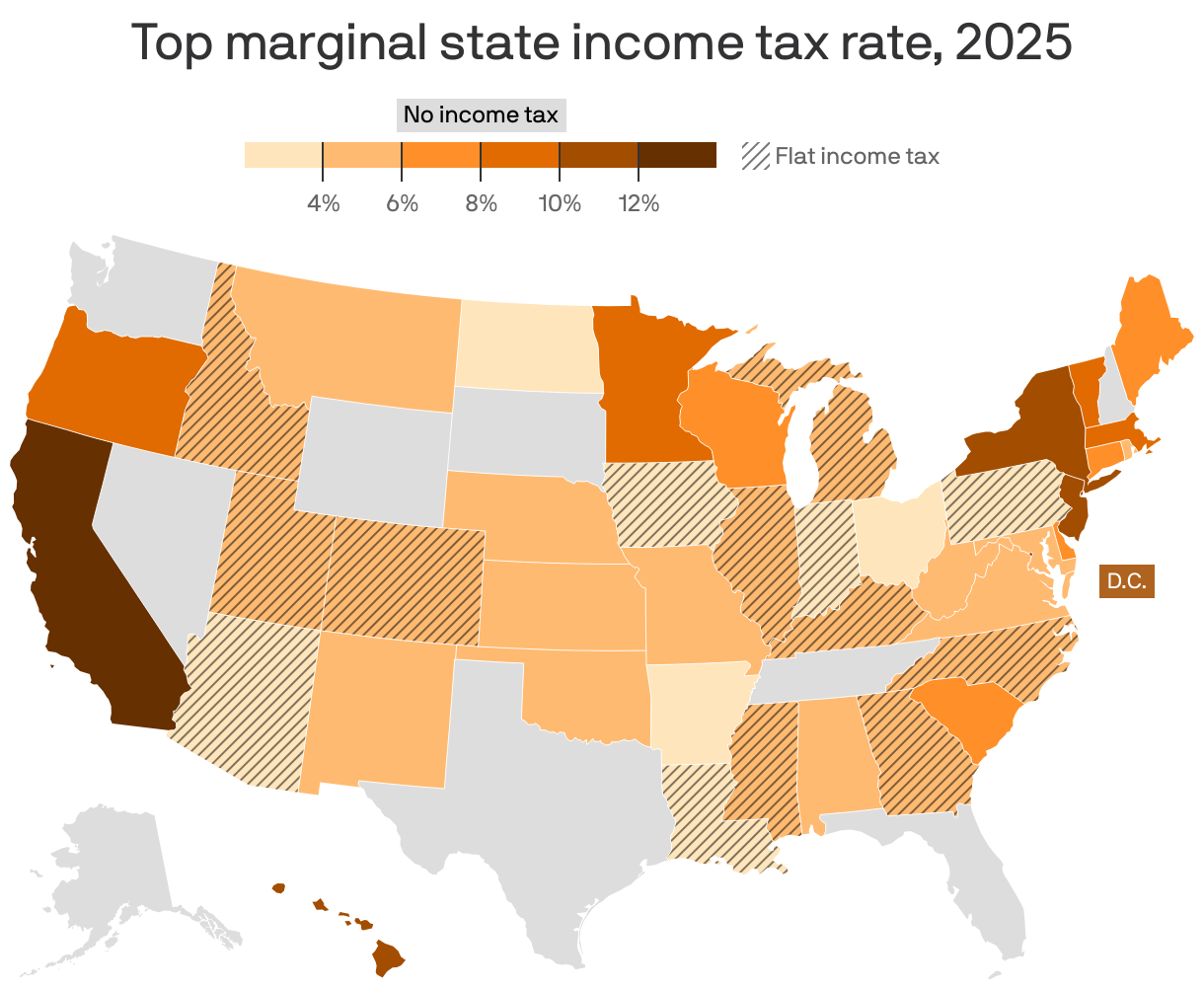
Your annual tax bill depends at least partly on where you live, with state income taxes varying from nonexistent all the way up to nearly 14% for some especially high earners.
Why it matters: Some states with low or no individual income tax, like Texas and Florida, are attracting lots of new residents — but could find themselves in trouble in a world with less federal aid.
- And states on the higher end of the scale — like Massachusetts — face outmigration from the super rich, competition from lower-tax states and a growing affordability crisis.
By the numbers: Massachusetts has a standard flat 5% income tax – putting us on the lower end. But there's an additional hit to some Bay State one-percenters: the 4% surtax charged for income earned over $1 million.
- California (13.3%), Hawai'i (11%) and New York (10.9%) have the highest top marginal income tax rates for individuals.
- Arizona and North Dakota (both 2.5%) have the lowest among states with an income tax.
How it works: That's according to data from the Tax Foundation, a nonpartisan think tank.
- Local taxes, as well as some state-specific taxes in a handful of states and a capital gains surtax on high earners in Minnesota, are not included.
Between the lines: The rates shown in the map above are the highest paid by the residents earning the most money.
- Many states have graduated income taxes, with higher amounts of income taxed at gradually higher rates.
- New York's tax rates, for instance, range from 4% to 10.9%.
The fine print: Other states besides Massachusetts with a flat tax include Arizona, Idaho and Illinois.
- Washington has no general income tax, but it does tax capital gains above a certain threshold.