Colorectal cancer's alarming rise in young Georgia adults


Add Axios as your preferred source to
see more of our stories on Google.
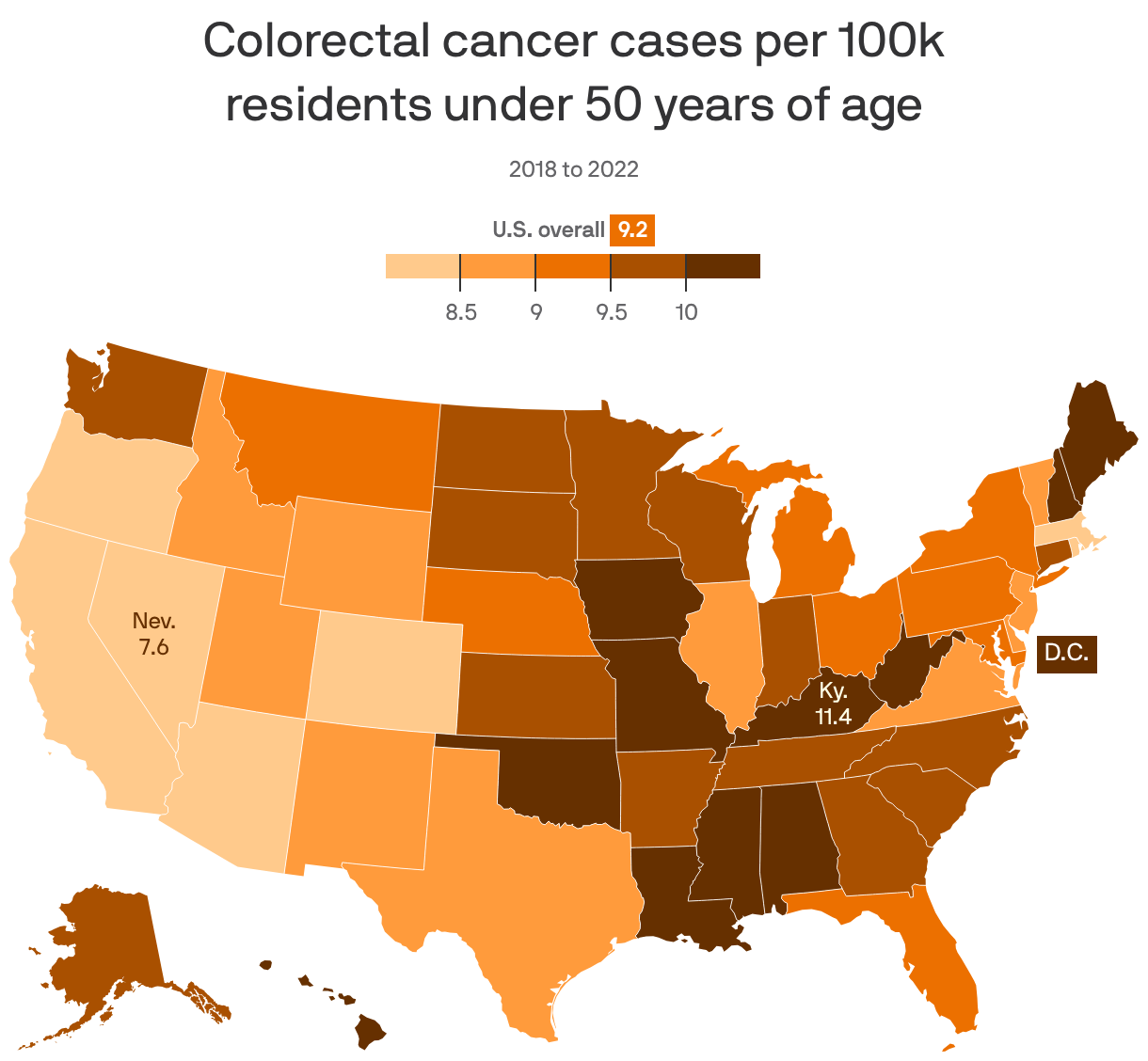
Colorectal cancer is now the deadliest cancer for Americans under 50, per new JAMA research — and cases are rising in Georgia.
Why it matters: Screening more young adults for colorectal cancer could save lives.
- The U.S. Preventive Services Task Force lowered its recommended starting age for colorectal cancer screening from 50 to 45 in 2021, meaning most insurers are now required to cover it starting at that age.
By the numbers: More young people are being diagnosed.
- Colorectal cancer cases in people under 50 have risen nearly 60% since the early 2000s — from about 6.4 cases per 100,000 people to more than 10 — per NCI and CDC data.
- And 3 in 4 colorectal cancer patients under 50 are diagnosed only after the disease has already spread, per the American Cancer Society.
- In Georgia, colorectal cancer cases in people under 50 jumped from around 7 per 100,000 people in the early 2000s to nearly 11.2 in 2022 — per NCI and CDC data. (9.7 is the five-year average that's charted.)
What's happening: "No one is 100% certain" about what is causing the uptick in colorectal cancer cases in young people, says gastroenterologist Austin Chiang.
- "The leading hypothesis is around the environment and ultra-processed foods and something that we're probably eating," he says.
Zoom in: The average screening rate for eligible patients in Georgia is 70%, according to the Georgia Center for Oncology Research and Education. The rate in southwest Georgia is 53% and in southeast Georgia, the rate is 33%.
- Roughly 20% of Georgia adults have never had a colorectal screening test, per a 2024 study in the American Journal of Gastroenterology.
Catch up quick: Colorectal cancer begins as growths called polyps in the colon or rectum. Colonoscopies, which allow doctors to visually scan for and remove those polyps, remain the "gold standard" screening tool available, according to Chiang.
Don't wait until age 45 to get screened if you're experiencing possible symptoms of colorectal cancer before then, Chiang says.
- Symptoms can include: abdominal pain, unintentional weight loss, bleeding, unexplained anemia, and a change in bowel habits.
- For example, your stool becomes "pencil thin" when it wasn't like that before, he says.
What we're watching: Whether AI-assisted colonoscopy devices — which research suggests help spot more precancerous polyps — become standard and prevent more deaths.
- The technology "serves as a second set of eyes for the doctor during the colonoscopy," says Chiang, who uses one such device in his role as chief medical officer at Medtronic.