More pregnant Georgians are skipping prenatal care, CDC finds


Add Axios as your preferred source to
see more of our stories on Google.
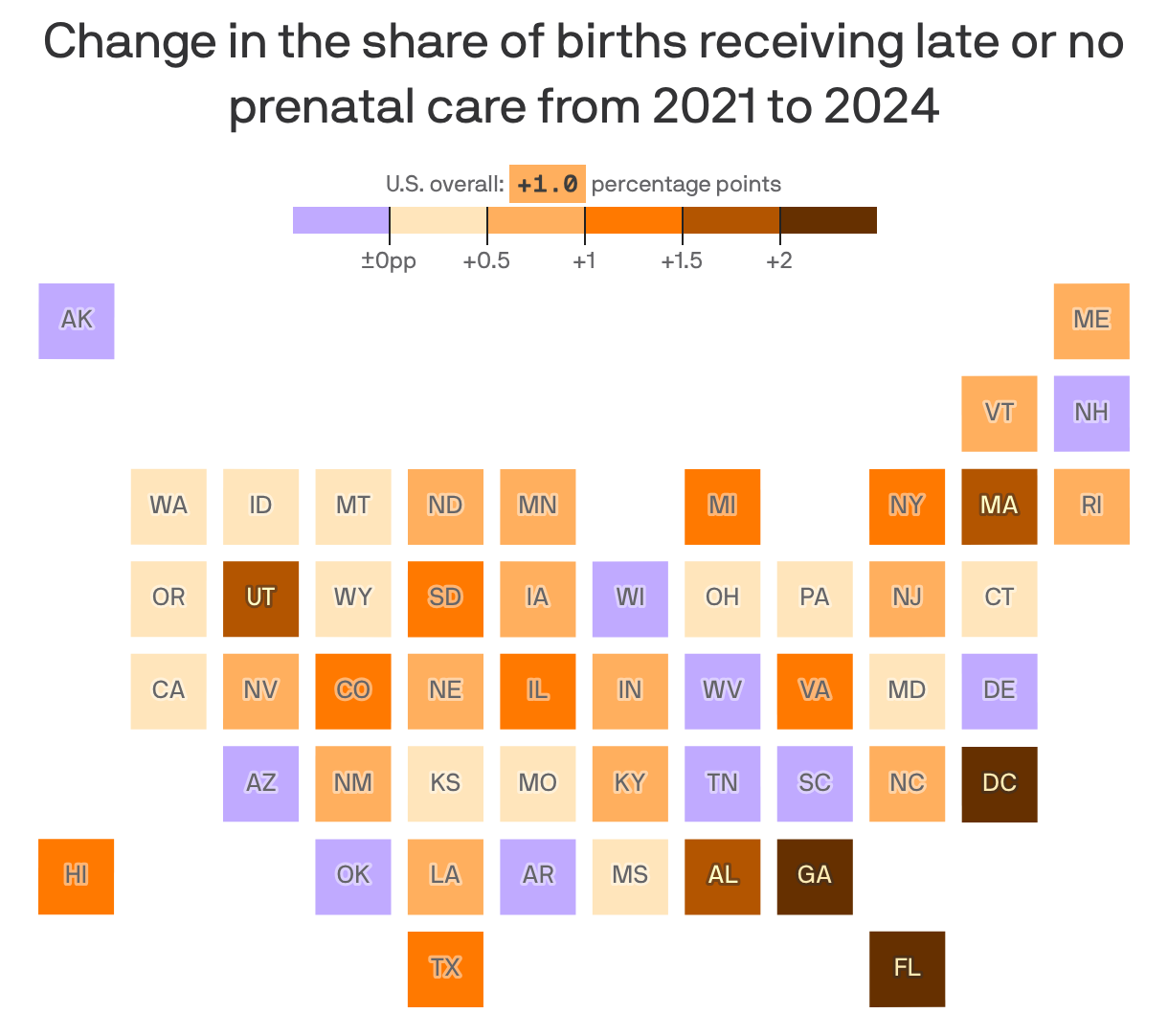
Fewer pregnant Georgians are getting prenatal care in the first weeks of pregnancy — or at all, new CDC data show.
Why it matters: Skipping first-trimester care raises the risk of preventable complications for moms and babies.
By the numbers: First-trimester prenatal care rose from 77.1% of U.S. births in 2016 to 78.3% in 2021 — but slid to 75.5% in 2024, per a CDC analysis of birth certificates.
- In Georgia, those receiving late or no prenatal care increased from 7.9% to 11.4% between 2021 and 2024, a 44% increase, per the CDC data.
- Late or no care increased in at least 36 states and D.C. in that same period — rising nationally from 6.3% to 7.3%.
- The shift spanned every age group and nearly all racial and ethnic groups.
What we're hearing: If caught early, conditions like diabetes and high blood pressure can often be managed to lower risks for mom and baby — sometimes with "easy interventions" like starting aspirin, says Alex Peahl, OB-GYN and ACOG Fellow.
- As more patients enter pregnancy with chronic conditions, early treatment becomes even more critical.
Between the lines: The growing number of maternity care deserts and hospital closures are the main drivers of the uptick in Georgia, state Department of Public Health spokesperson Nancy Nydam Shirek told Axios.
- 82 counties currently have no OB/GYNs, Nydam said, citing the Georgia Board of Health Care Workforce. 108 counties have no labor and delivery facilities.
Zoom in: DPH's free home visit program aims to connect pregnant moms and babies with nurses for the basic check-ups and check-ins that can catch problems early.
- Home visits, which are meant to complement, not replace, OB/GYN visits, are now available in 75 counties. The state will add 21 more counties in the upcoming fiscal year.
The state is also investing in workforce development, including a new medical school in Athens, to increase the number of health care professionals in Georgia.
What we're watching: Whether health systems respond to access pressures by adopting any of ACOG's new tailored prenatal care guidance — coauthored by Peahl — such as streamlining prenatal care for low-risk patients into only eight to nine visits.