30-somethings nudge U.S. birth rate off record low

Add Axios as your preferred source to
see more of our stories on Google.
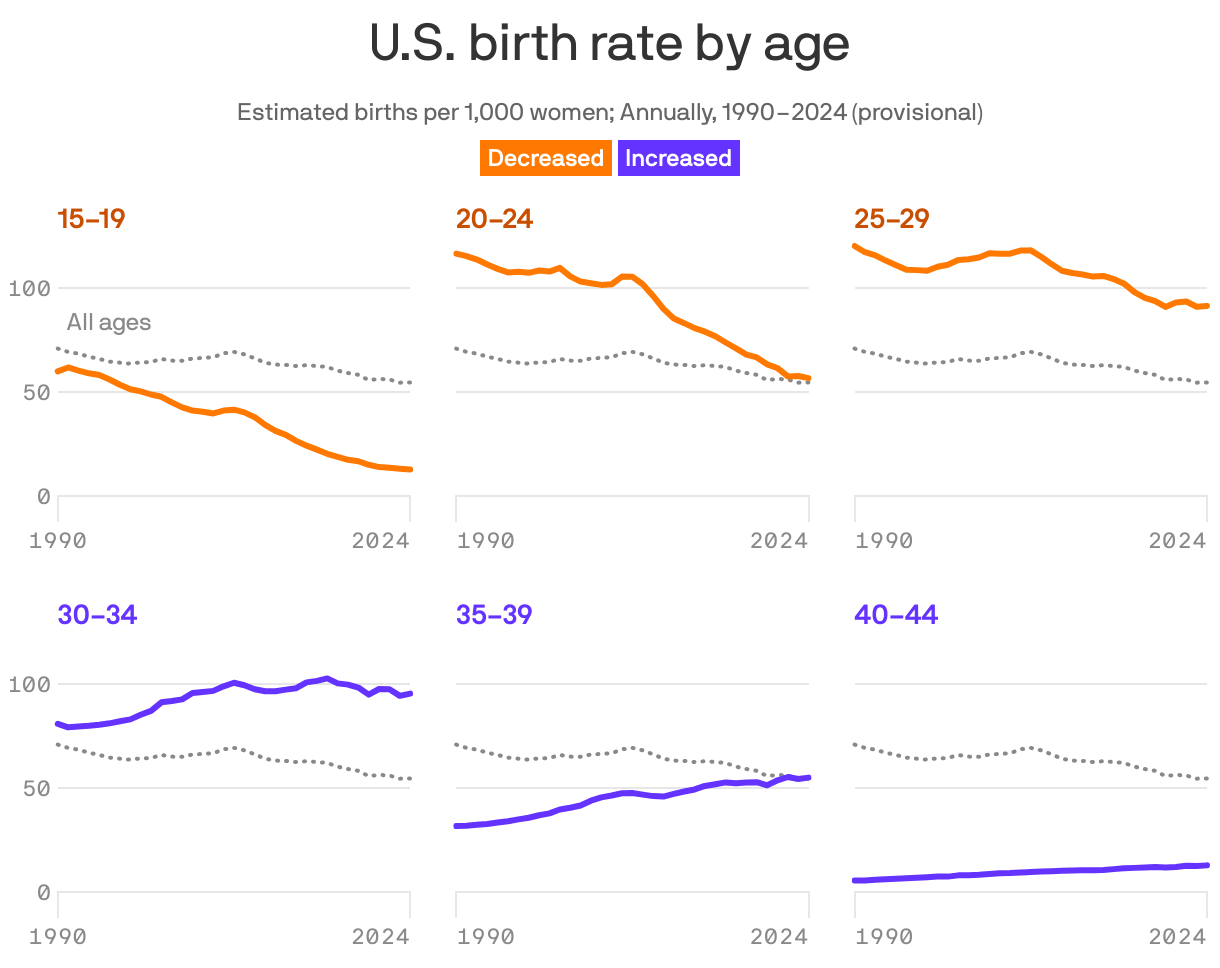
With more people delaying parenthood thanks to increased access to reliable birth control and fertility treatments, older moms are having more babies.
Why it matters: Although it's become more common, getting pregnant at "advanced maternal age" isn't always easy.
By the numbers: The birth rate for teenagers and women in their early 20s dropped to record lows in 2024, as the birth rate for women over 30 rose, according to provisional CDC data released Wednesday.
- Women aged 30-34 had a higher birth rate (95.4 per 1,000 women) than those in their late 20s (91.4).
- Reality check: Although the number of overall births rose 1% from 2023 to 2024, that's an increase from the nation's lowest fertility rate in nearly a century.
The big picture: Since the first IVF baby was born nearly 50 years ago, we've made big breakthroughs in understanding and treating infertility — and giving people options if they choose to delay parenthood.
- Egg freezing, in-vitro fertilization (IVF), intrauterine insemination (IUI) and even uterine transplants have become more common.
- Plus, we have a better understanding of how lifestyle affects fertility in both men and women.
Today, many hopeful parents, especially those over 35, can have babies through medical advancements that seemed like science fiction a generation ago.
"Fertility declines with age, but 35 is not a cliff by any stretch," Emily Oster, an economist and bestselling author of pregnancy and parenting books, tells Axios.
- "Plenty of people have kids in their late 30s, but it might take a little more work and you might want to be thoughtful about your timing," says Oster, who recently launched a "trying to conceive" (TTC) section on her ParentData website.
Knowing about fertility barriers ahead of TTC could encourage hopeful older parents to address a medical issue and/or freeze eggs for IVF early on — giving them a better shot at pregnancy.
- It remains unclear whether access to IVF will be affected by recent reproductive health funding cuts and legislative battles.
Yes, but: Even with new fertility technology and planning ahead, infertility can't always be overcome.
Tips to getting pregnant
Here's what prospective older parents can do to learn whether they have fertility roadblocks — and get pregnant more easily when they're ready:
Track their cycle.
- If women knew earlier whether they had a normal menstrual cycle, it could save them from finding out too late that they have a condition, such as endometriosis or PCOS, that can interfere with getting pregnant.
- And being educated on when they ovulate could prevent hopeful moms from reaching a point where "they're now 34½ and realize, 'Oh, I was having sex at the wrong time for the last five months, and now I've lost five months of good fertility," Oster says.
Boost sperm health.
- Unlike eggs, sperm is produced continuously — and certain habits could help improve its quality.
- Men should limit heavy drinking, heavy marijuana use and heat, like tight underwear and hot tubs, Oster says.
More from Axios:
