Georgia once again receives an F in preterm birth report


Add Axios as your preferred source to
see more of our stories on Google.
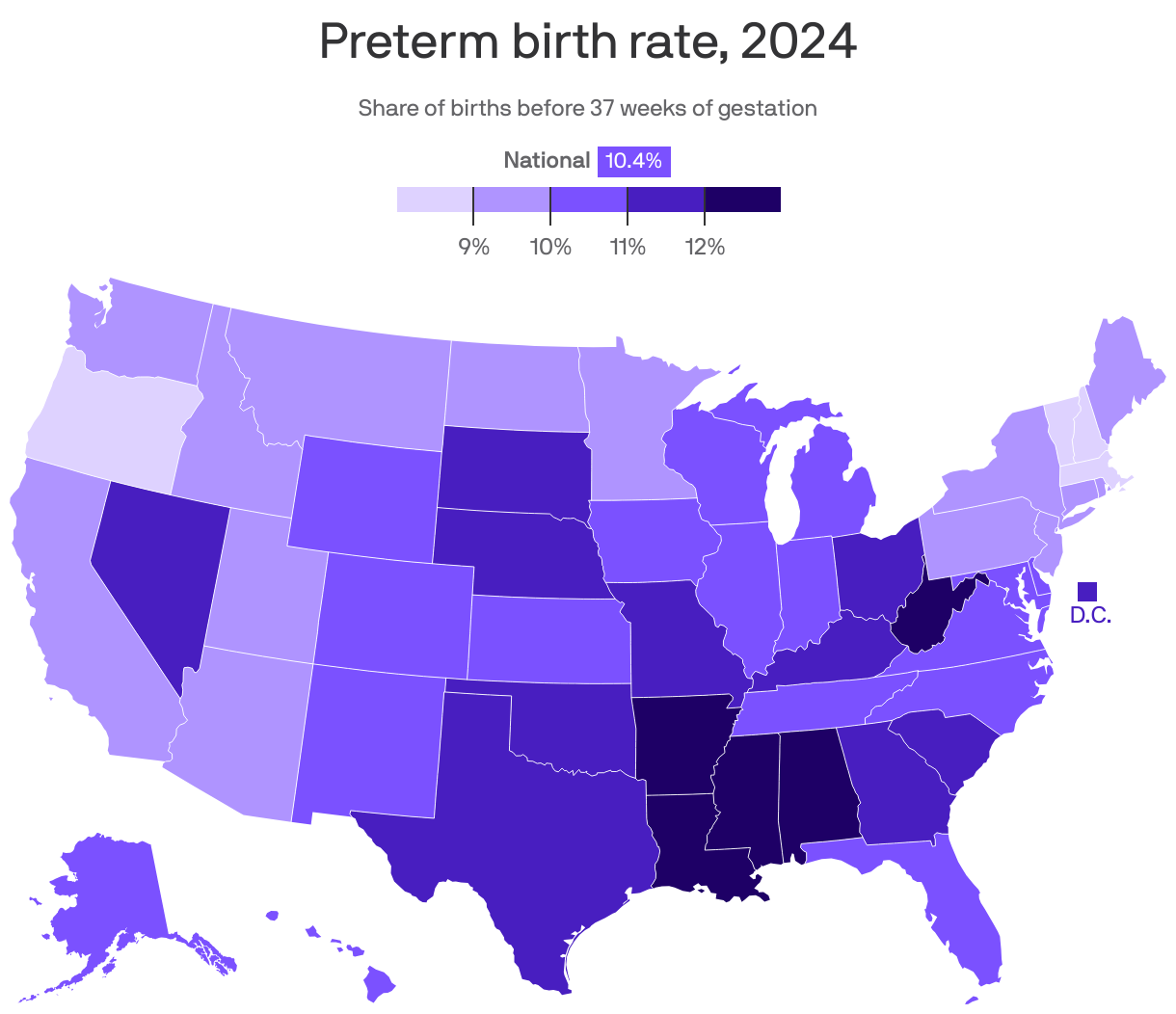
Georgia's preterm birth rate did not change from 2023 to 2024, according to an annual report from March of Dimes — but that's not exactly good news.
Why it matters: The report underscores persistent gaps in equity, access and maternal care. It should be a "wake-up call" that change is needed in the U.S., said Michael Warren, the chief medical and health officer of March of Dimes, a nonprofit focused on ending preventable preterm birth and infant death.
Driving the news: Georgia's preterm birth rate in 2024 was 11.8%, the same failing grade it received in 2023, according to the March of Dimes report card.
- The national rate was 10.4%, earning the U.S. a D+ for the third straight year.
- Georgia ranks 45th out of 52 (including all states, the District of Columbia and Puerto Rico).
Context: Preterm babies — born before 37 weeks of pregnancy — may not be fully developed at birth, leading to more health problems.
Zoom in: The racial and ethnic disparities in preterm birth rates are also jarring in Georgia.
- The rate for Black mothers is 15.1%, followed by Pacific Islander (10.6%), white (10.3%), American Indian/Alaska Native (10%), Hispanic (9.9%) and Asian (9.7%) mothers.
- Medicaid recipients (13.3%) also have higher rates, followed by the 10.9% who have private insurance and the other 9.9% who have other plans.
The big picture: Although 19 states improved their preterm birth percentages, 21 states worsened, per the report that relies on CDC data.
- South Dakota saw the biggest rate decrease (10% lower), while D.C. saw the steepest rate increase (8% higher).
- New Hampshire received the best grade: an A- for its 7.9% preterm birth rate. And Mississippi got the lowest: an F for its 15% rate.
The fine print: The grades are calculated based on how far away they are from a goal rate of 8.1%.
Between the lines: There are also major infant health discrepancies at the national level when it comes to race, Warren tells Axios.
- 9.5% of babies born to white mothers were preemies.
- 14.7% of babies born to non-Hispanic Black mothers were preemies.
What we're hearing: "There's no biological reason" for the major state and racial differences in preterm birth rate, Warren says.
- Instead, factors like poverty, housing stability and discrimination influence these health outcomes, he says.
- Many expectant mothers lack access to maternity care services and may skip prenatal visits and other appointments.
- A separate March of Dimes report found that more than a third of U.S. counties lack a single obstetric clinician.
What we're watching: Whether funding cuts from President Trump's "big, beautiful bill" lead to more maternity care deserts across the country.