How "big beautiful bill" tax cuts could affect Georgians

Add Axios as your preferred source to
see more of our stories on Google.
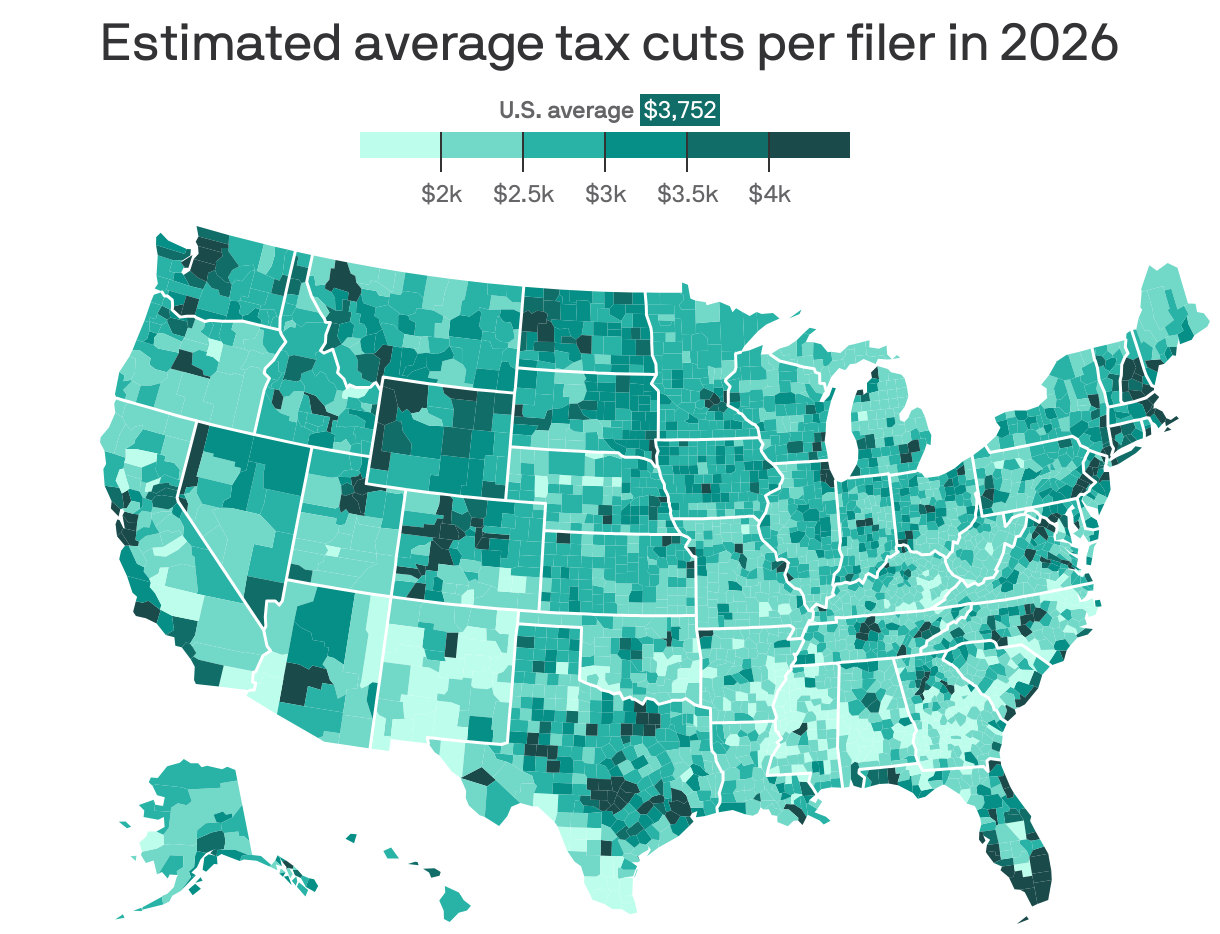
The average Fulton County resident will see a federal tax cut of $5,666 in 2026 thanks to the "big, beautiful bill," per an analysis from the Tax Foundation, a nonpartisan research group that mostly supports lower taxes.
Why it matters: That's money people can spend on rent, groceries or bills, which may be needed next year as inflation outpaces wages, and tariffs threaten to increase costs even further.
Catch up quick: Americans dodged a big tax hike when Congress passed the "big, beautiful bill," making permanent the tax cuts of President Trump's first term — and adding on a bunch more.
By the numbers: At $5,666, Fulton residents will see the second-highest average tax cut next year in Georgia, per the Tax Foundation.
- Residents of Cherokee, Cobb, DeKalb, Fayette and Forsyth counties will see at least $3,500.
There are broad geographic differences in tax benefits from the spending bill due to variations in state and local taxes, plus areas where more high-earners live, Axios' Emily Peck and Jason Lalljee report.
- Greene County residents will see the most ($5,963), data shows. Residents next door in Hancock County will see the smallest — $1,272.
Yes, but: Overall, the top 10% of earners will see the largest benefit from the cuts, according to an Aug. 11 Congressional Budget Office estimate.
Zoom in: Business owners will get some of the biggest cuts — thanks, in part, to tax breaks being made permanent for research and development expenses and other provisions.
- Those in high-tax coastal regions will also get big breaks, thanks to the increased cap on state and local tax deductions (known as SALT — also temporary).
- For example, the average tax cut in 2026 for Westchester County, New York — a high-income New York City suburb poised for a big SALT payoff — is $6,644. But just to the south, in the Bronx, the average tax cut is $1,761.
Reality check: The "big, beautiful bill" also made some steep cuts to social spending on food benefits and Medicaid, but those mostly don't kick in until 2027 and 2028.
- For many lower-income Americans, those cuts will outweigh any benefits of these tax breaks.