White House solar panels still power Carter's environmental legacy

Add Axios as your preferred source to
see more of our stories on Google.
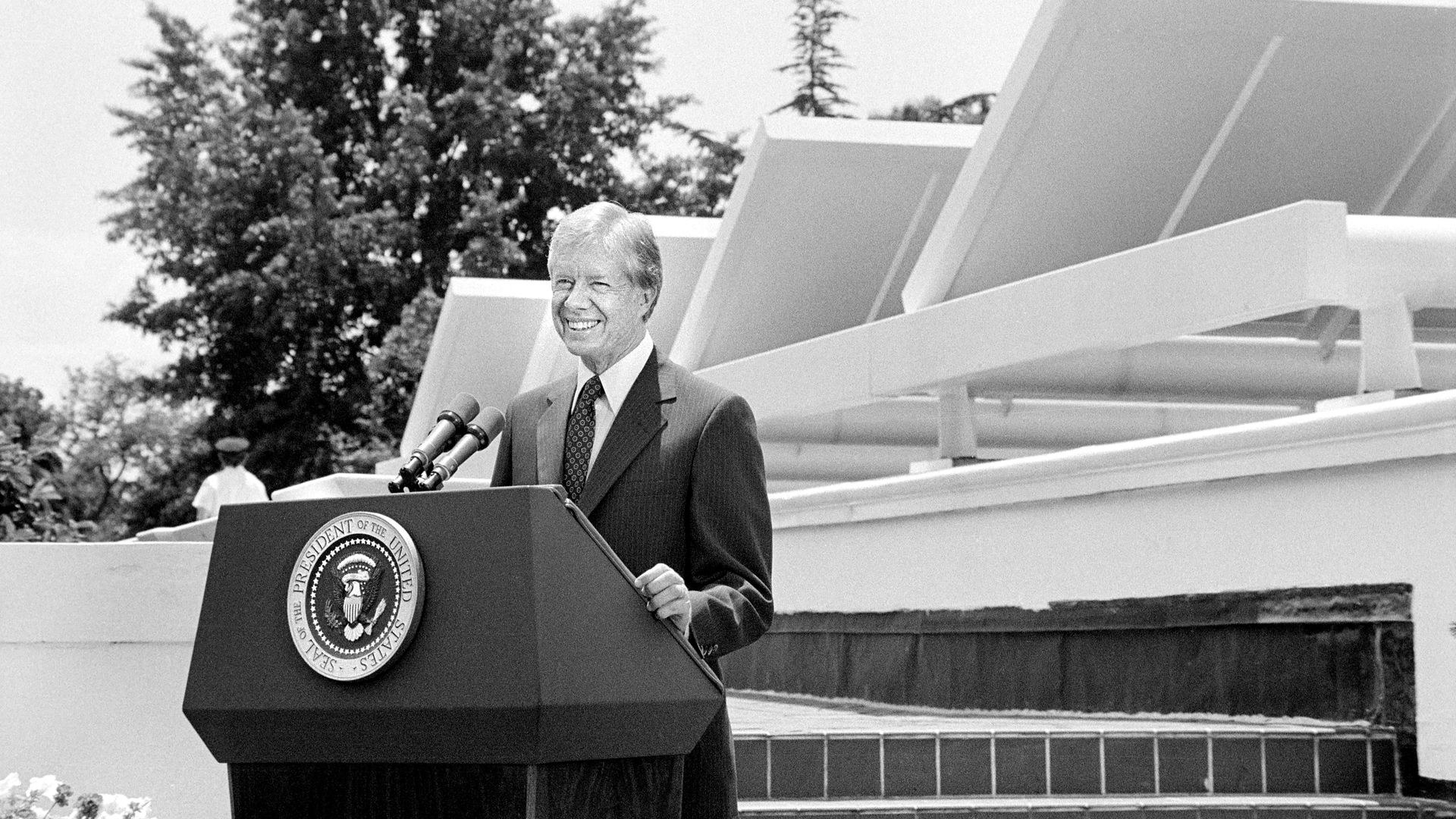
Former President Carter had solar panels installed on the West Wing of the White House in June 1979. Photo: Universal History Archive/Universal Images Group via Getty Images
Nearly 40 years after President Carter had 32 solar panels installed on the White House's roof, he watched nearly 4,000 of them go up in his hometown of Plains, Georgia, in 2017.
- The panels were capable of powering more than half the town.
The big picture: With Carter's death, the United States lost one of its most environmentally friendly presidents.
- “Carter was the first global leader to recognize the problem of climate change,” reports Time magazine.
Flashback: Everybody remembers the cardigan. In a national address just weeks after taking office in the winter of 1977, Carter, wearing a beige sweater next to a steady fire, urged Americans to drop their thermostats in a bid to decrease the nation's need for fossil fuels.
- Soon, he created the Department of Energy, consolidating American energy research and planning.
- "Without public conversation, there may not be enough energy to allocate,” Carter said in the fireside address.
Context: The years before and during Carter's presidency were marked by a major energy crisis as Western nations struggled with rising oil and gas prices, decreased production and instability in oil-producing Middle Eastern nations.
To drive down fuel costs, Carter's administration implemented the 1975 Corporate Average Fuel Economy standards, which required American-produced cars to double fuel efficiency within 10 years. The standards caused Persian Gulf fuel imports to drop by 87%, according to the Rocky Mountain Institute.
- The standards have been rolled back and accelerated in the decades since, but today's goals call for a 49mpg average by 2026.
Zoom in: As governor of Georgia and a charter member of the Georgia Conservancy, Carter established the Georgia Heritage Land Trust to buy and protect land, and vetoed the construction of a dam on the Flint River. They were the first of many public acts of conservation, eventually protecting millions of acres of public land.
- As president, Carter in 1978 established the Chattahoochee River National Recreation Area in his home state. It was one of 29 national parks the president signed into law that year.
- He protected over 150 million acres of public land, establishing or expanding 19 parks in Alaska alone.
- Carter oversaw the creation or protection of national monuments, memorials and historic sites, including the Pearl Harbor National Memorial in Hawaii and the Vietnam Veterans Memorial in Washington, D.C., among others.
- On his last day in office, Carter protected over 1,300 miles of Wild and Scenic Rivers.
Carter's policies fought back too. In 1980, Carter created the Superfund program, in which hazardous waste sites are investigated and cleaned up.
- He gave the Environmental Protection Agency, which had been around for about a decade, authority to clean up hazardous sites such as the Love Canal landfill, which housed toxic chemicals and sickened local residents near Niagara Falls, New York. Carter initially authorized use of FEMA funds to help remediate the landfill, and the site became the first in the Superfund program.
- Since its establishment, the program has identified 40,000 hazardous sites across America.
Yes, but: Not all of Carter's environmental endeavors were successful. He pushed back against 32 federal water projects, claiming they would harm river health, risking his political clout. Ultimately he conceded on edits to 23 of the projects while the rest moved forward unchanged.
Then, Carter's energy plan, which would have established tax credits for solar panel installations and called for renewables to comprise 20% of the nation's energy by 2000, failed to clear Congress.
- The energy crisis is often cited as one reason Carter lost reelection in a landslide to Ronald Reagan.
Reagan's administration also removed those White House solar panels.
- Today they can be found at the Smithsonian's National Museum of American History, a science museum in China, the Unity College in Maine and the Carter Presidential Library and Museum in Atlanta.
- When they were in use at the White House, the panels heated water for daily activities, including washing the Carter family's laundry, and in the cafeteria.
The bottom line: Though not all of Carter's environmental policies were successful, his efforts to protect the nation's natural resources might prove to be his most lasting legacy.