Atlantans are driving even more than we did before COVID


Add Axios as your preferred source to
see more of our stories on Google.
Here's some interesting news to consider before hopping into your car for your traffic-plagued commute into the city: We are driving even more than we did before the pandemic.
Why it matters: The lockdown period, when driving plummeted as people sought to "stop the spread," was a unique chance for cities to get a lasting handle on transportation-related emissions.
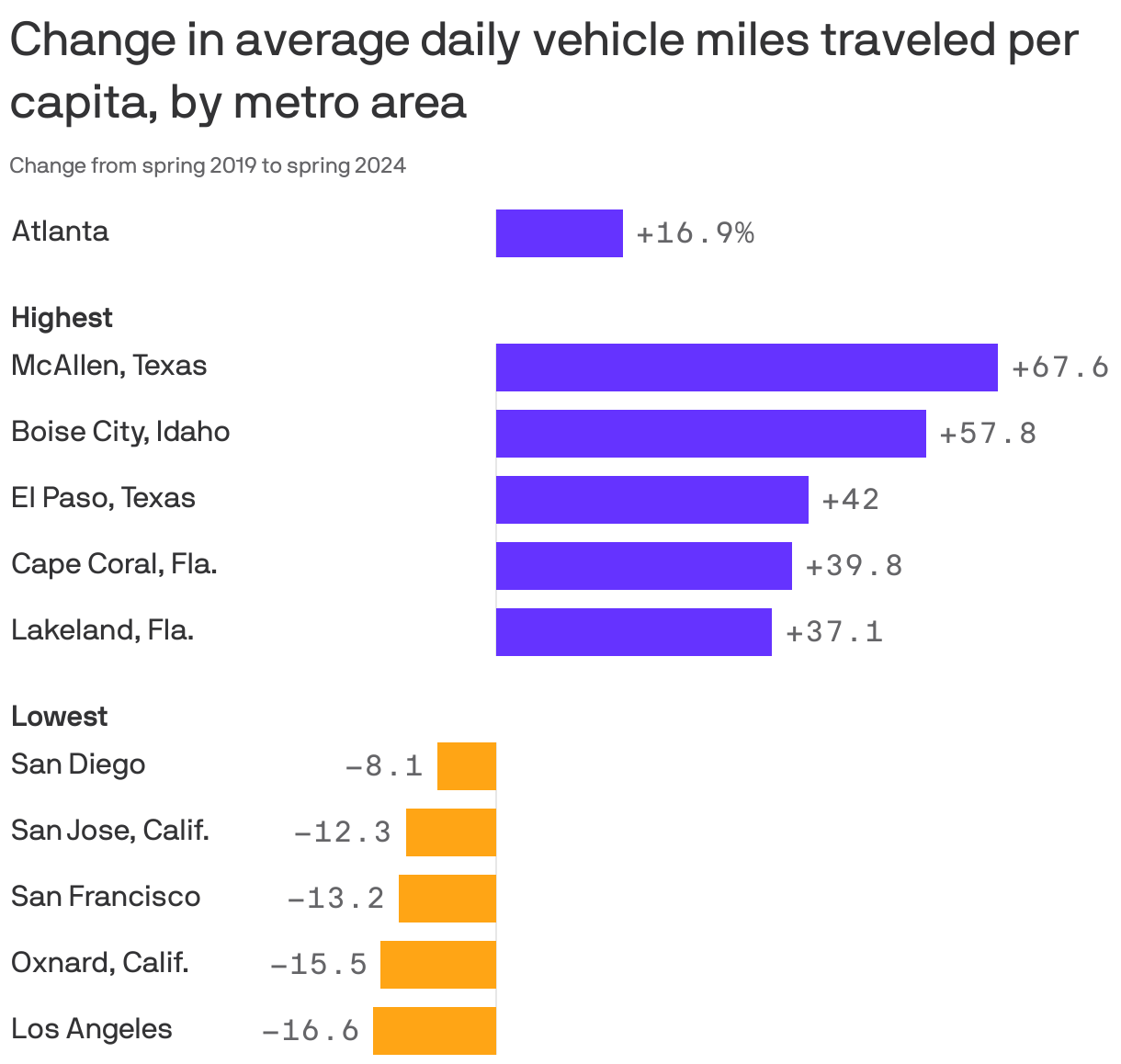
Driving the news: Average daily vehicle miles traveled (VMT) per capita increased by nearly 17% in the Atlanta-Sandy Springs-Alpharetta region between 2019 and this year, according to a new report from StreetLight Data, a transportation analytics firm.
The big picture: Metro Atlanta's driving habits and sprawling land use are decades-long problems that counties and cities — protective of their own fiefdoms — have been reluctant to work together to solve.
- Cobb and Gwinnett are taking steps to invest in alternate ways to get around. Voters in November will be asked to approve a new sales tax to pay for transit projects.
Yes, but: Building projects to address our vehicle-first habits aren't going away any time soon.
- The Georgia Department of Transportation recently unveiled plans to install toll lanes on I-285 through Cobb, Fulton and DeKalb counties — just as its roughly $1 billion overhaul of the I-285 and Ga. 400 interchange winds down.
Zoom out: VMT per capita increased the most in McAllen, Texas (+67.6%); Boise City, Idaho (+57.8%) and El Paso, Texas (+42%).
- The metros with the biggest reductions in VMT per capita are concentrated in California, like Los Angeles (-16.6%), San Francisco (-13.2%) and San Jose (-12.3%).
Between the lines: While higher VMT tends to mean more vehicle-related emissions, it can also be a sign of changes generally perceived as positive, like more economic activity.
- Lower VMT can be a sign of successful public transit or cycling projects — or an indication that lots of people are still working hybrid or remotely.
Go deeper: Change in Atlanta travel times; Uber, Waymo to debut driverless cars in Atlanta in 2025