The gender gap in Georgia politics extends to campaign donations



Add Axios as your preferred source to
see more of our stories on Google.
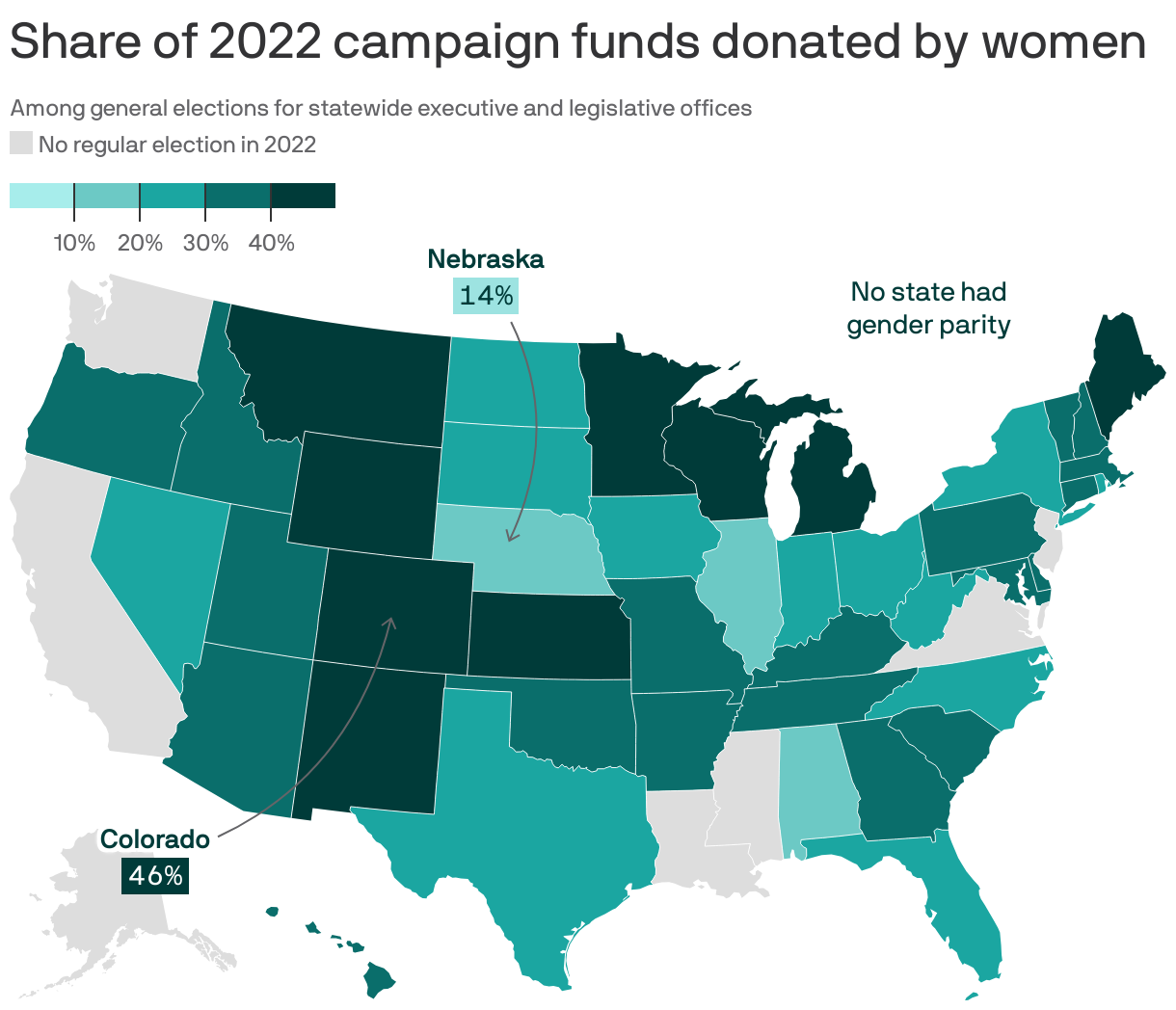
Even though women represent more than half of the Georgia population, they made up just over one-third of total political donations in statewide and state legislative races last year.
Driving the news: Donations from Georgia women made up just 36% of contributions to 2022 campaigns.
- That's according to a new report on the "donor gap" from Rutgers' Center for American Women and Politics using data from OpenSecrets.
Why it matters: While women are registered to vote at higher rates than men, they remain disproportionately absent from the halls of political power — and from the political donations that fuel those halls.
The big picture: The gap is also present nationwide. Women donors made up between 29-33% of contributions to general election candidates at statewide and state legislative levels between 2019 and 2022, per data from campaign finance tracker OpenSecrets.
By the numbers: Roughly 34% of the 236 Georgia state legislators are women, the center reports — on par with the national average of 33%.
- Of Georgia's 13 statewide elected officers, only one — Georgia Public Service Commissioner Tricia Pridemore, who was appointed to the regulatory body in 2018 — is a woman.
- 51% of the state population is female.
What they're saying: Many women tend to focus their giving on nonprofits until legislation or budgets affect their biggest issues and causes, Melita Easters, the director of Georgia WIN List told Axios. The WIN List recruits female Democratic candidates in the state.
- "You have to educate women donors, sometimes about the need to give to political causes," Easters said.
The intrigue: There are about triple the number of female Democratic lawmakers (60) than Republican female lawmakers (21) under the Gold Dome.
- The majority of all women lawmakers, however, live in metro Atlanta. Some argue the proximity makes it easier for women legislators to spend time with family during their service, WABE previously reported.
Between the lines: The underrepresentation of female politicians and donors is entwined, Kira Sanbonmatsu, a Rutgers political science professor and the report's lead researcher, told Axios.
- It's a cycle that puts women at a disadvantage — female donors on both sides of the aisle disproportionately support women candidates, but the number of women running for office is significantly lower than the number of men.
- Incumbents, most of them men, tend to raise more money than challengers, and well-funded candidates are most likely to win on election day.
The last word: There's a "need for some new strategies and new mobilization ideas" to rectify the "donor gap," Sanbonmatsu said.
- "Women are voting. They're interested in politics. They're engaged. They maybe haven't been recruited yet in this capacity."
Editor's note: This story has been updated to include quotes from Melita Easters.