Just one-third of state political donors are women

Add Axios as your preferred source to
see more of our stories on Google.
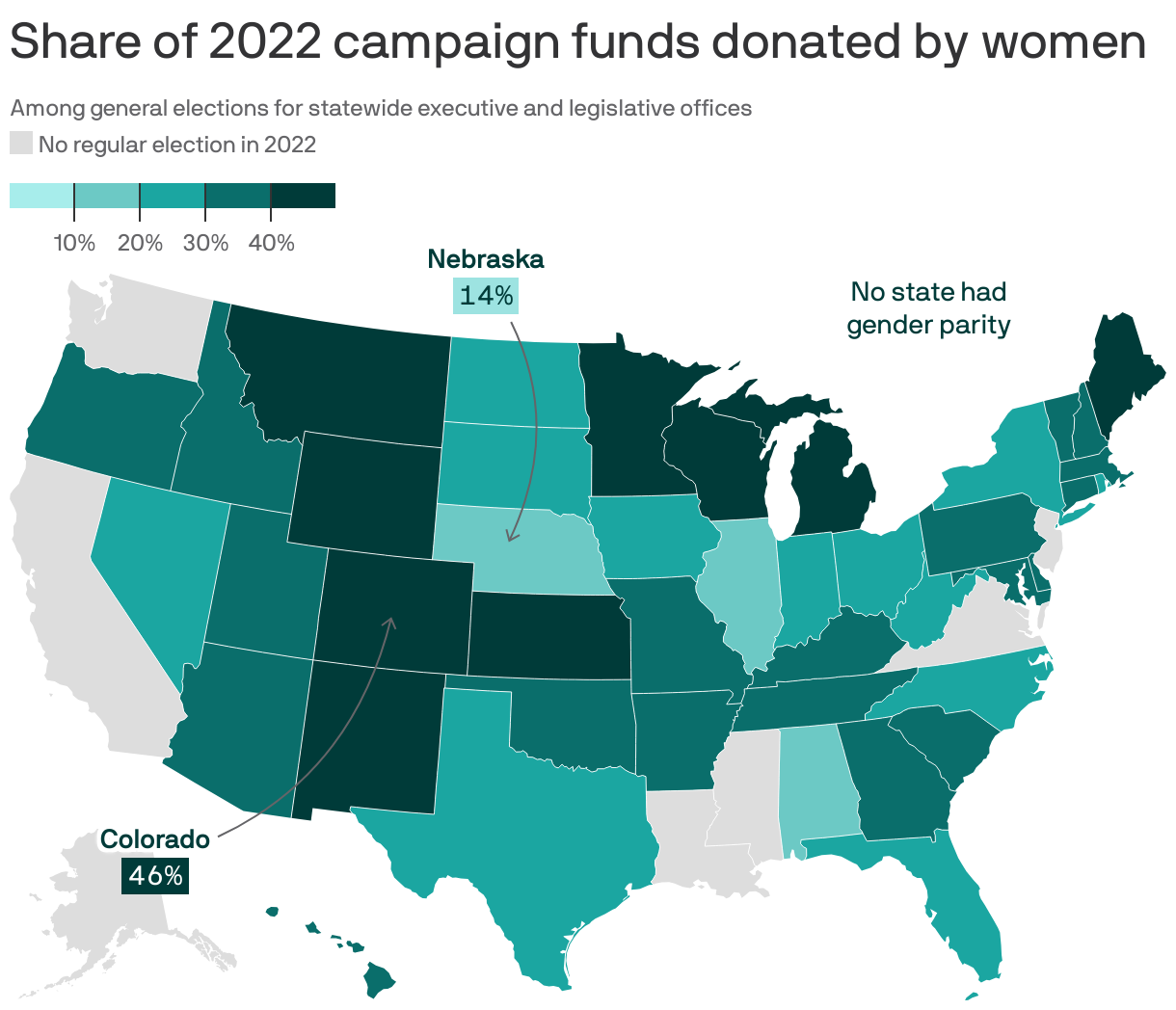
Women are not only underrepresented as political candidates across the country, they're also underrepresented as donors.
Driving the news: Women donors made up just 29% to 33% of the contributions to general election candidates at statewide and state legislative levels between 2019 and 2022.
- That's according to a new report on the "donor gap" from Rutgers' Center for American Women and Politics using data from OpenSecrets.
Why it matters: While women are registered to vote at higher rates than men, they remain disproportionately absent from the halls of political power — and from the political donations that fuel those halls.
What's happening: The underrepresentation of women candidates and donors are entwined, Kira Sanbonmatsu, a Rutgers political science professor and the report's lead researcher told Axios.
- "We're not able to disentangle which comes first ... it's a mutually reinforcing relationship," she said.
- It also is inextricable from a persistent gender wealth gap, she said.
State of play: Just 33% of state legislators are women. Only eight of the 28 governors running for re-election in 2022 were women.
- About 50.4% of the U.S. population is female, per census data.
Zoom in: Female donors on both sides of the aisle disproportionately support women candidates, according to the report.
- However, the pattern is stronger among Democratic women. For example, women donors accounted for 49% of the money given to Democratic women statehouse candidates, compared to 36% of contributions to male candidates.
- For Republican women statehouse members, meanwhile, women donors accounted for 29% of total donations, compared to 21% of the money given to men.
The big picture: While the report found the disparity to be worse in some states — just 14% of Nebraska's contributions in 2022 were from women, 17% of Illinois' and 18% of Alabama's — no state had contributions equivalent to their female population last year.
- Colorado came in on top with 46% to its 49% female population.
- "It's not unique to any state," Sanbonmatsu said.
Of note: States without regular elections in 2022 were excluded from the data.
The intrigue: Across the country, Democratic women outnumber Republican women as candidates at all levels, the report says.
- Among women state legislators, 66% are Democrats compared to 34% who are Republicans.
- That could be in part thanks to a disparity in groups recruiting and supporting female candidates. More of them, like Emily's List, are for Democrats, though Republicans are trying to catch up.
Yes, but: Once they run, women candidates are strong fundraisers, the report outlines.
- 51% of the top Republican fundraisers and 52% of the top Democratic fundraisers in statehouse races between 2019 and 2022 were women.
Reality check: Among women candidates, another funding disparity along racial lines exists.
- In 2022 gubernatorial non-incumbent primaries, white women received more contributions than those from underrepresented racial and ethnic groups, the report points out.
- "The campaign finance space yields similar challenges for people of color regardless of gender," Sanbonmatsu told Axios.
What we're watching: There's a "need for some new strategies and new mobilization ideas" to rectify the gender gap, Sanbonmatsu said.
- That includes trying to activate new donors and untapped sources of candidate funding support.
- "Women are voting," she said. "They're interested in politics. They're engaged. They maybe haven't been recruited yet in this capacity."
