Georgia's higher-than-average skin cancer rate

Add Axios as your preferred source to
see more of our stories on Google.
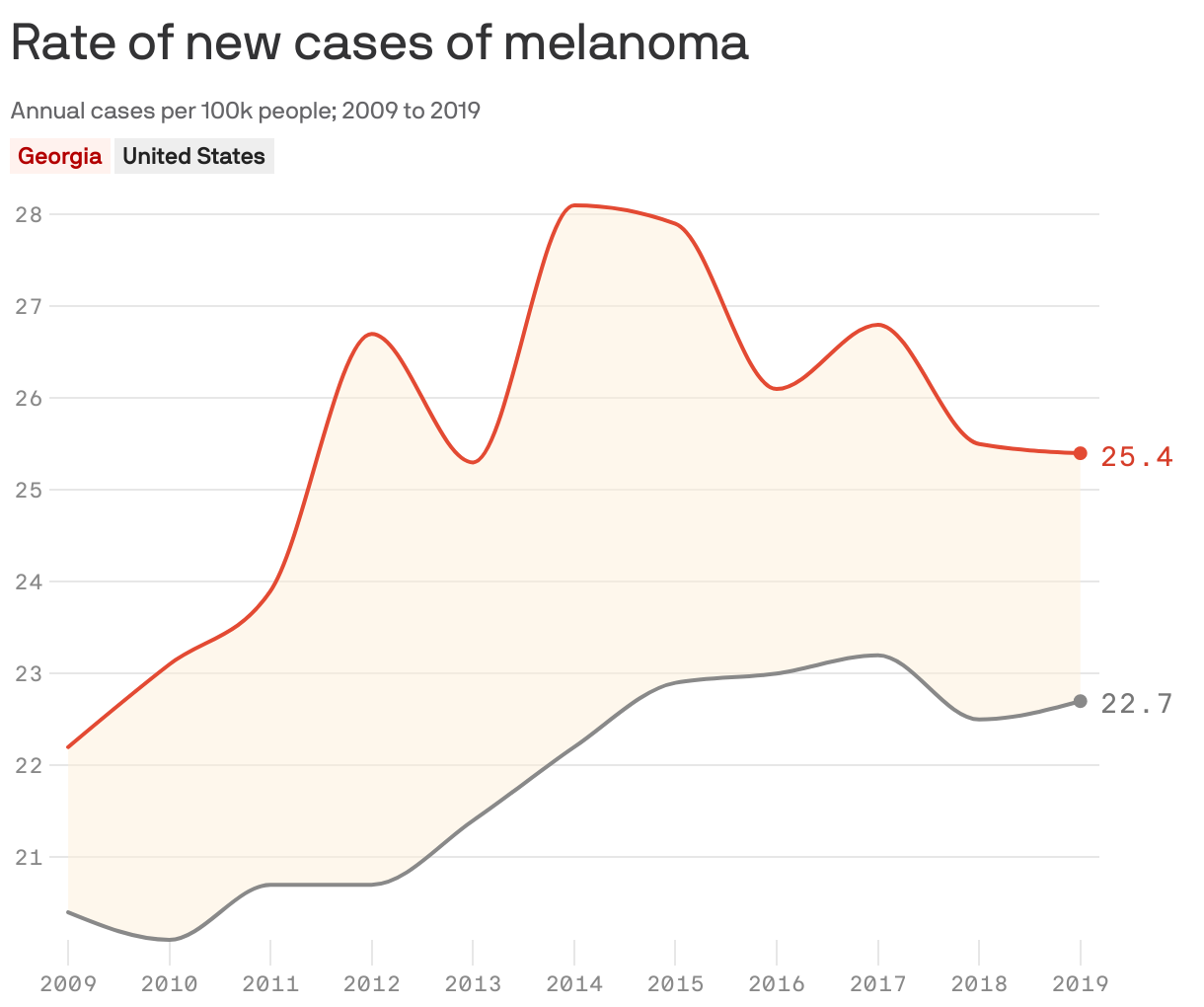
Skin cancer rates in Georgia are higher than the national average, according to the Centers for Disease Control and Prevention.
Why it matters: Experts consistently say that the biggest factor in lowering melanoma rates is managing sun exposure and applying (then reapplying!) sunscreen.
Driving the news: In 2019, 25 cases of melanomas of the skin were reported per 100,000 Georgians — and 203 Georgians died from it. The national rate in 2019 was about 23 cases.
What's happening: There are multiple factors behind melanoma, says Wentao Li, a University of Georgia professor who studies how carcinogens, including UV rays, alter and damage DNA — and cause cancer.
- In the South, the sun is simply stronger, he said. People's interest in outdoor activities also contributes to more cases.
- Better education about sun protection is needed, he told Axios.
- "Many people enjoy the sunlight, but I don't think they are all aware of this potential risk of skin cancer," he said.
By the numbers: Li said the state's racial breakdown — 51% white — makes a difference. People with light skin pigmentation are more vulnerable.
- 97% percent of melanoma cases in Georgia in 2019 were among white people.
Yes, but: Death rates among people of color are higher, partially because cases are harder to detect early, according to the Association of American Medical Colleges.
Between the lines: The general advice that you should get a "protective" base tan before a beach vacation is not accurate, Axios' Carly Mallenbaum reports.
- A suntan provides an SPF of less than 4 and still "increases your likelihood of developing not only skin cancer but also wrinkles [and] brown spots," dermatologist Nazanin Saedi told Axios.
Flashback: Melanoma case totals in the U.S. and Georgia are up compared to 1999 data, but Li attributes that in part to vast improvements in early detection technology.
- "That does not mean 20 years ago people did not get skin cancer," he said.
- There's also climate change: "It's becoming hotter," Li told Axios.
What we're watching: Li's research is focused on how DNA successfully repairs itself after damage like a benign sunspot — versus a sunspot that turns cancerous. The hope is nailing that down will help pave the way for early preventative treatment.
- "It's a long journey," he said, but he hopes that in a decade people will have access to personal genomic files to help with early detection of skin cancer.
In the meantime (and all the time): Wear sunscreen.
💭 Thomas' thought bubble: I've had skin cancer (basal cell) twice, so I wear sunscreen and stick to the shade as much as possible.
- Find a sunscreen that works for you. Apply, and reapply regularly.
- You'd be amazed at the sun protection products out there. (Yes, I bought them.)