Friday's health stories

Trump admin to expand foreign aid abortion ban to gender identity and DEI

Vice President Vance on Friday announced plans to block foreign aid for groups supporting gender identity and diversity programs, expanding an existing ban on organizations providing abortion-related services.
Why it matters: The broadened "Mexico City" policy — referred to as a global gag rule — affects more than $30 billion in foreign assistance to both foreign and domestic organizations.

Why infants are especially vulnerable to measles

The rising measles caseload is bad news for one particularly vulnerable group of people: infants, who typically aren't vaccinated against the disease until they're a year old.
Why it matters: Even parents who want to protect their babies against the disease have few options for the first 12 months of their children's lives.

Clorox buying Purell maker for $2.25 billion

Clorox on Thursday agreed to acquire GOJO Industries, the Akron, Ohio-based maker of Purell, for $2.25 billion in cash.
Why it matters: The pandemic may have subsided, but hand sanitizer habits didn't.


Dr. Oz: AI and robots can already provide medical care

AI and robotics could help reduce the obstetrics crisis in the U.S. in the next few years, Dr. Mehmet Oz, administrator of the Centers for Medicare & Medicaid Services, said Thursday at an Axios event in Davos.
Why it matters: It's a tangible use of AI that could bring real benefits soon — better than speculating on advances 10 years from now, Oz said.
Driving the news: Oz said AI and robotics can be part of the solution for parts of America that don't have access to critical medical care, like obstetricians and mental health services.
- "Within the next three years, before our administration is done, we will be using agentic AI to accelerate our ability to take care of people, especially when they're in places where we don't have access to care," Oz said at the Axios House event.
- More than one-third of U.S. counties don't have any obstetricians, midwives or birthing centers. More than 500 hospitals have closed OB units since 2010.
How it works: One idea that has been proposed is to "use robots to do ultrasounds on pregnant women," Oz said. "Robots can do it. We already have simple systems that are effective."
- There are also technologies under development "where you can take a wand, you don't even see the image, you get digitized insights back that tell you whether the child's OK or not."
- "And frankly, I don't have to see the image. I just have to know if the image is good enough to tell me the child doesn't have a problem," Oz said.
For mental health care, "we will never, ever have enough practitioners in those areas to do this" in rural America, Oz said.
- "We have AI systems now [that] augment the ability of doctors to take care of patients by fivefold, maybe more, without burning out," he said, "helping them do much of the laborious work of collecting information, and giving them some navigation tools and most importantly by allowing or empowering patients to control their own decisions."
Context: Some states already are experimenting with AI tools for expectant and new mothers, using smartphones and wearables to monitor vitals, provide maternal health advice, book vaccinations and order tests.
- Oz's agency finalized a proposal last fall to expand Medicare payment policies for digital mental health services to include payment for devices used to treat ADHD. It also solicited feedback on how it might pay for innovative software algorithms and AI.
The bottom line: "I think talking about AI in 10 years is almost a futile effort. I think most of the changes are going to happen in three to five years," Oz said.

Insurers face new GOP pressure on affordability

Health insurers are feeling political heat as Republicans try to shape the affordability narrative and counter Democratic messaging on health care costs.
Why it matters: President Trump and his allies have been increasingly assailing health plans over costs while seeking to deflect blame for blocking enhanced Affordable Care Act subsidies that help people afford premiums.

Charted: The big measles surge
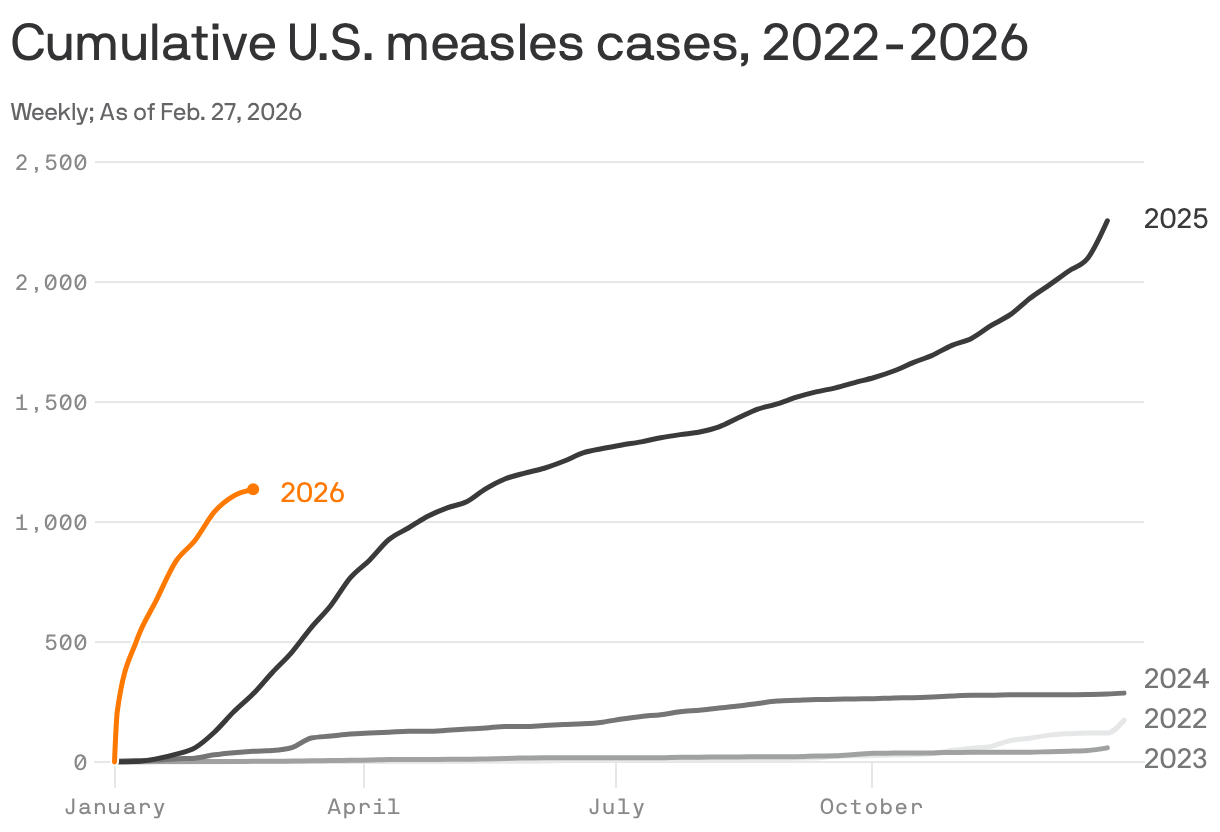
This chart shows what it looks like to hit a 30-year high in measles cases — and why the U.S. is on track to lose its measles "elimination status."
Why it matters: We've all heard that cases are on the rise, but the reality is that they're skyrocketing.