Mosquitoes probably don't think your blood's "sweet," but they might like your stink.
Why it matters: Thanks to the warmer, wetter weather, mosquito season could be especially itchy and long this year. And everything from body odor to what you drink can affect how miserable you get.
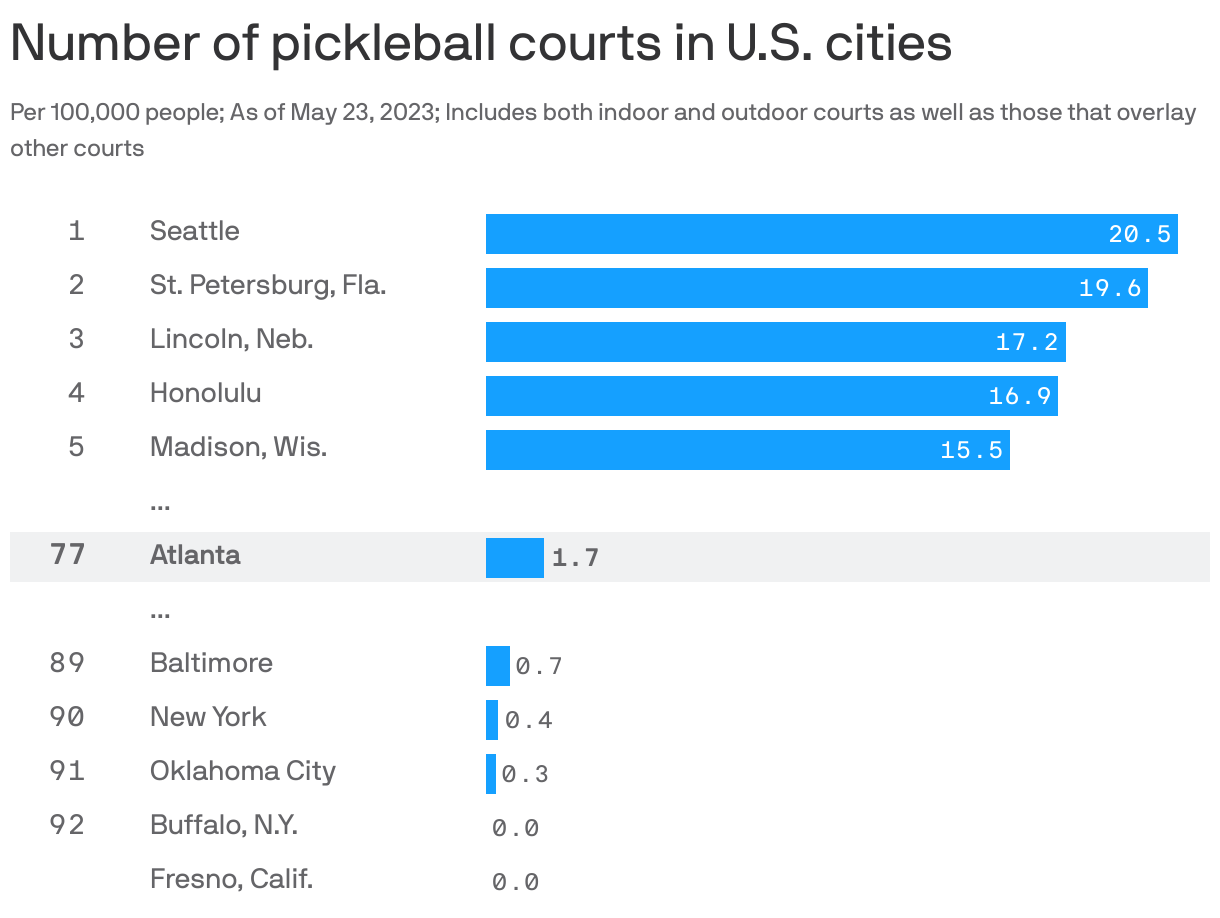
Data: Trust for Public Land; Chart: Alice Feng/Axios
There's been a sixfold increase in the number of public pickleball courts in the 100 biggest U.S. cities since 2017 — from 420 to 2,788 — but municipal leaders say they still can't come close to meeting demand from pickleheads.
There's now about one pickleball court for every 24,000 residents in these cities, according to the Trust for Public Land (TPL), a pro-parks nonprofit.
A high-profile appellate court hearing on Tuesday took up whether a single judge could halt the Affordable Care Act's preventive health services mandate nationwide.
Why it matters: Nationwide injunctions have become a hotly contested topic in several cases involving health care, with critics questioning if one judge should be able to shape national policy on matters like drug safety.
Merck's lawsuit challenging drug price negotiations established bythe Inflation Reduction Act is the likely start of a flurry of litigation to undo Democrats' signature effort to tackle pharmaceutical costs.
Why it matters: At a minimum, the IRA's drug pricing provisions probably won’t start on time, experts say. And a Merck victory could cripple the way the law forces manufacturers to the bargaining table with the threat of steep excise taxes.
Intermittent fasting (IF)was a natural part of life thousands of years ago, when food was scarce for our hunter-gatherer ancestors. But interest in the idea as a modern life hack continues to grow in the U.S.
Why it matters: Although IF can lead to quick weight loss, there are concerns around it, partly because there's a lack of conclusive data on its long-term effects.
A federal judge on Tuesday temporarily blocked a pair of Florida bans on gender-affirming care for three minors while a legal challenge plays out, arguing that both are likely to be found unconstitutional.
Why it matters: U.S. District Judge Robert Hinkle, a Clinton appointee, wrote that "gender identity is real" and agreed with the plaintiffs in a lawsuit against the state that gender-affirming care is "medically necessary."
Why it matters: Merck will litigate the case up to the U.S. Supreme Court if necessary, the company said in a news release accompanying the lawsuit.
The details: The pharmaceutical company claims the Medicare drug price negotiation program is unconstitutional and a "sham" that doesn't involve real negotiations or agreements.
Merck alleges the law violates the Fifth Amendment, which requires the government to compensate appropriately when it takes property.
It also says the law goes against the First Amendment by forcing the company to say it's agreed to the Health and Human Service Department's mandated price for a drug and to say the price is fair.
What they're saying: "This is not 'negotiation.' It is tantamount to extortion," the complaint reads.
Remember: The pharmaceutical industry has been hinting at a lawsuit since Congress passed the drug pricing legislation.
Under an administration timeline, HHS is due to reveal in early September the first 10 high-cost drugs that will be subject to talks with manufacturers. Discussions would begin next February and the maximum negotiated prices will be announced in September 2024.
The new prices will take effect starting on Jan. 1, 2026.
Merck says its diabetes drugs Januvia and Janumet and the cancer treatment Keytruda are projected to be subject to negotiations.
Health insurers responded to the 2015 Supreme Court decision recognizing same-sex marriage with more equitable coverage for LGBTQ couples, including spousal benefits, according to a new study published in Health Affairs.
What they found: The percentage of all LGBTQ adults with a usual source of health care access increased from 64% to 75% from 2013 to 2019.
A federal appeals court will hear arguments today on whether to lift a freeze on a decision halting the Affordable Care Act's requirement that employers fully cover the cost of specified preventive health care services.
Driving the news: If the New Orleans-based U.S. 5th Circuit Court of Appeals affirms the ruling, it could eliminate cost-free coverage for certain cancer screenings, behavioral counseling, HIV prevention and other services recommended by the U.S. Preventive Services Task Force.