Friday's health stories

Suicides increased 4% in 2021 after two consecutive years of decline
Suicide rates in the U.S. increased 4% in 2021 after declining for two years, according to preliminary data released Friday by the Centers for Disease Control and Prevention (CDC).
Driving the news: Suicide remains a "major contributor to premature death in the United States, especially among people aged 10–34, for whom it is the second leading cause of death," the CDC found.

HHS: Prices of 1,200 drugs rose faster than inflation
Drugmakers raised the list prices of more than 1,200 treatments above the 8.5 percent rate of inflation from July 2021 to July 2022, according to a new report from the Department of Health and Human Services.
Why it matters: The report, shared with Axios, highlights the potential impact of the drug pricing provisions in the Inflation Reduction Act that President Biden signed into law in August, which requires drug companies to pay rebates to Medicare if prices rise beyond the rate of inflation.
- While the methodologies between the law and the report aren't exactly the same, it gives a ballpark of the number of drugs that could be subject to the new requirement.
Between the lines: The new requirement begins to take effect on Saturday, with price increases being measured in the 12-month period beginning Oct. 1.
- For comparison: The 1,200 drugs with price increases above inflation make up about one percent of all drug products in the study.
- The report looks at list prices, which do not account for rebates paid to negotiators known as pharmacy benefit managers.
What they're saying: "If the Inflation Reduction Act had been in place from July 2021 to July 2022, more than 1,200 prescription drugs potentially would have been subject to the new provision requiring drug manufacturers to pay rebates to Medicare if they enact price increases greater than inflation for drugs," HHS said in a statement.
- The average price increase for those 1,216 drugs was 31.6 percent, the report said.
The big picture: The limits on drug price increases are one of the first provisions of the drug pricing law to take effect. New negotiated prices under Medicare for some drugs take effect in 2026, for example.
- Democrats see the drug price law as a clear political winner. President Biden touted the law earlier this week.
The other side: Drug industry groups say pricing policies like those in the IRA will threaten patient access and future innovations.

Hurricanes pose growing flood threat to U.S. hospitals
The evacuations of thousands of patients from hurricane-stricken Florida health facilities this week served as an ominous warning to hospitals along the Atlantic and Gulf Coast that researchers say could be swamped by surges from much weaker storms.
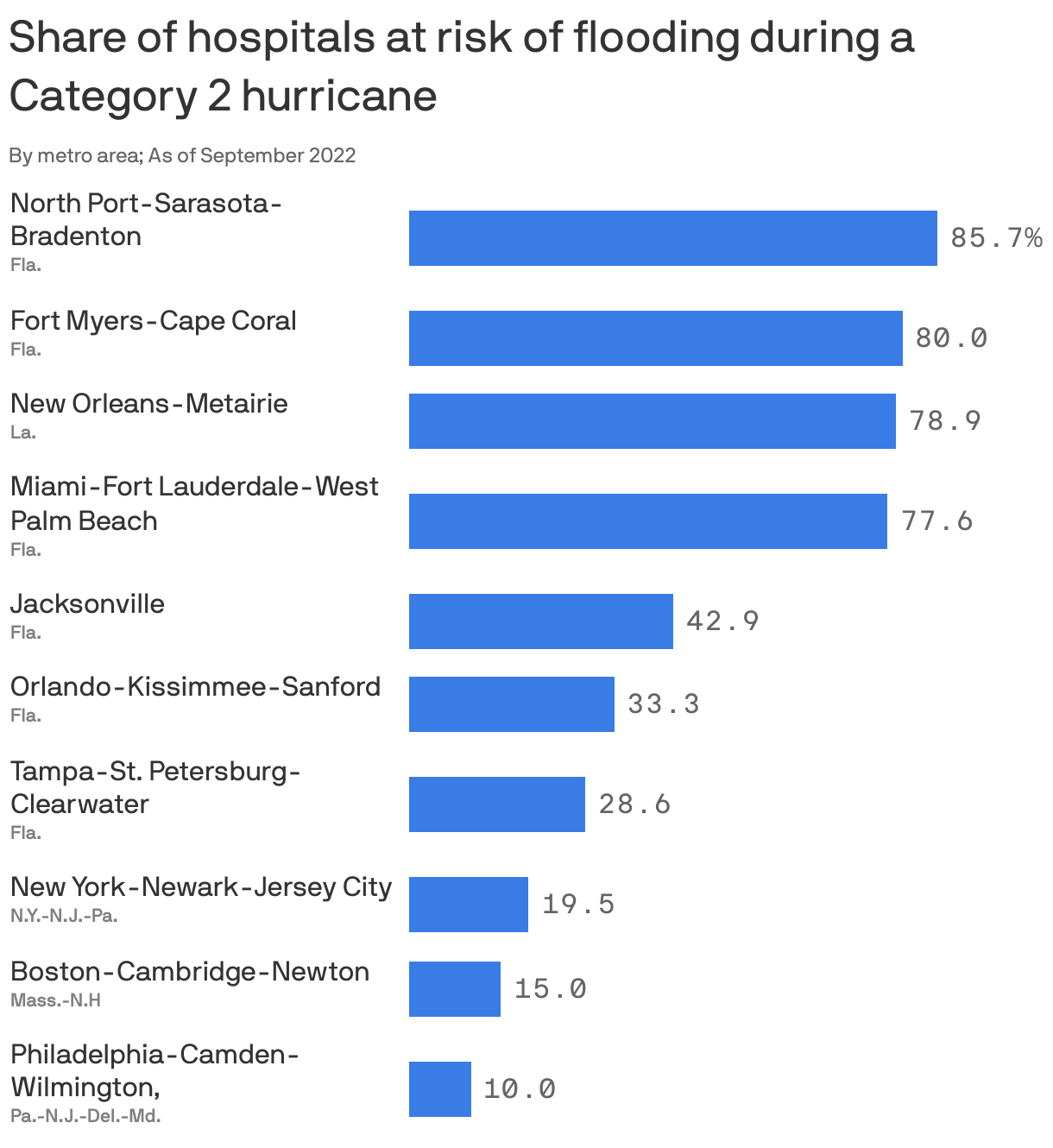
Driving the news: From Miami to Boston, hospitals along the East Coast face a growing risk from flooding, according to a study published Thursday in GeoHealth.
- Rising sea levels and storms that are more violent and track further north are posing new kinds of threats that health systems have to confront.
What they're saying: "Where are the metro areas that have the most beds at risk proportional to the number of the people they serve? It turns out number one is Miami. But number two is New York and the New York area and number three is Boston," said Aaron Bernstein, a co-author of the study and interim director of the Center for Climate Health and the Global Environment at Harvard T.H. Chan School of Public Health.
- "While the likelihood of a hurricane making landfall in the New York region or Boston is much less than places on the Gulf Coast, the consequences for access to hospital beds is, in fact, very high," he told Axios.
By the numbers: Researchers identified 682 acute care hospitals in 78 metropolitan statistical areas that were located within 10 miles of the Atlantic and Gulf Coasts.
- Those hospitals cover a population of nearly 85 million people, or about one of every four Americans, they said.
- The study found almost a third of those metro areas have half or more of their hospitals at risk of flooding from a Category 2 hurricane. A sea level rise of .82 meters, which is estimated to occur this century, would increase the odds of hospitals flooding by 22%.
Zoom in: The study also found in 18 metro areas, at least half of the roads within about one mile of hospitals were at risk of flooding from a Category 2 storm.
- "Roads are critical. If you have a fully functional hospital but you can't get folks in or out, it's not going to save us," Bernstein said.
Limitations: The study did not take into account the actual amount of rainfall that might be delivered from any particular storm.
- It also did not take into account specific infrastructure improvements or preparedness planning that has already taken place by the respective hospitals.
- "This study gives people a more nuanced way to think about the risks and a way to plan for them," Bernstein said.
The big picture: It's not only access in the days around a storm, but in the weeks, if not months, after a hurricane has passed that are critical, Bernstein said.
- For instance, a 2o19 study published in JAMA found the longer a disaster declaration persisted following a hurricane, the more likely lung cancer patients were to die because of a lack of access to care.
- New York-area hospitals and other health facilities incurred billions of damages from Hurricane Sandy in 2012, leaving emergency departments at some facilities overflowing with patients.
- There are also concerns of inequity as poorer neighborhoods and on poorer hospitals are disparately impacted by flooding and other climate impacts.
The bottom line: "We can't behave as if the world is stable. The climate is unstable and it absolutely matters to how we think about our ability to do our jobs," Bernstein said. "We can take steps that are not hugely expensive and, hopefully, pave a path toward being more resilient."
Go deeper: The climate-driven health crisis

Study: Creating a diversity score could improve medical research

Measuring racial and ethnic diversity within medical trials — and requiring a certain threshold to be met for researchers to publish in major journals — could be key to improving research into cancer and other diseases, a recent study found.
The big picture: White non-Hispanics made up 75% of all participants in medical research trials in 2020, the last year for which data is available, an FDA report shows. That means treatments or cures developed through research that largely excludes Latinos and other demographics might not work for them or cause unforeseen side effects.
America's big consumer medical debt problem

The number of Americans who have health insurance has never been higher — but more than 40% surveyed this year said they struggled to pay medical bills or were paying off medical debt, according to a biennial report from The Commonwealth Fund.
Why it matters: It's the latest evidence that insurance coverage alone can't insulate people against soaring medical costs, leaving some facing long-term financial consequences.


Another prospect for an Alzheimer's drug renews cost concerns


The prospect of an effective new Alzheimer's treatment came roaring back this week with the announcement of preliminary clinical trial data, giving millions of seniors renewed hope after a tumultuous year.
Why it matters: Alzheimer's is a devastating disease, and the topline results boosted analysts' expectations for an entire class of drugs targeting the condition. But they also resurrect enormous questions about who'll cover the costs and how the U.S. will oversee what's likely a multi-billion dollar market.