The Americas reported 63% of worldwide COVID cases in the first two months of 2022 despite accounting for around 13% of the global population, World Health Organization (WHO) officials said Wednesday.
The big picture: Though overall cases and deaths are falling in the Americas, as they are globally, the WHO is warning countries not to let their guard down.
The U.S. has pledged to donate more than 1 billion COVID vaccines around the world, but it would have to significantly scale up its monthly donation rate to meet that goal by the end of this year, according to a new Public Citizen analysis.
Why it matters: Vaccines not only save lives, but also help protect the world against new variants.
The first person to receive a heart from a genetically modified pig died on Tuesday, two months after the experimental operation, the University of Maryland Medical Center announced.
Driving the news: The hospital said David Bennett's condition began to deteriorate several days earlier but did not identify an exact cause of death.
Austria on Wednesday suspended its sweeping coronavirus vaccination mandate less than a week before it was set to be enforced.
Driving the news: Authorities were expected to begin checking people's vaccination status on March 15, but officials said they "don't see any need" to implement the law at this time, citing milder illnesses from the Omicron variant, AP reports.
Congress appears likely to allocate more than $15 billion more toward pandemic preparedness, but that probably wouldn't be enough to adequately safeguard the U.S. against future waves of COVID-19 — or even a potential wave this fall.
Why it matters: Having vaccines and therapeutics ready for a threat that may not fully materialize is difficult and expensive, but the alternative is risking hundreds of thousands more deaths and another huge hit to the economy.
The biotech industry is slumping after delivering life-saving COVID treatments and attracting droves of investors early in the pandemic.
Why it matters: Biotechs keep the drug pipeline flowing with novel treatments — and make attractive M&A targets for big pharmaceutical manufacturers. But regulatory uncertainty and a return to pre-pandemic life are combining to cool interest in public and private markets, experts say.
Nonprofit and government-owned hospitals are more likely to offer relatively unprofitable services than for-profit hospitals, according to a new study published in Health Affairs.
Why it matters: Nonprofits' financials are often evaluated based on factors like how much charity care they offer and how they pursue patient debt.
Patients with mild cases of COVID-19 suffered a loss of the brain's "gray matter" plus damage in areas associated with the sense of smell and a larger-than-average decline in cognitive function, according to research published Monday in the journal Nature.
Why it matters: The U.K. study is the first to compare brain scans before and after infection — and mostly deals with patients who had mild cases, which are the most common type arising from COVID infections.
The World Health Organization's advisory group on COVID vaccines said Tuesday it "strongly supports urgent and broad access" to booster doses.
Why it matters: WHO officials, including Director-General Tedros Adhanom Ghebreyesus, had strongly called on wealthy countries with large vaccine supplies to forgo booster shots through the end of 2021 due to a global vaccine disparity.
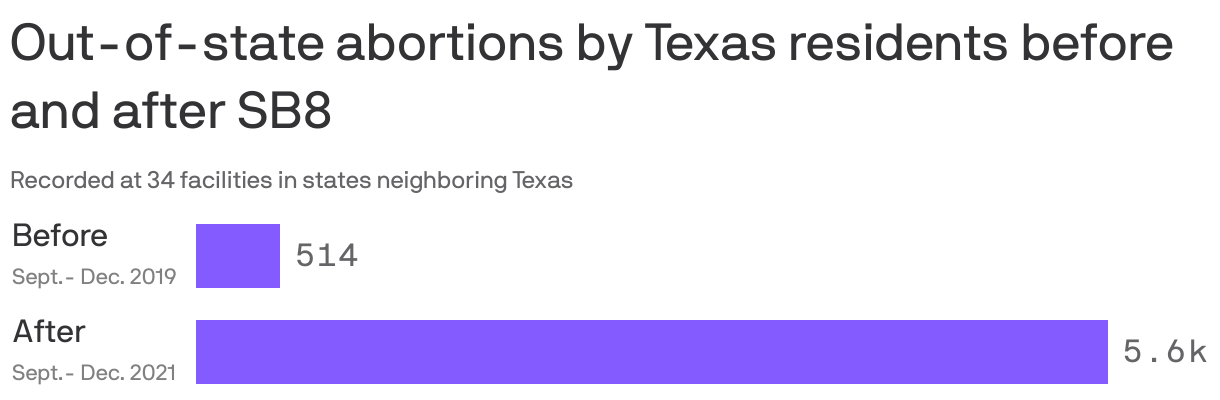
Data: The University of Texas at Austin; Chart: Baidi Wang/Axios
Texas' restrictive abortion law has compelled women to travel out of state for abortions or to seek self-managed abortion medication, per new research out of the University of Texas.
The big picture: Even as in-state abortions have plummeted, the law, known as Senate Bill 8, has not reduced the need for abortion care in Texas.
America needs major new spending in areas like disease surveillance and next-generation PPE if it wants to avoid repeating mistakes of the COVID-19 pandemic, according to two reports out this week.
Why it matters: The reports are among recent attempts by public health officials to lay out the weaknesses exposed by the pandemic and the steps needed to build more resiliency in the health system before the next crisis.