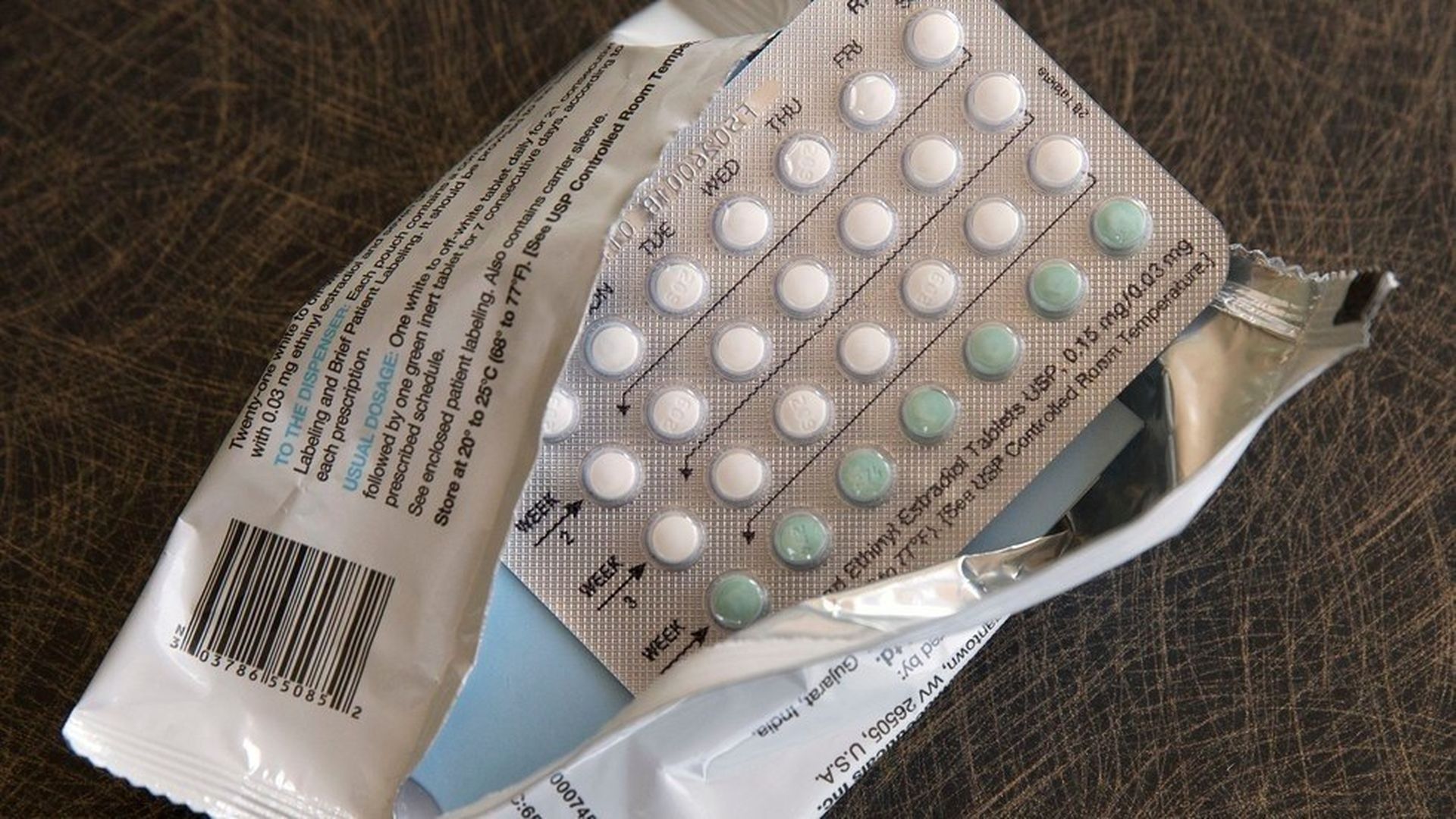
A federal judge in California temporarily blocked the Trump administration from enforcing new contraception rules, Reuters reports. The rules would have allowed employers to deny an Obamacare requirement mandating them to provide insurance that covers women's birth control.
Why it matters: This ruling follows a similar decision made last week by a federal judge in Philadelphia against the policy. That judge said it would cause serious and irreparable harm, according to multiple reports.
The Centers for Disease Control and Prevention put out its latest life expectancy and death rate numbers this morning, and the figures are pretty grim.
The bottom line: "Life expectancy declined in the U.S. for the second consecutive year in 2016" from 78.7 years to 78.6 years, the CDC said. "This was the first time life expectancy in the U.S. has declined two years in a row since declines in 1962 and 1963."
The city of Detroit yesterday joined a torrent of an estimated 400 cities, counties and states suing opioid makers. Their main allegation: the companies are complicit in an addiction crisis that has killed about 37,000 people in the U.S. in just the 12-month period ending in May, or 103 per day.
Read this statistic: When you add in heroin, to which opioid addicts often turn because it's cheaper and often easier to obtain, the 12-month number of opioid deaths through May exceeds 53,000, meaning 145 people per day.
More suits will be filed this week in Illinois, and Paul Hanly, one of the leading lawyers for the plaintiffs, tells Axios that the number of cases will rise to almost 1,000 by this time next year, a deliberate strategy of driving the opioid-makers to the negotiating table. The suits, first filed in 2014, have vastly accelerated pace this year. In a settlement, Hanly said, "we're talking tens of billions if not hundreds of billions for a nationwide resolution." The lawyers' model is 1990s litigation that led to a $246 billion settlement with Big Tobacco under similar allegations.
There's been a lot of focus on how repealing the individual mandate affects the individual market (it raises premiums and decreases competition). But, as my colleague Caitlin Owens notes, repealing the mandate is also likely to decrease the number of people with employer-based coverage, too.
The big difference: While decreasing coverage on the individual market is likely to destabilize the market itself, the effect on the employer market is probably negligible.
There were plenty of reasons to think the individual mandate was here to stay. It was a linchpin of Republicans' failed effort to defeat the Affordable Care Act in 2010. They couldn't persuade the Supreme Court to strike it down in 2012, or muster enough votes in that year's elections to do it themselves. They failed to repeal it once again in July. This July. Not even five months ago. And yet, here we are.
The bottom line: As important as the passage of Republicans' tax overhaul is for tax policy, and for President Trump's legislative agenda and Paul Ryan's legacy and everything else, this is at least as big a moment in the life of the ACA. After years upon years of dire warnings about what would happen to the ACA without an individual mandate, we're about to find out in a live experiment.