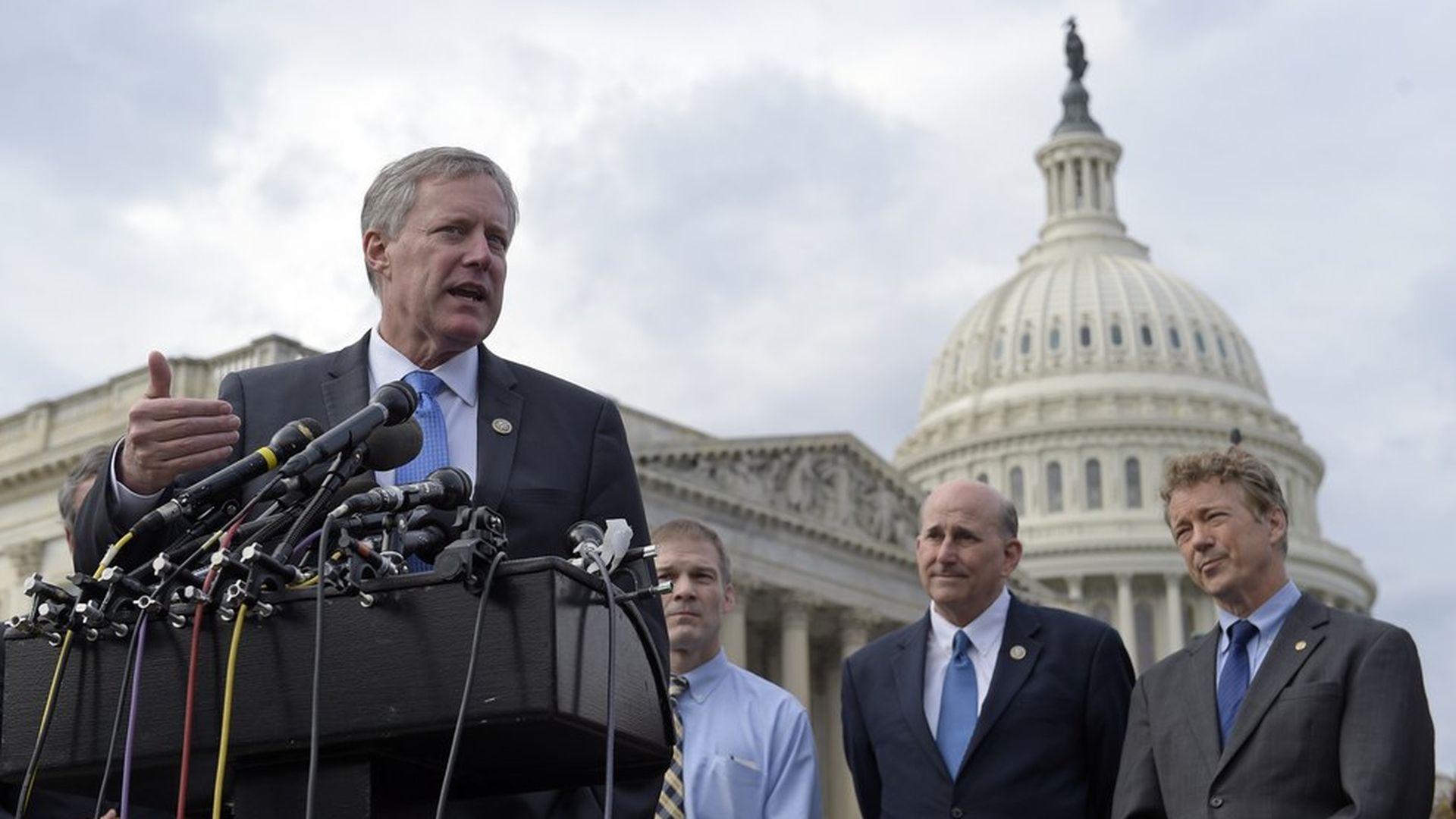
Trump's team is doing its utmost to sell Mark Meadows on its Obamacare replacement bill, but the Freedom Caucus leader ain't buying it.
Here's what Meadows told Axios early Monday evening:
After investing hours and hours and hours of trying to find common ground between our moderate members and conservative members, and believing, because of the White House's engagement in the process, that we could find common ground; I've now reached a conclusion that our leadership is going to put forth a bill that does not address any of the concerns in a meaningful way and will dare us to vote against it.
Why this matters: If the White House loses most of the Freedom Caucus members they can't pass this bill. Meadows was only speaking for himself tonight, but his is a voice to move votes. The caucus will meet tonight, and whether to collectively oppose the bill or not will certainly be discussed.
A new survey from MerrittHawkins shows that 53% of physicians across 15 major metropolitan areas accept Medicaid patients, up from a low of 45.7% in 2014, per Forbes.
The uptick is largely due to state Medicaid expansion under the Affordable Care Act, something that many moderate Republicans want to retain in the upcoming repeal battle.
The big picture: It's still hard to find doctors who take Medicaid patients, despite the improvement in this report. That's a frequent Republican criticism of Medicaid — though experts have warned that the GOP's proposed budget cuts to the program aren't going to help.
I was all set to give you an in-depth look at all of the health care bills Republicans are lining up for "Phase 3" of Obamacare replacement — all the proposals they can't put in the budget "reconciliation" bill.
There are substantive reasons to learn about the pros and cons and all of them. But here's the problem: All of them might be able to pass the House pretty easily, but then they'd all need Democratic votes to pass the Senate, since they'd need 60 votes.