Levels of carbon dioxide in the atmosphere reached the highest levels on record for any calendar month during April, averaging 420 parts per million (ppm) for the first time since observations began in 1958, according to new data.
Why it matters: Carbon dioxide is a long-lived, planet-warming greenhouse gas, the concentration of which is increasing due to human activities, such as the burning fossil fuels like coal and natural gas for energy. Studies show current levels are higher than any time in as long as 4.5 million years.
Venture capitalist John Doerr and his wife, Ann, have donated $1.1 billion to Stanford University for the establishment of a new school focused on climate change and sustainability, the university announced Wednesday.
Why it matters: The school will "dramatically amplify" Stanford's impact on addressing these dual challenges, per the press release.
The European Commission on Wednesday announced plans for a phased ban on all Russian oil by the end of the year, in a proposed sixth round of sanctions aimed at pressing President Vladimir Putin to end the invasion of Ukraine.
Why it matters: Russia is the world's second-largest crude oil exporter and Europe, unlike the U.S., is hugely reliant on Russian oil, gas and coal, per Axios' Ben Geman.
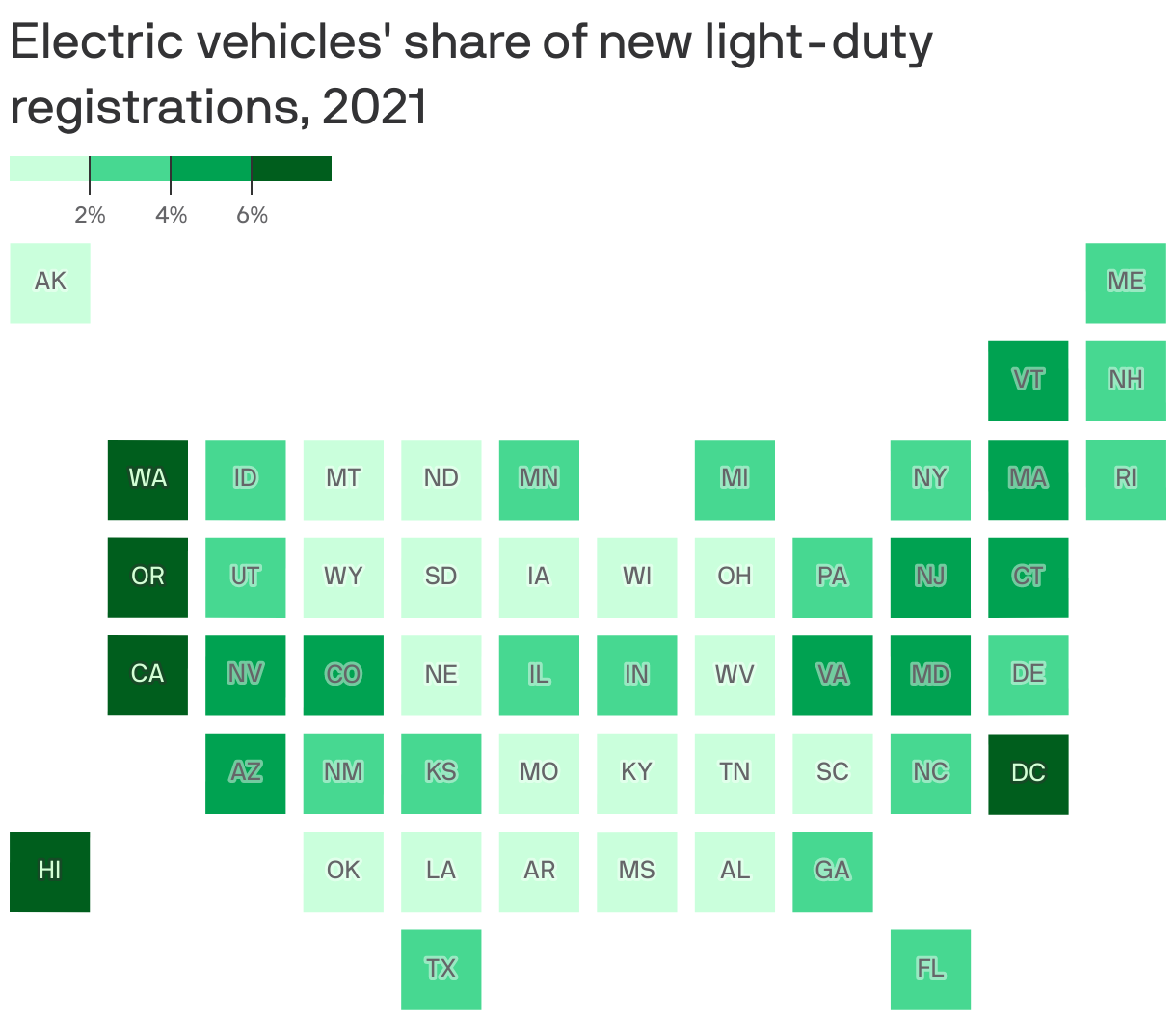
Adapted from DOE; Note: Includes fully electric and plug-in hybrid models; Cartogram: Axios Visuals
EV sales growth is highly uneven, and an analysis argues this badly limits the climate benefits of federal purchase subsidies.
The big picture: EVs were over 12% of new light-duty vehicles registered in California last year, and Oregon, Washington, Hawaii and D.C. were all over 7%, per the Energy Department.
An influential nonprofit called Carbon180 is working to shape how the Energy Department spends $3.5 billion to develop four regional direct air capture hubs.
Driving the news: These installations would seek to prove the scalability of the climate tech option, which is attracting increasing interest from investors.