President Biden's first budget request to Congress contains large increases in climate-change-related spending, on the order of $14 billion above the prior year's levels, according to a White House summary.
Why it matters: It provides details on how the White House hopes to translate its vow to act aggressively on global warming, both at home and abroad, into specific funding levels and agency-by-agency plans.
A volcano on the northern tip of the main island of St. Vincent and the Grenadines that had been dormant for decades erupted Friday after showing signs of activity in late December, the New York Times reports.
Why it matters: La Soufrière's eruption came hours after the Caribbean country evacuated around 20,000 people from near the volcano. There were no immediate reports of casualties, according to AP.
Climate change will lead to a less secure, more crisis-prone world that will strain global institutions, according to a major national security assessment released Thursday.
Driving the news: The “Global Trends Report,” produced every four years by the National Intelligence Council, spotlights climate change among the main structural forces shaping the next two decades.
A successful global effort to slash carbon emissions demands huge investments to finance the unprecedented transformation of energy systems and related infrastructure — and it's a capital shift that's already well underway.
Why it matters: Private investment is already ramping up, and President Biden wants to spend hundreds of billions of dollars. Independent experts say the spending that will be needed to achieve net-zero carbon emissions by 2050 — a goal now embraced by the U.S. and many other countries — would be on the scale of the Industrial Revolution.
Data: The Breakthrough Institute; Chart: Sara Wise/Axios
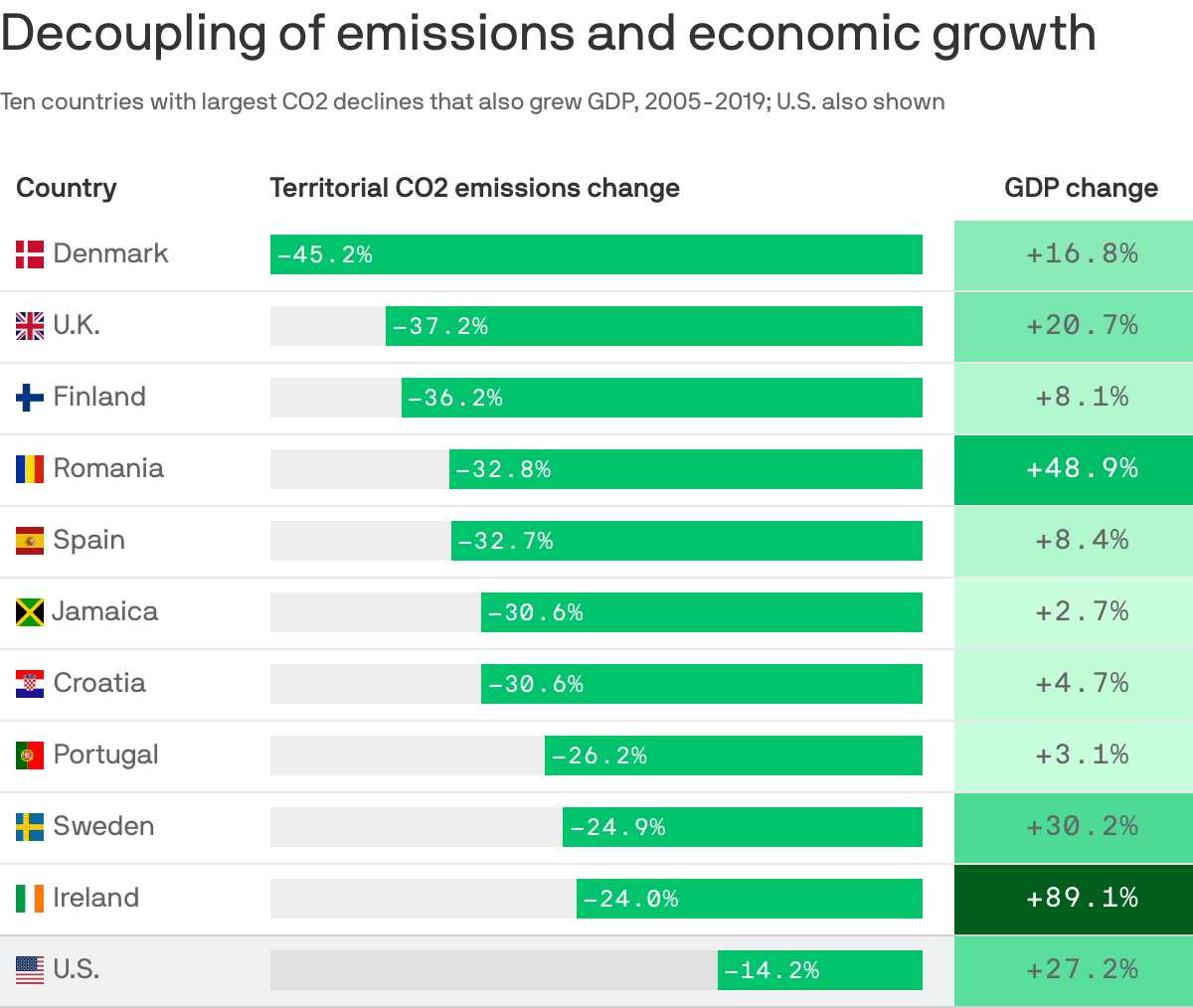
An analysis finds "increasing evidence" of a fraying connection between economic growth and higher carbon emissions — a needed first step toward steep CO2 cuts.
Driving the news: The Breakthrough Institute's Zeke Hausfather finds that since 2005, emissions have become "decoupled" from GDP growth in 32 nations with a population of at least 1 million people.
The Treasury Departmentestimates its plan to end subsidies for fossil fuel companies would bring in over $35 billion in federal revenue over 10 years.
Driving the news: "The main impact would be on oil and gas company profits. Research suggests little impact on gasoline or energy prices for U.S. consumers and little impact on our energy security," officials said in a report on the wider White House tax policy proposal.
The new(ish) group Law Students for Climate Accountability just launched a pressure campaign against the heavyweight law firm Gibson Dunn over its work for oil industry clients.
Why it matters: It's just one of many examples of how climate activism has been tactically evolving in recent months and years. That includes taking aim at a wider suite of corporate targets, like PR agencies and big tech, and intensifying a years-long focus on the finance sector.