Some Senate Democrats are bracing for President Biden's Build Back Better package to get punted into 2022, despite Democratic leaders insisting the massive social and climate spending bill will pass before the end of this year, Axios has learned.
Why it matters: Beyond pushing major spending legislation into a midterm year, a delay in the $1.75 trillion bill creates several technical and financial obstacles for Democrats. They include lapses in key provisions like the child tax and clean energy credits.
Companies large and small, some with longtime roots in their neighborhoods, are on the hunt for new real estate that is less prone to weather and climate extremes.
Why it matters: The corporate migration underway indicates vulnerable communities may see an exodus of large employers in the coming decades as oceans encroach. Inland areas prone to flooding or wildfires mare see similar challenges.
As coronavirus cases rise and fall, companies continue to grapple with the return to work: Should we ask workers to come to the office? Should we go remote forever? If we do hybrid, what does that look like?
Why it matters: Finding the answers to all of those questions is a windfall for consultants.
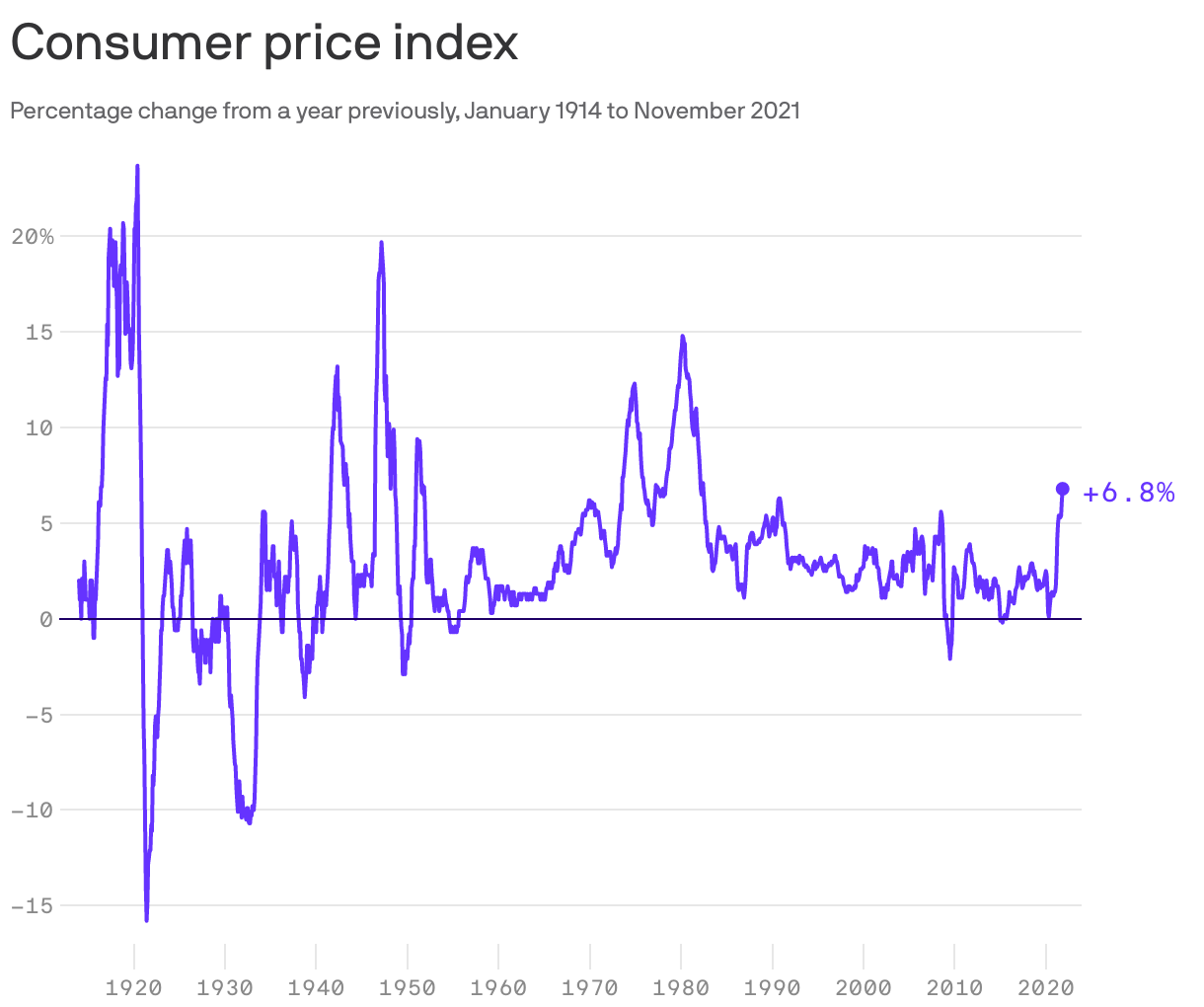
Data: Bureau of Labor Statistics. Chart: Baidi Wang and Felix Salmon/Axios
Massive economic disruptions cause massive price volatility. That's the lesson of the past 100 years of consumer prices, according to data from the Bureau of Labor Statistics.
Why it matters: By the standards of global disruption — two world wars, the Great Depression, the oil-price shock of the 1970s — today's 6.8% inflation rate, the worst since 1982, seems positively tame.
There's been an uptick in cancellations of special purpose acquisition company (SPAC) mergers, with three since Thanksgiving and eight since the beginning of Q4.
Why it matters: After the SPAC euphoria of 2020 and early 2021, the market is continuing its reverse trip to Earth.
Inflation is bursting almost everywhere— a warning that rapid price spikes may stick around.
Why it matters: Until recently, high prices have been shrugged off as temporary, thanks to pandemic-era quirks (read: messed-up supply chains) that are expected to ease.