Monday's economy stories

The Uber situation has somehow devolved even further

The Uber situation has somehow devolved even further since last Friday morning, when we knew that Benchmark had sued former CEO Travis Kalanick for fraud.
Axios scooped just hours later that a group of small outside investors (led by Shervin Pishevar) asked Benchmark to both leave the board and divest enough shares so as to no longer have board appointment rights (including a claim that it had enough enough investor interest to buy Benchmark's stock at the latest valuation, which would value the bucket north of $6 billion).
Uber's board — minus Kalanick and Benchmark — later issued a "can't we all just get along" statement, while the NY Times reported yesterday that the board also is proceeding with preliminary secondary offer talks. Not only from SoftBank, but also the Pishevar group and a third bid from Dragoneer and General Atlantic (the latter of which may have the best chance of bringing the warring factions together, due to existing relationships). This is all still very fluid, but some thoughts:

Netflix poaches Shonda Rhimes from ABC

"Netflix Lures Shonda Rhimes Away From ABC Studios," by Variety Co-Editor-in-Chief Andrew Wallenstein:
- "Netflix has signed Shonda Rhimes to a multi-year production deal, ending a 15-year relationship with ABC Studios that yielded hits from 'Grey's Anatomy' to 'Scandal.'"
- "Her shingle, Shondaland, will begin producing new series for Netflix while she continues to stay involved in her current broadcast series."
- Why it matters: "The Rhimes pact reflects Netflix's increasing interest in producing original series the company can own, as well as the arms race continuing to escalate between not only the streaming service and TV networks, but other subscriber VOD [video on demand] options like Amazon Prime and Hulu."
The next wave of financial deregulation
Wall Street Journal lead story, "Trump Chips Away at Postcrisis Wall Street Rules" by Ryan Tracy and Dave Michaels:
- "Efforts toward financial deregulation are beginning to take concrete shape on rules governing trading desks, bank boardrooms, corporations' financial disclosures and more. Nearly seven months into the Trump administration, regulators are setting the stage for a wave of eased rules."
- Why it matters: "The moves show that while President Donald Trump is struggling to advance his legislative agenda in Congress, his administration has begun laying the groundwork to change some of the myriad rules that Wall Street has sought for years to overturn or water down."

Sears was retail's cutting edge for a century, until it wasn't

The New York Times Business section takes a deep dive into Sears' recent woes under the leadership of hedge fund titan Eddie Lampert. He took control of the firm in 2005, after coordinating a merger between it and Kmart, and has since presided over the loss of $26 billion in market value and the elimination of 176,000 jobs.
The failures of Sears are numerous:
The housing market has recovered; construction workers haven't
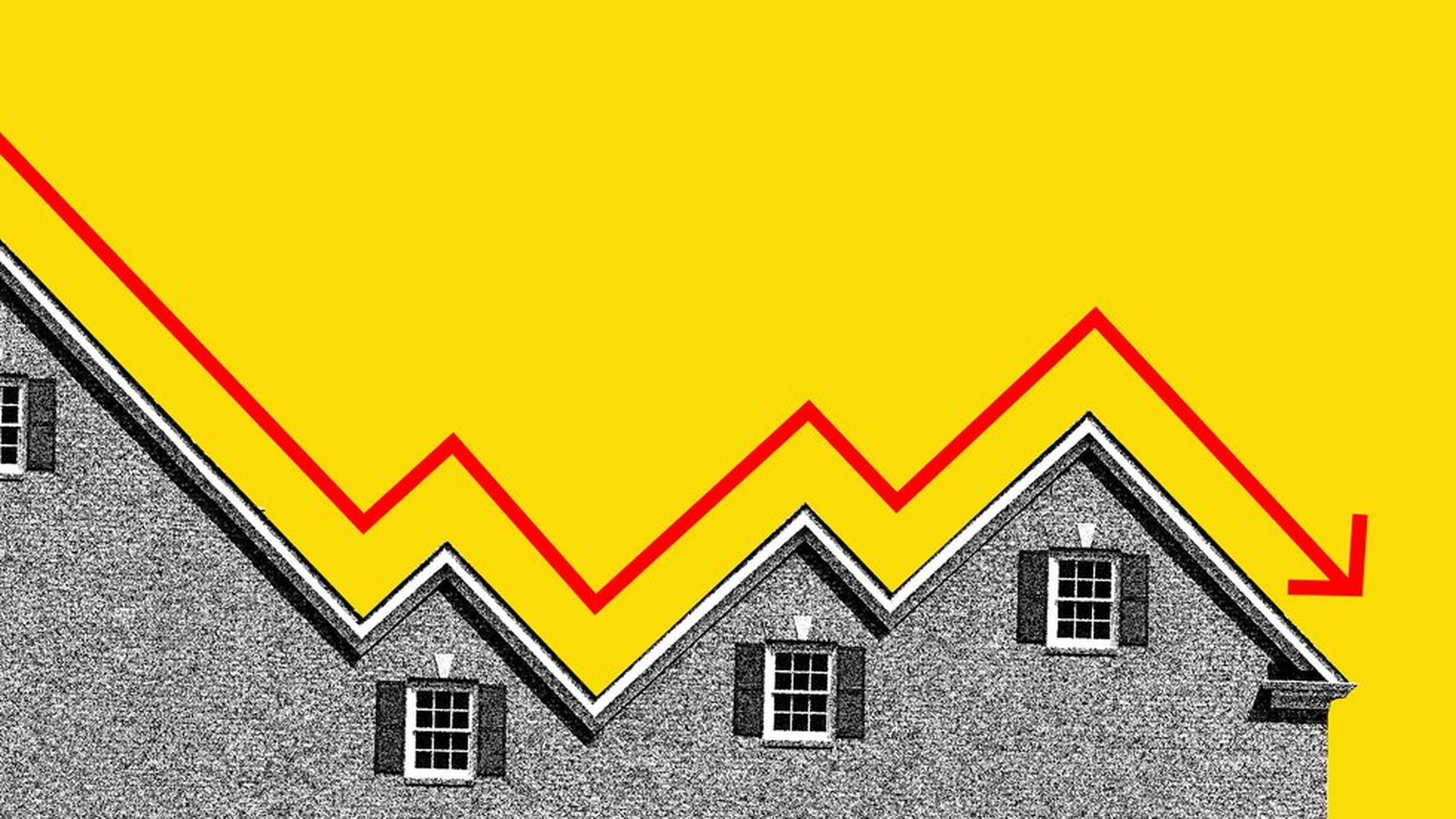
It's one of the great mysteries of the U.S. real-estate recovery: home prices nationally are just a touch below pre-crisis levels, and at all-time highs in many populous markets, as buyers scramble to grab what they can during a 30-year low for housing inventory. Yet homebuilders are moving at a snail's pace to meet this heated demand — they are breaking ground on just 849,000 new single-family homes per year, well below the 2007 rate of 1,036,000.
This is having a spillover effect in jobs: Just 767,000 people are employed in residential-construction in the U.S., 20% below the figure a decade ago.