Sunday's economy stories
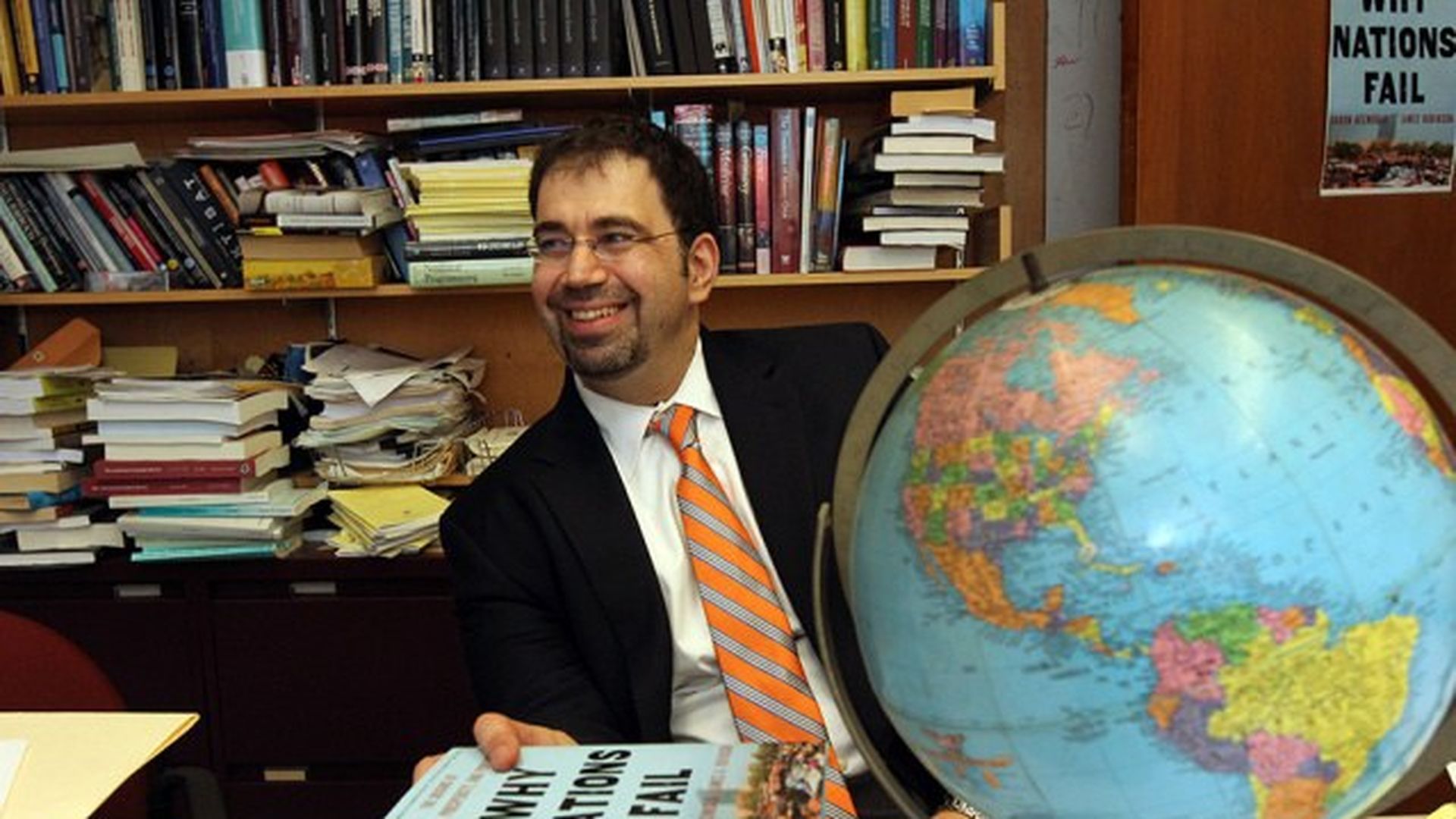
Daron Acemoglu: Paul Revere of the robot revolution
Imposing in size and resembling a retired linebacker more than the MIT economist that he is, Daron Acemoglu has built the reputation of an iconoclast. Over the last five years, he has taken on the grasping leaders of the world's failed nations, and, most recently, automation.
In March, Acemoglu, along with Boston University's Pascual Restrepo, made waves with a paper that described industrial robots punching a hole in employment and wage growth, and potentially costing millions of more jobs by 2025. While challenging the orthdoxy, the paper immediately became central to the early scholarship on the new wave of robotization. Policymakers, fellow economists and journalists rely on his core conclusion — that each robot will cost three to six jobs.
His central message: "History is not uniform," Acemoglu tells Axios: Technological development tends to bring broad prosperity, but that is not a law of nature. "The industrial revolution didn't lead to higher wages for many years between 1760 and 1850," and if it weren't for democratization, the rise of labor unions, and universal education, it may never have.
Since 2011, Acemoglu has been mentioned regularly as a candidate for the Nobel Prize. I spoke with him twice — at MIT and, in a catchup chat last week, by phone. Unsurprisingly, his office is lined with books, history next to economics, including stacks of Why Nations Fail, the 2012 work that he co-authored with the University of Chicago's James Robinson. That's the one that, challenging the theory of Jared Diamond and others, said nations fail not because of culture, history or geography, but simply because their leaders prefer to loot; there simply isn't the institutional strength to pull the country through bad leadership.
Acemoglu earned his Ph.D at the London School of Economics, but the most important economics lesson leading to his theory about the prosperity of nations came while growing up under the Turkish military dictatorship in the 1980s. He witnessed that the purpose of many institutions was not to do its job or make sure people were treated equally, but to extract wealth from the population.
- What he grasped: Winning nations — the key determinant of a country's prosperity — are inclusive, having universal property rights and democratic forms of government.
But Acemoglu worries that these institutions in the U.S. and Europe are under attack. One of the enemies at the gate: technology. It's a conclusion he would not have made ten or fifteen years ago. "Economists are trained to think of technology as always increasing employment and raising wages," he says by phone, "but there's no theoretical justification for believing this."
Robinson — his Why Nations Fail collaborator — met Acemoglu during a lecture Robinson was giving at LSE. Acemoglu sat in the front row and peppered Robinson with questions and challenges to his assumptions. (Thomas Piketty, the rockstar economist and author of Capital in the 21st Century, sat just a few seats down.).
The two went to dinner afterward, and a decade of collaboration followed. Robinson says what sets Acemoglu apart is the breadth of his curiosity: "His house is filled to the brim with books on all sorts of topics. Few economists have read half what he's read." Says his MIT colleague Joshua Angrist, "Daron breathed life into the field of political economy."
Lessons from the industrial revolution: Acemoglu saw that advancing technology did little to raise the prosperity of the common man. Now, it's important that everyone be engaged. "There's a real mismatch between our institutions and the technologies coming on board," he says. He calls for a menu of changes:
- Education reform that includes technical skills needed today
- An expanded social safety net
- Changes in how capital is taxed

Data reveal: how automation is suppressing wages
It's the great economic conundrum of our day: if the unemployment rate is so low, why aren't wages growing faster? The law of supply and demand tells us that as labor gets scarce, wages should rise. Yet, as we saw in the latest jobs figures on Friday, average U.S. hourly earnings have barely exceeded inflation for three years running.
What's going on? The answer may lie in the Wage Growth Tracker (below), an alternative gauge produced by the Federal Reserve's Atlanta bank. It substantiates what a lot of people have suspected: that older, higher-paid workers are leaving the workforce and being replaced with cheaper, younger workers who hold little bargaining strength when they can be quickly replaced by automation.
Data: Federal Reserve Bank of Atlanta; Chart: Lazaro Gamio / Axios


Everything Trump has called "FAKE NEWS"
President Trump first tweeted the words "fake news" on December 10, and since then has lobbed accusations of "fake news" (or more often "FAKE NEWS") over Twitter 66 times, referring to everything from the salacious Russia dossier to a lack of coverage of his crowd sizes.
Everything Trump has labeled fake news to date:

Hollywood cashes in on old ideas


Data: Box Office Mojo; Chart: Andrew Witherspoon / Axios
There's a lot of grumbling about the dearth of originality in Hollywood today, and it can't be denied that established properties own the box office. A look at the top 25 grossers of 2017 thus far shows that only four are completely original concepts. The rest — including the top six films — are all sequels, reboots, or adaptations.
The reasoning: Hollywood's obsession with established franchises is based on one key factor: marketability. And these numbers prove it. On paper, it's much easier to get audiences to trek to the eighth Fast and the Furious flick than a horror movie like Get Out that's equal parts Guess Who's Coming to Dinner and The Stepford Wives.